
Lalique Museum in Wingen-sur-Moder: Glass and Crystal in Alsace
In Wingen-sur-Moder (Bas-Rhin), the Lalique Museum tells the story of René Lalique and glassmaking on the site of a former glassworks. Closed since the burglary of July 2026, it reopens on 28 November 2026.

Good to know before you go
In the early hours of 5 July 2026, the museum was burgled. Twenty-seven pieces of jewellery were stolen, with losses estimated at more than €4.5 million. The museum has been closed ever since. After security work, it reopens on 28 November 2026: the date appears on its opening-hours page and in its calendar, where it marks the start of the Christmas season, running until 3 January 2027.
Following the recommendations of the French Ministry of Culture, the museum will not display any jewellery when it reopens. The galleries will still cover jewellery-making and Art Nouveau, and the “Cristallisation” exhibition looks back at fifteen years of collaborations between Lalique and artists or architects, from Yves Klein to Zaha Hadid. After the holidays, the museum closes for its annual January break. Check the latest information on the museum’s website before you travel.
Why Lalique in Wingen-sur-Moder?
Glass and crystal are a long-standing tradition in the Northern Vosges. The sandstone supplies the silica and the forest supplies the fuel. The museum stands on the very site of the Hochberg glassworks, built in 1715. It specialised in window glass before putting out its last furnace in 1868, for lack of wood.
René Lalique, born in 1860 in Aÿ, in Champagne, and died in Paris in 1945, had two careers. First a jeweller, he triumphed at the 1900 Exposition Universelle and became one of the leading figures of Art Nouveau. He then turned to glass: in 1912 he held his last jewellery exhibition and from then on devoted himself to glass, which he would take all the way to Art Deco.
Half a century after the Hochberg closed, in the aftermath of the First World War, René Lalique built a second factory in Wingen-sur-Moder, the Verrerie d’Alsace. Here he found a workforce trained in neighbouring glassworks such as Saint-Louis and Meisenthal. The Lalique factory has been operating in the village since 1921. Around 230 people still work there today, including about ten holders of the Meilleur Ouvrier de France title, France’s top craftsmanship award.
Architecture set into the landscape
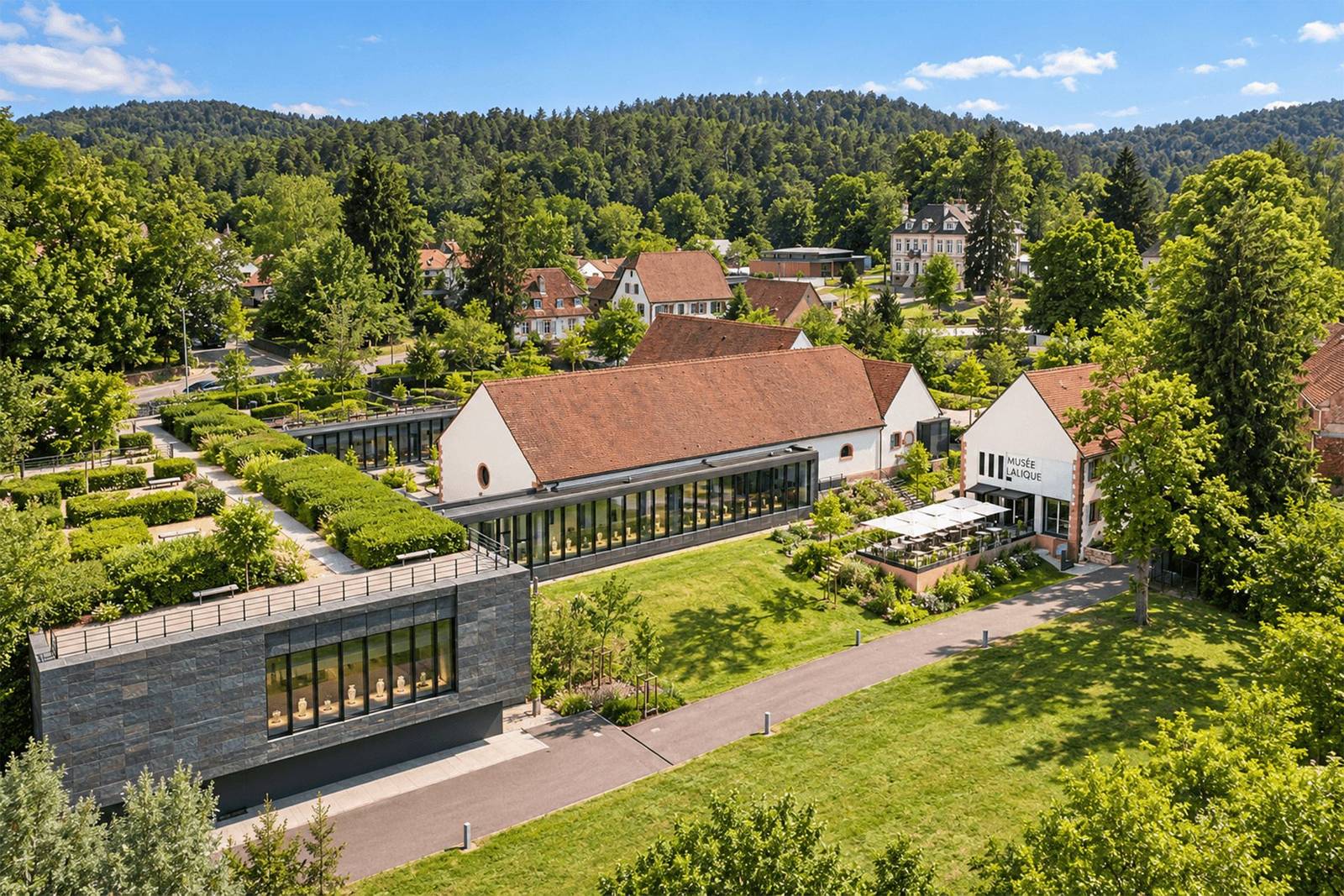
The museum opened on 1 July 2011 and welcomed nearly 720,000 visitors between its opening and the end of 2025. It has held the Musée de France label since 2007. The architectural project was entrusted to Jean-Michel Wilmotte’s practice, working with Atelier Crupi of Colmar. The new buildings are partly underground, with a green roof. A cantilevered façade gives a view over the valley from the permanent exhibition. The old glassworks buildings, listed as historic monuments since 1996, are linked to the new ones by galleries surrounding a garden, in the manner of a cloister.
The gardens extend the visit. They consist of formal beds on the forecourt, a flower garden at the heart of the museum and a woodland garden on the roof of the permanent exhibition. An interpretation trail explains the history of the Hochberg site and of the glassworks of the Grand Est region, with the raw materials of glass and crystal, such as sand and potash.
Highlights not to miss
The permanent exhibition covers 900 m². It presents the full range of René Lalique’s work, with a focus on glass and crystal, followed by creations by his successors, Marc and Marie-Claude Lalique, and by today’s studio. The collection numbers more than 650 works, supplemented by loans from the Lalique company and from Paris museums.
- Marc Lalique’s chandelier in the entrance hall: nearly 3 metres tall, around 1.6 tonnes and 337 pieces of crystal. Created in 1951, it once lit the nave of the Musée des Arts Décoratifs in Paris.
- The Bacchantes vase, created in 1927 and still made today. A touch table lets you follow each stage of its production, from mould to polishing.
- The perfume bottles, born of René Lalique’s collaboration with François Coty.
With children
The museum offers educational workshops and interpretation tools designed for different ages and levels. Admission is free for under-6s, and the family ticket covers up to five children. The touch table and the production videos go down well with younger visitors.
Practical information and tips
The museum is on rue du Hochberg in Wingen-sur-Moder, in the La Petite-Pierre area. Without a car, get off at the village station on the Strasbourg – Sarreguemines – Saarbrücken line: the museum is 2 km away, just under half an hour on foot. There are no taxis waiting at the station, so you need to book one. On site: two car parks, a shop, a café-restaurant area and an 85-seat auditorium. The museum is all on one level and holds the Qualité Tourisme and Tourisme & Handicap labels. Opening hours and prices are on the official website.
My tip: combine your visit with the Meisenthal glass site, a few kilometres away. There you will see glass being hot-blown, while the Lalique Museum tells the story and the design.
Good to know
Expected crowds this week: usual, busier at the weekend
In the Northern Vosges
- 25 December Christmas Day, public holiday in France (long weekend)
- 26 December St Stephen’s Day (Alsace-Moselle), public holiday in France
- 1 January New Year's Day, public holiday in France (long weekend)
- 20 December – 3 January French school holidays
Back home: the Netherlands
- 25 December Christmas Day
- 26 December St. Stephen's Day
- 19 December – 3 January Christmas Holidays
- 13 February – 21 March Spring Holidays (depending on region)
Getting here
- From Belgium and the Netherlands by car: via Luxembourg and Metz, or via Germany towards Karlsruhe and Wissembourg.
- By train: high-speed trains to Strasbourg (via Paris) or to Karlsruhe (via Germany), then regional trains.
- On site: a car is the easiest way to get around.
Holidays: Nager.Date and OpenHolidays.