
The antlion larva and its funnel trap in the sand
At the foot of the Northern Vosges’ sandstone rocks, small funnels in the sand give away the antlion larva. Here is how its trap works and where to look for it.

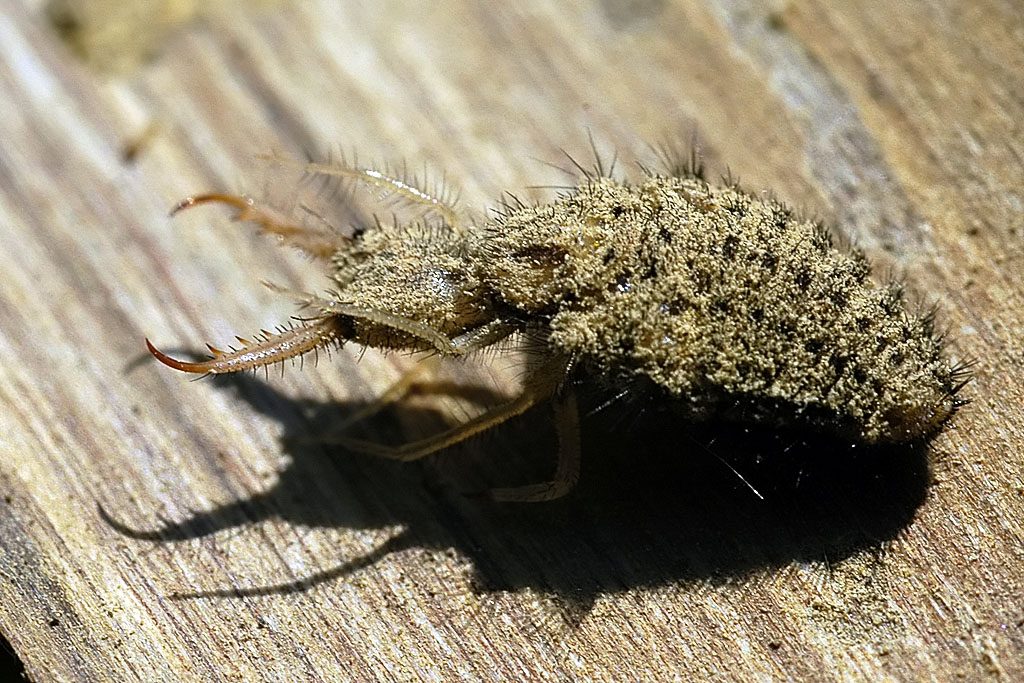
On your walks through the Northern Vosges, you may already have noticed strange little funnels dug into fine sand, sheltered beneath a sunny rock. They are the traps of the larva of a very discreet insect, the antlion. Buried at the bottom, it waits for an ant to slide down to it. These funnels can be seen from spring to autumn at the foot of the sandstone rocks of the Northern Vosges Regional Nature Park.
What is an antlion?
The common antlion (Myrmeleon formicarius) is an insect of the order Neuroptera. The adult looks remarkably like a dragonfly: a long, slender body and four transparent wings. Look a little closer, though, and the two are fairly easy to tell apart. The antlion has short, clearly visible antennae that thicken at the tip – known as “clubbed” antennae – whereas a dragonfly’s are barely visible.
The adult flies mainly at dusk and at night, chiefly from May to August, and lives for only three to four weeks. A closely related species, Euroleon nostras, digs the same kind of trap, and the two are often confused.
Yet it is the larva that has the most astonishing biology. Its development usually takes two years, sometimes one or three depending on conditions. It spends most of that time buried in a layer of very fine, dry, sun-warmed sand.
Where can you find antlion funnels in the Northern Vosges?
There is no shortage of this kind of habitat in the Northern Vosges. The sandstone rocks offer both shelter from the rain and a fine enough substrate, produced by their own erosion, which builds up at their base.
Look beneath sunny overhangs along the paths leading to the massif’s rocks and natural sites. Sandy path edges and dry clearings are also worth a look. The funnels, often grouped together, are a few centimetres across and can be seen from spring to autumn.
How does the larva dig its trap?
The antlion larva has a large triangular abdomen, topped by a slender thorax and a small head armed with two imposing mandibles. Its two hind legs are the strongest, and they do most of the work of moving it along – usually backwards.
When it finds a suitable spot, the larva digs its funnel in a spiral. It works, so to speak, “level by level”, once again in reverse, the shape of its abdomen being well suited to shifting sand. The surplus sand is flicked out of the hole with quick, precise movements of the head.
How does the antlion catch its prey?
Once the funnel is finished, the larva buries itself at the bottom, with only its mandibles sticking out. It waits for prey – often an ant, hence the name antlion – to wander onto the slippery slopes of the trap.
If the prey tries to climb back out, the larva pelts it with sand. The slope collapses and speeds the future meal’s slide to the bottom of the pit.
The antlion then seizes its catch with its pincers. Like the fangs of spiders or the hooks of the diving beetle larva, these inject a cocktail of venom and digestive enzymes. The prey is dissolved from the inside, and all the antlion has to do is suck up the contents, again through its hollow pincers. The remains, reduced to the victim’s cuticle, are then thrown out of the hole.
Ants are not the only ones to get caught: a woodlouse that ventures onto the slope can meet the same fate.
When it has finished growing, the larva spins a well-camouflaged cocoon in the sand. The adult emerges in summer.
The antlion as an ally against ants?
These remarkably efficient funnels and the larva’s appetite caught the attention of some 19th-century entomologists, who tried to turn the antlion into a helper for our homes and gardens. One of them was Charles Goureau, an army officer and entomologist, in Les insectes utiles à l’homme (Insects Useful to Man), published in 1872. He proposed the following:
“It could be used to wage war on ants. One would use a box 20 to 25 centimetres square and 15 centimetres high, filled with fine, dry sand or powdered earth, in which one would place an antlion larva. This box would be sunk into the ground, flush with the surface, on the path of the ants that roam around the house. It should be covered with a small canopy to keep the rain from wetting the sand, without however blocking the sun’s rays. Ten or so of these traps, more or less depending on circumstances, suitably placed, would destroy a considerable number of ants.”
Today the idea may seem rather far-fetched. It is still interesting, because it reflects a desire to recreate the larva’s habitat artificially and bring it closer to where people live. Don’t we do much the same with the insect hotels set up in so many urban green spaces? With one difference: an antlion larva will never move into these little shelters of its own accord.
How can you watch it without disturbing it?
As you walk, remember to look beneath sunny rocks. A cluster of small, regular funnels in dry, fine sand is a sign that larvae are present. Approach gently and avoid trampling the base of the rocks: the traps collapse at the slightest step.
My tip: on a dry, sunny day, settle down next to a funnel for a few minutes and keep still. With a little patience, you may see an ant slip down the slope and the larva fling up its sand.
The antlion is not the only ambush hunter in the Northern Vosges: in tall grass, the wasp spider also waits for its prey at the centre of its web. You can spot other insects of the Park on hiking trails.
Good to know
Expected crowds this week: usual, busier at the weekend
In the Northern Vosges
- 25 December Christmas Day, public holiday in France (long weekend)
- 26 December St Stephen’s Day (Alsace-Moselle), public holiday in France
- 1 January New Year's Day, public holiday in France (long weekend)
- 20 December – 3 January French school holidays
Back home: the Netherlands
- 25 December Christmas Day
- 26 December St. Stephen's Day
- 19 December – 3 January Christmas Holidays
- 13 February – 21 March Spring Holidays (depending on region)
Getting here
- From Belgium and the Netherlands by car: via Luxembourg and Metz, or via Germany towards Karlsruhe and Wissembourg.
- By train: high-speed trains to Strasbourg (via Paris) or to Karlsruhe (via Germany), then regional trains.
- On site: a car is the easiest way to get around.
Holidays: Nager.Date and OpenHolidays.