
René Lalique in Wingen-sur-Moder: the Verrerie d’Alsace and Art Deco
In 1921 René Lalique chose Wingen-sur-Moder, in the Bas-Rhin, to build his Verrerie d’Alsace. It still produces Lalique crystal, and a museum tells the story.

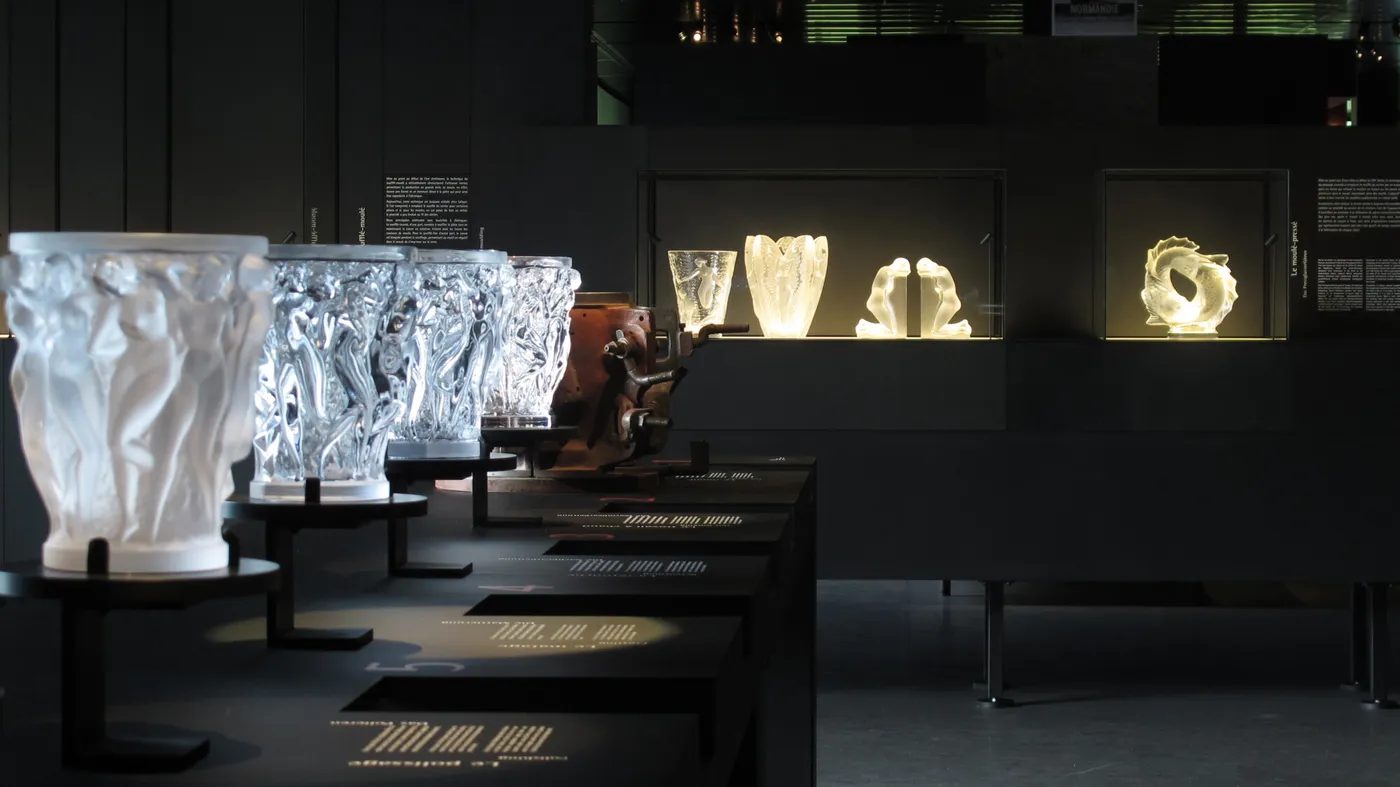
René Lalique (1860–1945) turned Wingen-sur-Moder, a small village in the Bas-Rhin on the border with the Moselle, into one of the great names in French glass. In 1921 the jeweller-turned-glassmaker decided to build a factory here, the Verrerie d’Alsace. It is still running: today it is the only production site of the Lalique house, and the Lalique museum tells the story in the village.
Why did one of the most celebrated designers of the Roaring Twenties settle in the heart of the Northern Vosges? To understand, we have to go back to his jewellery.
Who was René Lalique before glass?
René Lalique was born in 1860 in Aÿ, in Champagne. In 1876, aged sixteen, he was apprenticed to the Parisian jeweller Louis Aucoc. He then took classes at the École des Arts décoratifs in Paris before spending two years in England.
Back in Paris, he set up as a freelance designer, selling his designs to the great houses, including Boucheron and Cartier. In 1885 he took over the workshop of the jeweller Jules Destapes and from then on worked for himself.
At first he followed the taste of the day. Late 19th-century jewellery was all about precious stones, often diamonds, set in heavy mounts. Lalique soon moved away from this and adopted the vocabulary of Art Nouveau: nature, flowing lines, flowers, insects and female figures.
Jewellery where the idea matters more than the material
His real break with tradition lay in his materials. Lalique combined horn, ivory, enamel, semi-precious stones and glass. The value of a piece no longer depended on the weight of the gold or the size of the diamond, but on the design. Moulded glass also allowed him to reproduce a motif faithfully. The Wingen museum quotes a line of his that sums up this idea: “Better the pursuit of beauty than the display of luxury.”
His pieces, often large and highly sculptural, did not win over middle-class customers straight away. Artists, however, recognised him early. The Nancy glassmaker Émile Gallé called him “the inventor of modern jewellery”. The actress Sarah Bernhardt was among his clients: in 1902 he designed a stage costume for her revival of “Théodora”. The oil magnate Calouste Gulbenkian was another client. These names made his jewellery known far beyond the workshops.
The 1900 Exposition Universelle in Paris marked the peak of his career as a jeweller. His stand was a resounding success.
How did Lalique move from jewellery to glass?
Lalique was already using glass in his jewellery. After 1900, the material became the focus of his work. He saw it as a way of reaching a far wider public than high jewellery, with objects made in larger numbers.
The turning point came with perfume. Lalique met the perfumer François Coty in the late 1900s (in 1907 according to the Lalique museum, in 1908 according to other sources). In 1910 he created the bottle for “Ambre antique” for him, then worked for other perfumers. The bottle, the label and the packaging became a creative field in their own right: the container had to evoke the scent.
To produce in series, he needed a factory. In 1913 Lalique bought a glassworks in Combs-la-Ville, in Seine-et-Marne. The aim was clear: to cut costs and make his creations more affordable. Vases, boxes, lamps and, in the 1920s, car radiator mascots came out of his workshops. One ambition remained: tableware. It was this that brought him to Alsace.
Why did René Lalique choose Wingen-sur-Moder?
In 1921 Lalique decided to build a second factory in Wingen-sur-Moder. According to the Lalique house, production began there in 1922. The factory took the name Verrerie d’Alsace and specialised in tableware: glasses, decanters, plates and dishes, which would be sold all over the world.
The Lalique museum gives two reasons for this choice.
- The glassmakers. The Northern Vosges have been working glass since the late 15th century, and the skills have been handed down for generations. In Wingen itself, the Hochberg glassworks operated from 1715 to 1868. Lalique knew he would find a skilled workforce here.
- Public subsidies. After the First World War, the French state gave financial support to industrialists who set up in Alsace and the Moselle, which had become French again.
The neighbourhood mattered too. A few kilometres away, across the departmental border in the Moselle, the Meisenthal glassworks made pieces for Émile Gallé from 1885 onwards. Désiré Christian headed the team that decorated them there. The Saint-Louis-lès-Bitche crystal works is also very close by. These sites in the Pays de Bitche show how long the craft had been established when Lalique arrived.
The “VDA” signature, then “R. Lalique”
At first, Lalique did not want to put his name to everyday objects. He signed some of the Alsace pieces “VDA”, for Verrerie d’Alsace. From 1923 the “R. Lalique” signature, more meaningful to buyers, became the rule. Pieces marked “VDA” are now sought after by collectors.
To keep costs down, the factory relied on moulded glass, which allows a model to be reproduced in series. The Lalique style is recognisable by the interplay of clear and frosted glass. This contrast gives relief and a sense of movement to figures that are in fact motionless.
Lalique, a leading figure of Art Deco
Through glass, Lalique became one of the great figures of Art Deco. At the 1925 International Exhibition of Modern Decorative and Industrial Arts in Paris, he presented, among other works, the fountain “Les Sources de France”. The new style favoured geometry and rigour, far from the Art Nouveau curves that had made his name as a jeweller.
The Saint Odile glasses
Lalique also created promotional items. In 1921 Pierre Weissenburger, a winegrower in Obernai, ordered 12,000 glasses bearing the image of Saint Odile from him. They were given away to promote his vineyard, the Clos Sainte-Odile. Decanters, ashtrays, small dishes and a statuette followed. The profile of the saint, proclaimed patron saint of Alsace in 1946, adorns many of these pieces. The Wingen museum holds one of the decanters.
What became of the glassworks after René Lalique?
René Lalique died on 1 May 1945. His son Marc, born in 1900, who had joined the family business in 1922, took over. He modernised the Wingen factory and moved the house from glass to crystal: a shift begun in 1945 and confirmed in the early 1950s.
It was a change of direction. René had sought to make his creations more affordable through series production. Marc focused on crystal, a more demanding and more prestigious material, and on a wealthy clientele, in a Europe emerging from war. Under his leadership, the crystal works joined the ranks of the great manufacturers. A chandelier he designed in 1951 is now on display in the museum.
Marc Lalique died in 1977, leaving the management of the crystal works to his daughter, Marie-Claude. The company later changed hands; since 2008 it has belonged to the group of Swiss businessman Silvio Denz. The Wingen-sur-Moder factory remains the brand’s only production site: a century on, the Lalique name is still a living part of the Northern Vosges’ heritage.
What is there to see in Wingen-sur-Moder today?
The Lalique museum
The museum opened in July 2011 on the site of the former Hochberg glassworks, listed as a historic monument in 1996. Lalique never produced glass at this exact spot: the site recalls the village’s older glassmaking tradition. The collections bring together more than 650 works. The visit follows René Lalique from his Art Nouveau jewellery to perfume bottles and tableware, then the crystal of his successors.
René Lalique’s villa
The house René Lalique had built in 1920 on the edge of the village was converted in 2015 into the Lalique house’s hotel and restaurant. A pavilion designed by the Swiss architect Mario Botta has been added next to the villa.
The factory
The glassworks founded in 1921 is still operating in the village. This is where the Lalique crystal pieces sold around the world are shipped from.
Practical information
Wingen-sur-Moder is in the Bas-Rhin, in the La Petite-Pierre area, very close to the Moselle. The museum is at 40 rue du Hochberg.
- By train: Wingen-sur-Moder station is served by the TER line Strasbourg–Sarreguemines–Saarbrücken, about 45 minutes from Strasbourg. The museum is 2 km from the station. There is no permanent taxi rank: book in advance.
- By car: the museum has two car parks. The one opposite the entrance is reserved primarily for people with reduced mobility and pushchairs. Car park P2, at the back, also takes coaches and has an EV charging point. It closes at the same time as the museum.
- Opening: after the burglary of 5 July, during which 27 pieces of jewellery were stolen, the museum closed its doors. It has announced it will reopen on 28 November for the Christmas season; according to its management, the jewellery cannot be displayed when it reopens. The museum closes every year in January. Opening times and prices on the official website.
- Time needed: allow half a day for the museum and a stroll around the village.
My tip: Wingen, Meisenthal and Saint-Louis-lès-Bitche are less than 8 km apart as the crow flies. Set aside a whole day to follow the trail of glass and crystal in the Northern Vosges, then carry on to the other sites of glass art in the Grand Est.
When to visit
The museum is open almost all year round, with an annual closure in January. From April to September it opens every day, with the longest hours. The rest of the year it is closed on Mondays, except in December, when it opens every day (except 25 December). In fine weather, the forest around the village is ideal for a walk before or after your visit.
Good to know
Expected crowds this week: usual, busier at the weekend
In the Northern Vosges
- 25 December Christmas Day, public holiday in France (long weekend)
- 26 December St Stephen’s Day (Alsace-Moselle), public holiday in France
- 1 January New Year's Day, public holiday in France (long weekend)
- 20 December – 3 January French school holidays
Back home: the Netherlands
- 25 December Christmas Day
- 26 December St. Stephen's Day
- 19 December – 3 January Christmas Holidays
- 13 February – 21 March Spring Holidays (depending on region)
Getting here
- From Belgium and the Netherlands by car: via Luxembourg and Metz, or via Germany towards Karlsruhe and Wissembourg.
- By train: high-speed trains to Strasbourg (via Paris) or to Karlsruhe (via Germany), then regional trains.
- On site: a car is the easiest way to get around.
Holidays: Nager.Date and OpenHolidays.