
Visiting La Petite-Pierre, a fortified town on its sandstone spur
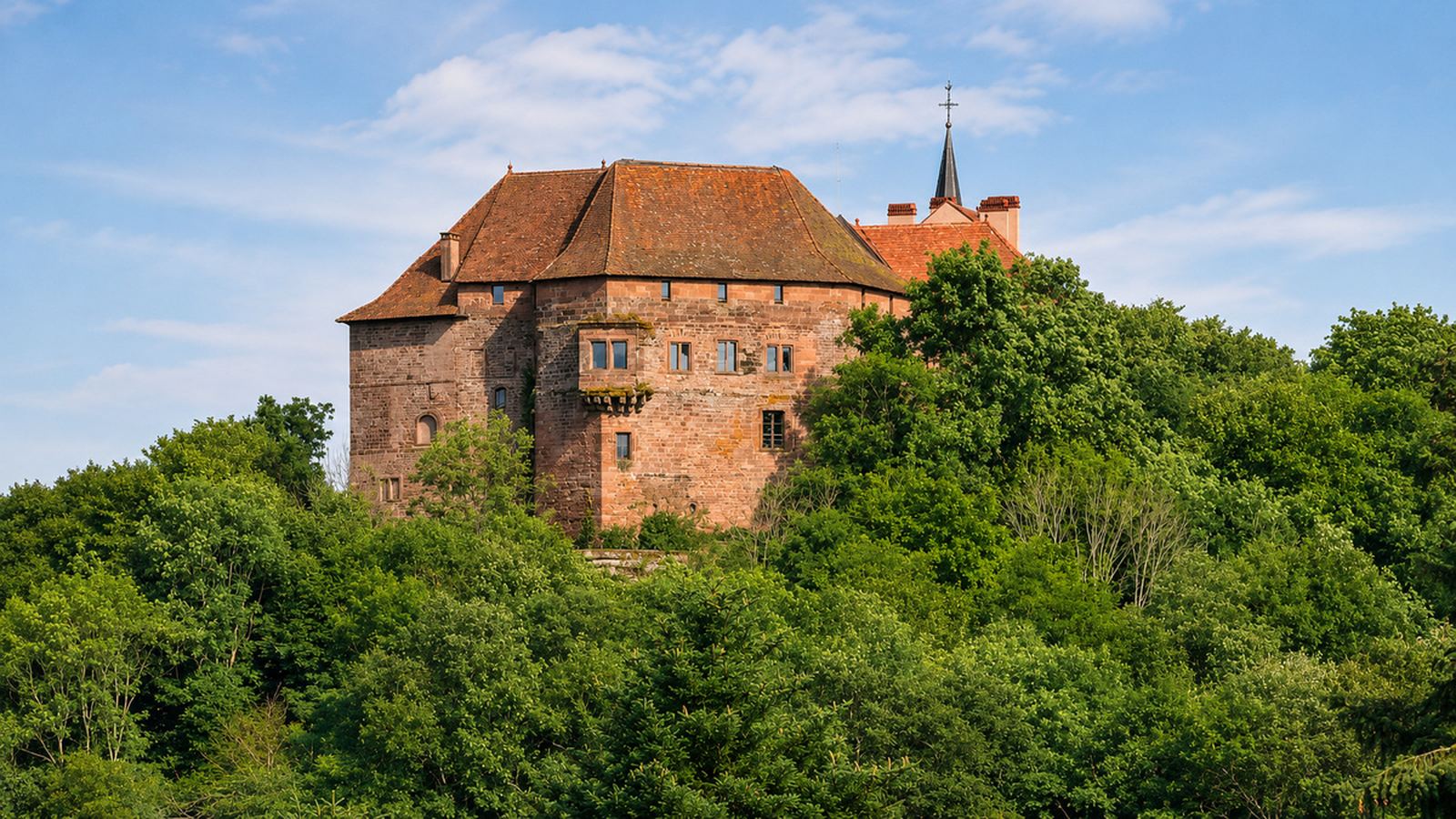
Perched on a sandstone ridge, La Petite-Pierre has kept its castle, ramparts and narrow streets above the forests. The castle houses the headquarters of the Northern Vosges Regional Nature Park.

A hilltop village guarding a pass
La Petite-Pierre, Lützelstein in German, has just under 600 inhabitants. The village sits on a narrow ridge, 24 km north of Saverne and 57 km north-west of Strasbourg. Forests and natural habitats cover more than 90% of the commune. This position is no accident: the site watches over a pass between Alsace and Lorraine. The castle stands at the end of the ridge, at an altitude of 340 metres, separated from the old town by a man-made ditch.
Eight centuries of history at the end of the ridge
Work on the castle began at the end of the 12th century, and it is first mentioned in 1212. The Counts of Eguisheim-Dabo set up a first defensive site here, then the fief passed to a family that took its Latin name, Parva Petra. In 1452, Frederick I of the Palatinate seized the whole castle after a nine-week siege.
In the 16th century, the Count Palatine George John of Veldenz modernised the castle and gave it most of its present appearance. In the 1680s, Vauban was tasked with reworking the fortifications. Many of these alterations are still visible. The castle and its ramparts have been a listed historic monument since 1922, like other castles of the Northern Vosges.
The castle, home of the Regional Nature Park
Since 1975, the castle has housed the headquarters of the Northern Vosges Regional Nature Park. The Park had it restored from 2017, and the completion of the work was celebrated in October 2023. The offices are not open to visitors, but the courtyard is open to the public. A trail of information panels there traces the history of the site.
On the ground floor, the Park’s welcome desk and shop displays some 180 items made by around fifty craftspeople and artists from the area: sandstone, wood, books on the landscapes and heritage. The shop is accessible to people with reduced mobility. No opening is announced between Christmas and the reopening in February: check the dates on the practical information sheet.
In the town: ramparts, church and museums
The ramparts trail is the best way to grasp the scale of the fortifications. The walk is easy and takes 30 to 40 minutes. It passes underground cisterns and offers several viewpoints over the forest.
In the old town, step inside the Notre-Dame simultaneum church. A simultaneum church hosts both Catholic and Protestant worship; Alsace has around fifty of them. This one has preserved frescoes painted in the 15th century.
The village is also home to the Musée du Sceau alsacien (Alsatian Seal Museum), on Rue des Remparts, which displays seals, banners and coats of arms as well as collections of folk art and traditions. Its opening days are not published online: ask at the tourist office before counting on it.
In season, guided tours of the fortified town are offered with a qualified guide. It is a chance to go into the detail of the military architecture and understand how the castle, town and fort work together on such a narrow ridge.
Hiking from La Petite-Pierre
The village is surrounded by trails waymarked by the Club vosgien. Three ideas, depending on how much time you have:
- The Trois-Rochers trail links the Rocher Blanc, the Rocher des Païens and the Rocher du Corbeau.
- The Imsthal loop starts from the tourist office car park and goes down to the Étang d’Imsthal and its inn.
- A literary trail starts from the sports ground, near the forester’s lodge, with stations recalling poems by René Char.
Several routes leave the town alongside the fortifications. One of them leads to the rock houses of Graufthal, carved into the cliff and lived in until 1958. The trails are waymarked, but take a Club vosgien map: in the forest, landmarks quickly run out.
Practical information and tips
Most visitors come by car. Without a car, the nearest stations are Wingen-sur-Moder, 10 km away, and Ingwiller, 13 km away. The Hanau-La Petite Pierre tourist office is on Rue du Château, in the old town.
My tip: start at the tourist office, whose car park is the starting point for several walks, then walk up the ridge to the castle. Come ideally between April and September, when the Park shop also opens at weekends. In autumn, the forest around the village takes on colours that alone justify the climb up to the ramparts. To extend your visit, the La Petite-Pierre area page brings together the sites nearby.
Good to know
Expected crowds this week: usual, busier at the weekend
In the Northern Vosges
- 25 December Christmas Day, public holiday in France (long weekend)
- 26 December St Stephen’s Day (Alsace-Moselle), public holiday in France
- 1 January New Year's Day, public holiday in France (long weekend)
- 20 December – 3 January French school holidays
Back home: the Netherlands
- 25 December Christmas Day
- 26 December St. Stephen's Day
- 19 December – 3 January Christmas Holidays
- 13 February – 21 March Spring Holidays (depending on region)
Getting here
- From Belgium and the Netherlands by car: via Luxembourg and Metz, or via Germany towards Karlsruhe and Wissembourg.
- By train: high-speed trains to Strasbourg (via Paris) or to Karlsruhe (via Germany), then regional trains.
- On site: a car is the easiest way to get around.
Holidays: Nager.Date and OpenHolidays.