
Visiting Saverne: Château des Rohan, Haut-Barr and the old town
Saverne, a small Bas-Rhin town on the edge of the Northern Vosges, combines the Château des Rohan, an old town, a canal and the Haut-Barr viewpoint. What to see and how long to allow.

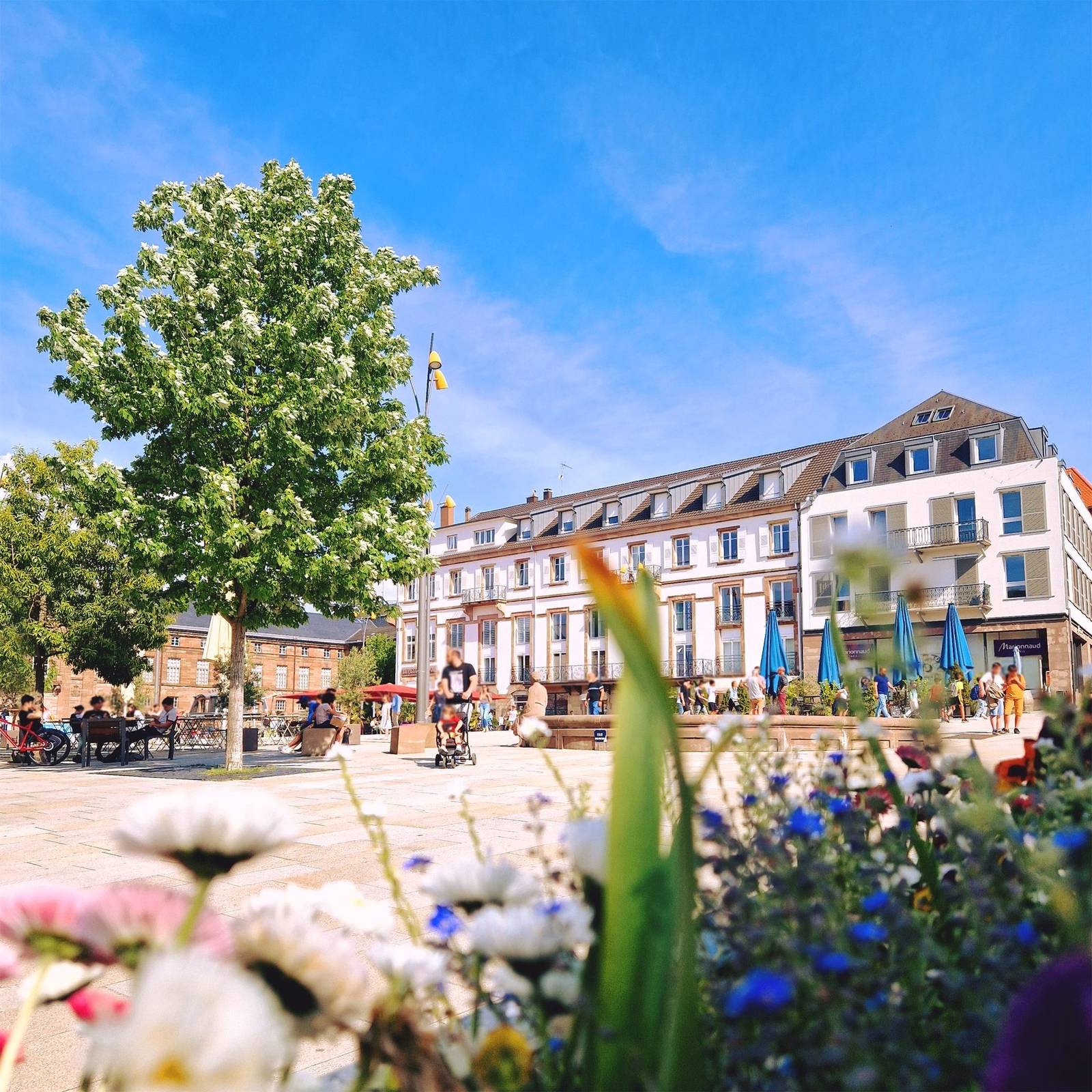
Saverne is a small town in the Bas-Rhin (67700), in Alsace, set at the foot of the pass that separates the Alsace plain from the Lorraine plateau, 33 km from Strasbourg as the crow flies. People come for the Château des Rohan and its pink sandstone façade, the old town and the Maison Katz, the Marne–Rhine canal and, up on the heights, the castle of Haut-Barr. Allow half a day for the town, a full day with Haut-Barr and the gardens.
Why visit Saverne?
First, for the Château des Rohan: the former palace of the bishops of Strasbourg presents a 140-metre neoclassical façade on the park side, facing the marina.
Next, for the view: a few minutes’ drive away, the castle of Haut-Barr, nicknamed the “Eye of Alsace”, looks out over the plain from its crags.
Finally, for the gardens: the rose garden, the botanical garden on the pass and the alpine garden at the Grotte Saint-Vit are open in the warmer months.
Saverne lies on the southern edge of the Northern Vosges Regional Nature Park, whose forests begin just above the town. On this site, it belongs to the Gateways to the Park area, along with Phalsbourg and Haguenau.
A little history
In the 1st century, a Gallo-Roman settlement, Tres Tabernae, grew up near a Roman camp, where the route to Lorraine opens out. It was fortified in the 3rd century.
The town came under the authority of the prince-bishops of Strasbourg from 1236 and became their residence in 1394. To watch over the Zorn valley and the plain, the bishops had already built the castle of Haut-Barr in the 12th century.
In 1779, a fire destroyed the main wing of the episcopal residence. Cardinal Louis-René-Édouard de Rohan then had a larger palace built by the architect Nicolas-Alexandre Salins de Montfort. The Revolution halted the work: the interior decoration was never finished. Napoleon III had the building completed to house the widows of senior civil servants who had died in service. A German barracks after 1871, it became a municipal cultural venue in 1952.
At the end of 1913, Saverne gave its name to a political crisis in the German Empire: the “Zabern Affair”. A second lieutenant of the garrison insulted the Alsatians in front of his recruits; the demonstrations that followed led to the arrest of civilians, and on 4 December 1913 the Reichstag passed a vote of no confidence in Chancellor Bethmann Hollweg.
What to see in Saverne
The Château des Rohan
On the town side, it closes off Place du Général-de-Gaulle; on the park side, its great pink sandstone façade looks onto the canal. Today it houses the Saverne museum, a youth hostel, a school and a cultural space. The museum brings together three collections: archaeology, the art and history of the town, and the bequest of Louise Weiss, journalist and leading figure in building Europe. Allow one to two hours for the museum.
The Grand-Rue and the Maison Katz
The main street runs through the old town to the château. At number 80, the Maison Katz, built in 1605 for Henri Katz, receiver general of the bishopric, then enlarged in 1668, is the most remarkable of the town’s old houses and is protected as a historic monument.
Notre-Dame-de-la-Nativité church and the Récollets cloister
The former collegiate church was built from the 15th to the 17th century, but it keeps a 12th-century Romanesque bell tower. A little further on, the 14th-century Gothic cloister of the Récollets was listed as a historic monument in 1900 after the town bought it. The tourist office is based there.
The canal and the marina
The Marne–Rhine canal enters the town through a double lock: there is a 5.10-metre difference between upstream and downstream. The marina stretches out at the foot of the château. The towpath is ideal for a walk or a bike ride.
The castle of Haut-Barr
About 2.5 km from the centre, on three sandstone crags more than 450 metres above sea level, the 12th-century ruins and the castle rebuilt in 1583 by Jean de Manderscheid offer one of the widest views over the Alsace plain; on a clear day, look for the spire of Strasbourg Cathedral. A footbridge, the Pont du Diable (Devil’s Bridge), links two of the rocks. The nearby Chappe telegraph tower recalls the Paris–Strasbourg line, whose Saverne station operated from 1798 to 1852. Access is free all year round. The Park publishes a Saverne castles loop that continues to the Grand Geroldseck, in the neighbouring commune of Haegen. The other ruins in the massif are gathered in the Castles section.
The gardens
The rose garden, created in 1898 at the foot of the pass, has several thousand rose bushes; since 1923 it has held an international competition for new roses. The botanical garden on the Col de Saverne, set up in 1931 at the initiative of the pharmacist and botanist Émile Walter, occupies 2.5 hectares of clearing, with a peat bog where the carnivorous pitcher plant grows. Higher up in the forest, the Grotte Saint-Vit, where a chapel is mentioned as early as 1338, is surrounded by an alpine garden, an hour’s walk from the centre.
Practical information
- Starting point: the Pays de Saverne tourist office, in the Récollets cloister, 4 rue Poincaré.
- Train: Saverne station is in the town centre, on the Paris–Strasbourg line. TER trains reach Strasbourg in about half an hour; the tourist office also mentions TGV services from Paris.
- Road: A4 motorway, exit 45 “Saverne” (toll).
- Getting around: a free electric shuttle, the e-Lico, links the swimming pool, the town centre and the hospital.
- By bike: the EuroVelo 5 runs along the canal.
- Time needed: half a day for the old town and the Château des Rohan, a full day with Haut-Barr and a garden.
- Accessibility: the rose garden is wheelchair accessible, according to the tourist office; elsewhere, ask before you come.
- Opening times and prices: on the websites of the tourist office, the museum and the gardens.
To continue into Lorraine, Phalsbourg, a town fortified by Vauban, is 8 km away, and the Saint-Louis-Arzviller boat lift carries canal boats up the slope of the Vosges in a single lift.
When to go
Haut-Barr, the old town and the canal can be visited all year round. From May to September, the rose garden and the botanical garden are open: the best time for a full stay. June is the month of roses, with the rose festival held every year. In December, the tourist office runs Christmas tours.
My tip: go up to Haut-Barr in the late afternoon, after the museum. The museum is best visited earlier in the day, and that is when the low light over the Alsace plain is at its most beautiful from the rocks.
Good to know
Expected crowds this week: usual, busier at the weekend
In the Northern Vosges
- 25 December Christmas Day, public holiday in France (long weekend)
- 26 December St Stephen’s Day (Alsace-Moselle), public holiday in France
- 1 January New Year's Day, public holiday in France (long weekend)
- 20 December – 3 January French school holidays
Back home: the Netherlands
- 25 December Christmas Day
- 26 December St. Stephen's Day
- 19 December – 3 January Christmas Holidays
- 13 February – 21 March Spring Holidays (depending on region)
Getting here
- From Belgium and the Netherlands by car: via Luxembourg and Metz, or via Germany towards Karlsruhe and Wissembourg.
- By train: high-speed trains to Strasbourg (via Paris) or to Karlsruhe (via Germany), then regional trains.
- On site: a car is the easiest way to get around.
Holidays: Nager.Date and OpenHolidays.