The colours of the Northern Vosges: sandstone, forests, heathland, orchards, lakes
Pink sandstone, green forests, mauve heathland, white orchards, blue lakes: where to see each colour of the Northern Vosges, and which season to visit to enjoy it.
The Northern Vosges can be recognised by five colours: the pink of sandstone, the green of the forests, the mauve of the heathland, the white of orchards in blossom and the blue of the lakes. They come from the bedrock, a red Triassic sandstone, and from a landscape two-thirds covered in forest, straddling the Bas-Rhin and the Moselle. Here is where to see each of them, and in which season.
The Northern Vosges Regional Nature Park covers 127,666 hectares and 111 municipalities, two-thirds in the Bas-Rhin and one-third in the Moselle. For each colour we have picked one specific place, accessible on foot, where you can see it up close. Each takes half a day at most.
The pink of sandstone: Fleckenstein Castle, Lembach
The bedrock of the Northern Vosges is sandstone. This Vosges sandstone was laid down at the beginning of the Triassic, around 250 million years ago. Its pink hue comes from iron oxides that formed as the sands were buried: geologists call this rubefaction.
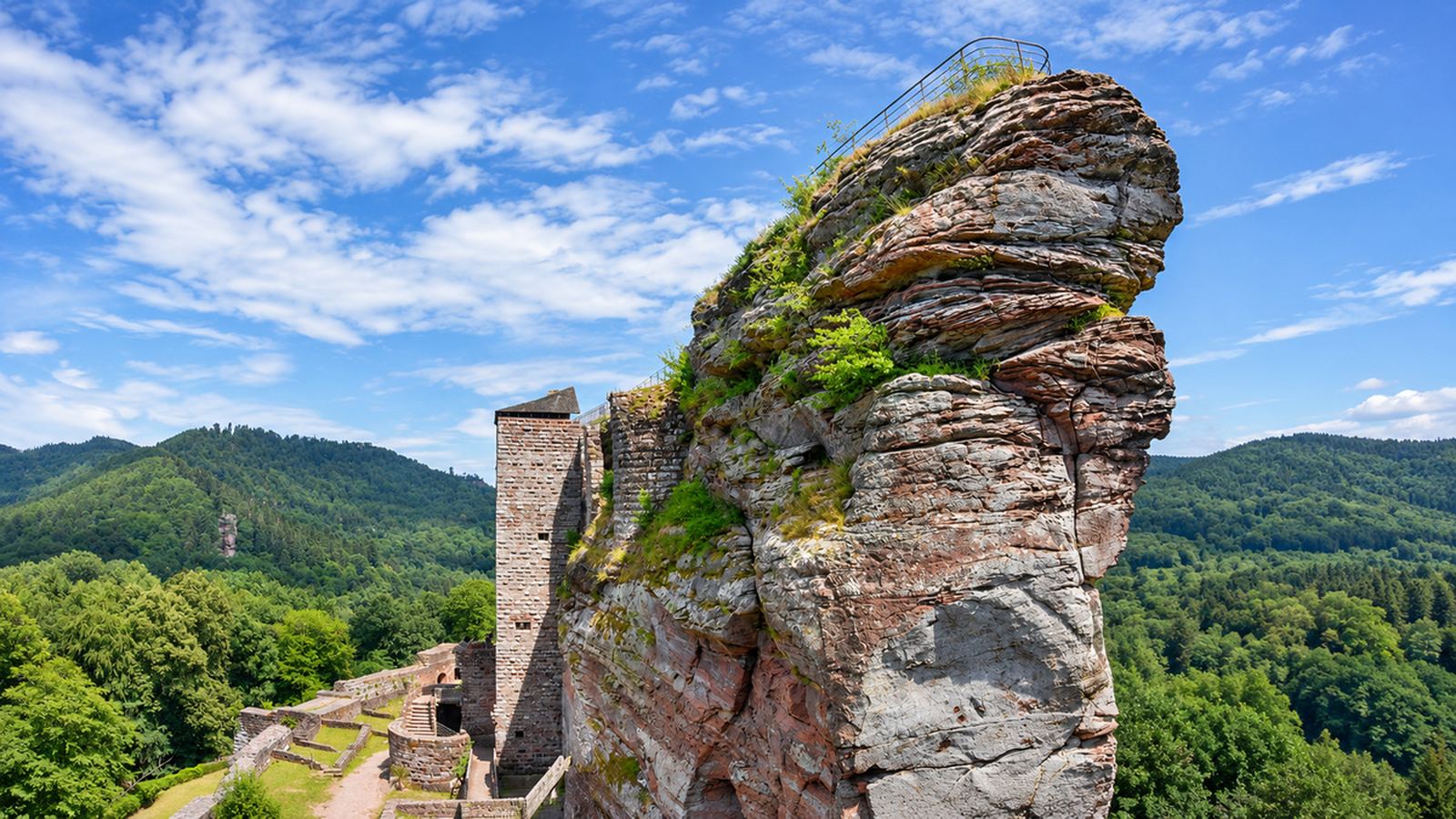
Erosion has exposed the sandstone as ridges and rock towers on the hilltops. In the Middle Ages, castles were built on them: the Park has more than thirty, perched on their rocky spurs. The most striking is Fleckenstein Castle, at Lembach (Bas-Rhin). Its rooms and staircases are carved into a rock about 90 metres long and 30 metres high. In the late-afternoon sun, the stone shifts from pink to orange.
Further north-west, the Altschlossfelsen forms a sandstone cliff 1.5 kilometres long. It has been nicknamed the “Colorado” of the Pays de Bitche, but it is actually in Germany, in the municipality of Eppenbrunn, in the Palatinate Forest. You can reach it on foot from Roppeviller, in the Moselle, on waymarked trails.
Best for: families, walkers, photographers. Time needed: about an hour to visit Fleckenstein Castle.
The green of the forests: the Grand Wintersberg, Niederbronn-les-Bains
Forest covers 83,525 hectares, almost 66% of the Park. Beech dominates, ahead of Scots pine, spruce and oak. So the green varies from place to place: the fresh green of beech woods in spring, the dark green of pines and spruces all year round.
The best viewpoint over this sea of trees is the Grand Wintersberg, the highest point in the Northern Vosges at 581 metres, in the municipality of Niederbronn-les-Bains. At the summit, a brick tower about 25 metres high, built by the Club vosgien in 1889–1890, looks out over the wooded hills, the Palatinate and the Alsace plain.
Best for: walkers. Time needed: the waymarked loop from the centre of Niederbronn is about 12.5 kilometres; allow three and a half to four hours’ walking.
The mauve of the heathland: the heaths of the Pays de Bitche
Heathland is rare in the Northern Vosges, which is what makes it so precious. On the sandy soils of the Pays de Bitche grows a heath of heather and garland flower daphne that is found almost nowhere else, except in the neighbouring Palatinate. In late summer, the heather, a small low-growing shrub, turns these open spaces mauve.
The largest heaths lie on the Bitche military camp, protected as a Natura 2000 site (“Landes et tourbières du camp militaire de Bitche” – heaths and bogs of the Bitche military camp). It is military land: you cannot move around it freely. These heaths survive only if they are managed; otherwise Scots pine takes them over again.
Best for: naturalists and anyone curious about botany. Ask the Park about guided nature outings in the Pays de Bitche.
The white of the orchards: the foothills of Niederbronn and Reichshoffen
The Park has around 2,350 hectares of orchards. Many are traditional standard orchards with tall trees, planted around the villages: apple, quetsch plum and mirabelle plum trees. In spring, their blossom turns the meadows white on the edges of the villages.
The foothills between Niederbronn-les-Bains and Reichshoffen are listed as a ZNIEFF (natural area of ecological, faunal and floral interest) for their meadows and orchards. These traditional orchards are under threat in Alsace. In the Sauer valley, a “vergers solidaires” (community orchards) scheme ran from 2007 to 2010 to replant them.
Best for: strollers, families. Time needed: a one-hour walk between two villages is enough to enjoy the blossom.
The blue of the lakes: the Étang de Hanau, Philippsbourg
The last picture is made of water. The Étang de Hanau, at Philippsbourg (Moselle), covers 16 hectares at the foot of the ruins of Waldeck Castle. You can swim there in summer, and a discovery trail of about one kilometre, partly on a boardwalk, crosses its peat bog. Information panels explain how the bog was formed.
This bog is part of the national nature reserve of the rocks and peat bogs of the Pays de Bitche, created in 1998. The reserve brings together 26 sites, covering 355 hectares, in seven municipalities of the Moselle. It is home to sphagnum mosses, cottongrass and two species of sundew, a small carnivorous plant.
Elsewhere in the Pays de Bitche, the Étang de Hasselfurth, in Bitche, and the Étang du Ramstein, in Baerenthal, offer more blue reflections. Our Lakes and swimming section describes them.
Best for: families, naturalists. Time needed: about 45 minutes for the bog trail.
Which colours in which season?
- Spring: the white of orchards in blossom and the fresh green of the beeches.
- Summer: the deep green of the forests, cooler than the plain, the blue of the lakes, then the mauve of the heather at the end of the season.
- Autumn: the gold of the beeches and the russet of the oaks against the pink sandstone. All our ideas for outings in this season are in our article what to do in the Northern Vosges in September and October.
- Winter: the bare trees reveal rocks and ruins that are barely visible in summer. The sandstone stands out under the frost.
How to combine them
In one day, in the north of the Park: Fleckenstein in the morning, then the Étang de Hanau in the afternoon, less than 20 kilometres away as the crow flies. You can see pink, green and blue in the same day.
Over a weekend: add the Grand Wintersberg from Niederbronn-les-Bains, and a walk through the foothill orchards if you come in spring.
Practical information
- Train: the TER line Strasbourg–Haguenau–Niederbronn-les-Bains–Bitche serves the heart of the Park. Another line links Strasbourg to Wissembourg via Haguenau.
- Car: recommended, as the sites are scattered and rarely served by public transport.
- Time needed: half a day per place, a full day to combine two or three.
- Season: all year round. Spring and autumn are the most colourful seasons.
- Opening times and prices: on the official Fleckenstein Castle website; for swimming at the Étang de Hanau, contact the municipality of Philippsbourg.
Good to know
Stay on the paths in the nature reserve: the peat bogs are fragile, and some rocks are home to nesting birds such as the peregrine falcon.
Sandstone is slippery in wet weather. Wear sturdy shoes, even for a short climb.
My tip: to photograph the sandstone, come at the end of the day. The low-angled light brings out the pink of the rock, especially when it is framed by autumn foliage.
Good to know
Expected crowds this week: usual, busier at the weekend
In the Northern Vosges
- 25 December Christmas Day, public holiday in France (long weekend)
- 26 December St Stephen’s Day (Alsace-Moselle), public holiday in France
- 1 January New Year's Day, public holiday in France (long weekend)
- 20 December – 3 January French school holidays
Back home: the Netherlands
- 25 December Christmas Day
- 26 December St. Stephen's Day
- 19 December – 3 January Christmas Holidays
- 13 February – 21 March Spring Holidays (depending on region)
Getting here
- From Belgium and the Netherlands by car: via Luxembourg and Metz, or via Germany towards Karlsruhe and Wissembourg.
- By train: high-speed trains to Strasbourg (via Paris) or to Karlsruhe (via Germany), then regional trains.
- On site: a car is the easiest way to get around.
Holidays: Nager.Date and OpenHolidays.