
Château de Fleckenstein, a castle carved into the rock
North of Lembach (Bas-Rhin), near the German border, Fleckenstein blends into its pink sandstone rock. You climb up stone-cut staircases to a view over the forests.

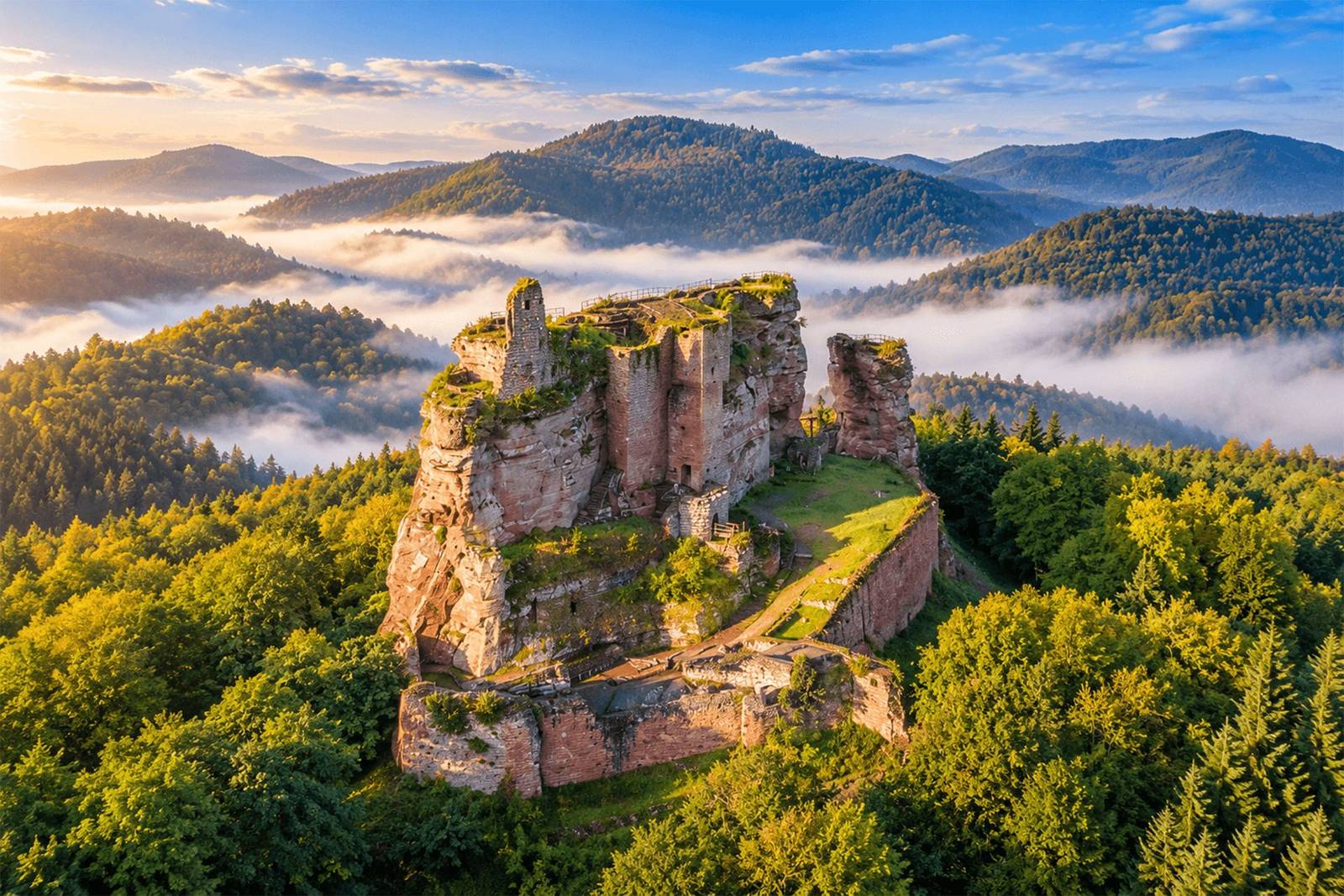
A castle at one with the rock
Fleckenstein is a semi-troglodyte castle. Its builders made use of a sandstone spur about 90 metres long and 30 metres high, whose silhouette recalls the prow of a ship. They hollowed out rooms, passages and staircases inside it. Masonry was added to complete the rock, at the top as well as at the base.
The castle appears in written records in the 12th century: it is mentioned as early as 1165, and the site’s chronology gives 1174 as the first known mention of the name Fleckenstein. The Fleckenstein family kept it until its last branch died out in 1720. The site was enlarged in stages between the 12th and 16th centuries. Its defensive architecture allowed the family to hold its fief for six centuries.
From fortress to ruin
In 1674, during the Franco-Dutch War, French troops under the Marquis de Vaubrun occupied and looted the castle. A few years later, it fell without a fight and the soldiers of Louis XIV blew it up with black powder. The date varies between sources: 1689 in most books, 1680 in the chronology on the official website. What you see today is what remains after this destruction: the rock withstood it better than the walls.
After the Revolution, the castle was sold as national property and changed hands several times. It was listed as a historic monument in 1898 and became state property in 1919. In 1958, the newly founded Lembach tourist association made its restoration its flagship project; it ran the site until 2005. In 1998, the Alsace Region bought the 270 hectares of land surrounding the castle and handed the ruin over to the commune of Lembach.
Visiting the castle
From the visitor centre, you cross the large esplanade, then tackle the rock. The climb is by staircases only, some of them cut straight into the sandstone. You go from room to room, inside the rock, before coming out on the summit platform. Up there, the view stretches far across the wooded hills of the Northern Vosges Regional Nature Park. On a clear day, you can spot other ruins perched on their own rocks.
Self-guided visits come with a leaflet handed out at the ticket office, in French, German, English and several other languages. Allow about an hour, a little more if you take time to read and take photos. Guided tours are available by reservation, with a guiding fee on top of the ticket. There is only one ticket office, at the visitor centre below: you cannot buy a ticket at the foot of the castle.
My tip: wear shoes with a good grip. The steps are uneven and become slippery after rain.
What is ChâteauXperience?
The site has opened an indoor exhibition, ChâteauXperience, devoted to the castles of the Northern Vosges and the Palatinate. Displays, films and interactive features tell the shared history of this territory, long part of the Holy Roman Empire. The exhibition answers simple questions: why are there so many castles here, how were they built, what was life like inside them, and why were so many of them destroyed?
The exhibition is available in French, German and English. The ticket includes the castle, and the site suggests 2 hr 30 for the whole visit. As it is indoors, it is a good option on a rainy day.
With children
The Château des Défis is a game trail leading from the forest to the castle. With Kim, the game’s character, players take on 25 challenges to free the baron and recover a stolen book of spells. The challenges call on logic, the five senses, skill and courage, and are available in French, German and English. The ticket includes the castle.
The site suggests three hours of adventure: allow half a day. Tickets are only sold until two and a half hours before closing time, so come early. You can stop for a picnic halfway. The trail closes in winter, from November to the end of March.
Le P’tit Fleck, a play and discovery area about sandstone and the forest for young children, is closed for renovation. The official website has not yet announced a reopening date: check before promising the activity to little ones.
For toddlers, bring a baby carrier. The castle cannot be visited with a pushchair, because of its steepness and its stairs. Leave the pushchair at the ticket office or in the area provided before the castle. On the Château des Défis, pushchairs can only manage the forest section. Dogs on a lead are welcome everywhere except in the P’tit Fleck area; let the ticket office know if you have a large dog so it can get through the turnstile.
The 4 castles walk from Fleckenstein
Fleckenstein is not alone in its forest. The 4 castles walk, waymarked by the Club vosgien, starts from its car park. The Northern Vosges Regional Nature Park gives it as about 6.8 km, 2 hr 30 of walking and just under 300 metres of ascent, of moderate difficulty.
- Loewenstein: built in the 13th century, it became a den of robber knights and was destroyed in 1386.
- Hohenbourg: built in the 13th century, restored in the early 16th century to become a residence.
- Wegelnburg: on the German side, in the Palatinate, at an altitude of 572 metres, it is the highest castle ruin in the region.
The way back passes the Gimbelhof and a medieval playground. A variant, the rocks trail, is not recommended with young children or in wet weather. In spring and autumn, the thinner vegetation gives clearer views of the rocks and viewpoints. More walking routes start from the neighbouring villages.
Practical information
The castle is in the commune of Lembach (Bas-Rhin), about 5 km north of the village, right by the German border. It is signposted from Lembach: take the D3 towards Bitche, then the D925 towards Schönau and finally the D525.
The forest car park, for cars only, has around a hundred free, shaded spaces. From there, the charcoal burners’ path climbs gently for 300 metres to the visitor centre. A disabled parking space is located at the top of the site, near the visitor centre. Passengers can be dropped off at the turning area, but the driver must then go back down to the car park: parking is not allowed there.
The visitor centre, the café and the P’tit Fleck are on one level or served by a lift. The castle and the Château des Défis are only very partially accessible by wheelchair.
Without a car, head for Wissembourg station, the gateway to the Outre-Forêt. A seasonal bus line (line 317 of the regional Fluo network) links the station with the castle on certain days during the summer season. Check its timetable before setting off.
The castle closes in winter, from November to Christmas, then reopens daily over the festive season with reduced hours. From January to the end of March, it opens on Sundays only, and access may be closed in snow or ice. Detailed opening hours and prices: see the practical information sheet and the official website.
Good to know
Expected crowds this week: usual, busier at the weekend
In the Northern Vosges
- 25 December Christmas Day, public holiday in France (long weekend)
- 26 December St Stephen’s Day (Alsace-Moselle), public holiday in France
- 1 January New Year's Day, public holiday in France (long weekend)
- 20 December – 3 January French school holidays
Back home: the Netherlands
- 25 December Christmas Day
- 26 December St. Stephen's Day
- 19 December – 3 January Christmas Holidays
- 13 February – 21 March Spring Holidays (depending on region)
Getting here
- From Belgium and the Netherlands by car: via Luxembourg and Metz, or via Germany towards Karlsruhe and Wissembourg.
- By train: high-speed trains to Strasbourg (via Paris) or to Karlsruhe (via Germany), then regional trains.
- On site: a car is the easiest way to get around.
Holidays: Nager.Date and OpenHolidays.