
Visiting Phalsbourg, a Vauban fortified town in Moselle
Phalsbourg, a small Moselle town in the Northern Vosges Park, still has two Vauban gates and a vast Place d’Armes. What to see, how long to allow and how to get there.

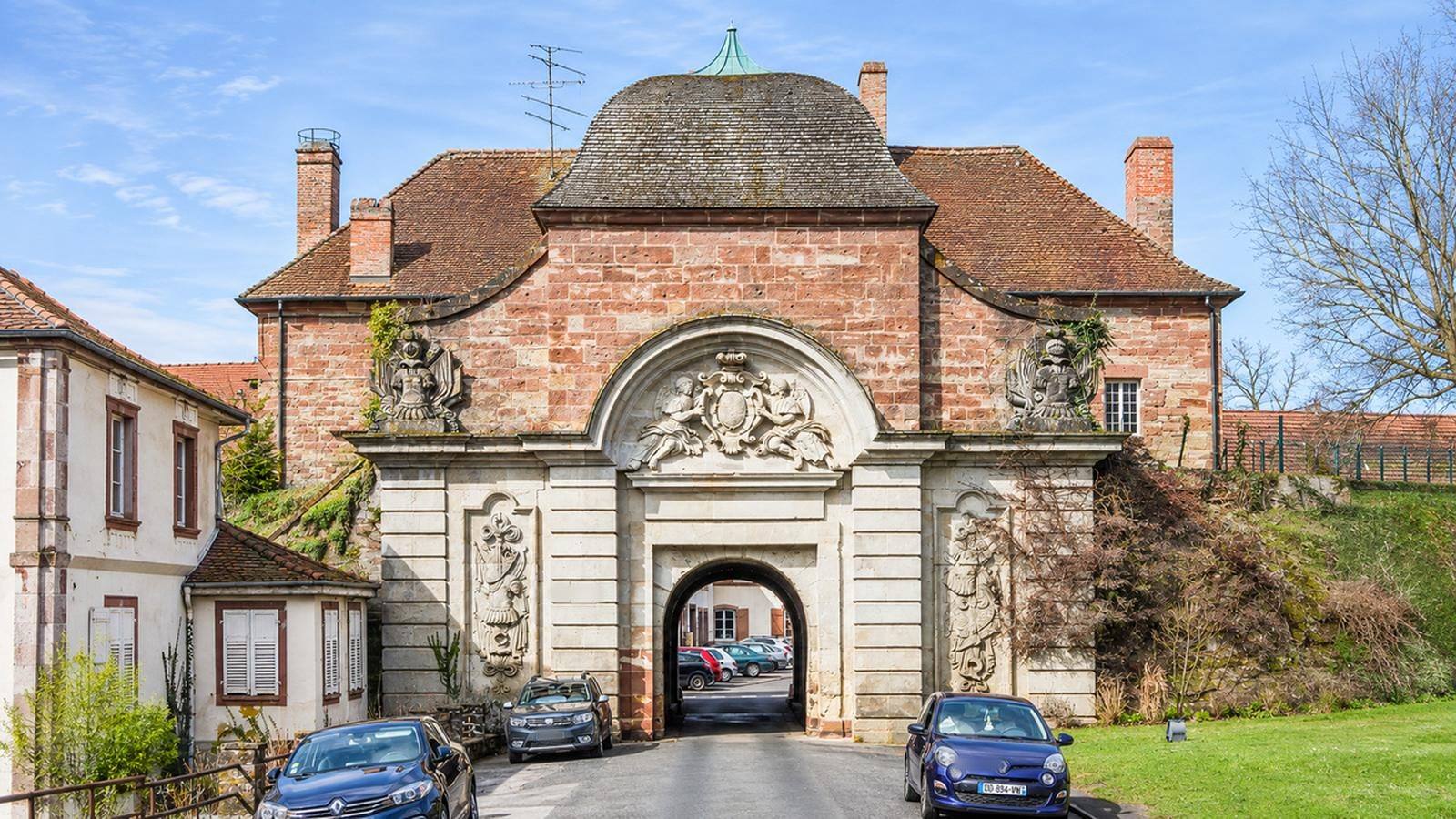
Phalsbourg is a small fortified town in Moselle (57370), in Lorraine, on the border with the Bas-Rhin and 8 km from Saverne as the crow flies. Founded in 1570 and fortified by Vauban from 1679, it has kept its two monumental gates, its large Place d’Armes and the layout of a garrison town. Allow two to three hours to explore it on foot, a full day if you add the nearby sites.
Why visit Phalsbourg?
First, for the military architecture: the Porte de France and the Porte d’Allemagne, listed as historic monuments in 1927, are two fine examples of late 17th-century fortress gates.
Next, for the history: the town withstood three sieges, in 1814, 1815 and 1870, and produced a line of generals that earned it the nickname “Nursery of the Brave”.
Finally, for literature: Émile Erckmann, one of the two writers of the Erckmann-Chatrian duo, was born here in 1822.
Phalsbourg is part of the Northern Vosges Regional Nature Park and of the cross-border Northern Vosges–Pfälzerwald biosphere reserve. On this site, you will find it in the Gateways to the Park area, along with Saverne and Haguenau.
A little history
Count Palatine George John of Veldenz founded the town in 1570 and gave it its name, Pfalzburg. Short of money, he sold it to the Duke of Lorraine: the Lorraine period ran from 1590 to 1661.
The Treaty of Vincennes, signed on 28 February 1661, transferred Phalsbourg to the Kingdom of France. Vauban reworked the defences from 1679: the two gates still standing date from this campaign.
As a garrison town, Phalsbourg supplied soldiers and officers. The best known is Georges Mouton, born here on 21 February 1770, made Count of Lobau by Napoleon after the Battle of Essling (1809), then Marshal of France in 1831. Napoleon liked to call the town the “Nursery of the Brave”, a motto taken up in its coat of arms.
The fortress endured three sieges. In 1870, defended by the 63rd Infantry Regiment and a battalion of the National Guard, it surrendered on 12 December. The Treaty of Frankfurt of 10 May 1871 annexed it to the German Empire: it was renamed Pfalzburg and its ramparts were dismantled in the years that followed.
French again in 1918 and annexed once more in 1940, the town was liberated on 23 November 1944 by the US Seventh Army.
What to see in Phalsbourg
The Porte de France
West of the old town, facing Lorraine, this is the monumental entrance to the fortress. It was listed as a historic monument by decree of 14 March 1927. Walk through it in both directions: it is the best way to gauge the thickness of the structure and to understand how access to the town was controlled.
The Porte d’Allemagne
To the south-east, Vauban’s other gate is protected by the same 1927 decree. Between the two, the walk across the old town follows the main axis of the former fortress. Along with the postern gates, they are the main survivors of a town wall almost entirely demolished after 1871.
The Place d’Armes and the statue of Lobau
The heart of the garrison town, the Place d’Armes has been a registered site since 1936. In the centre stands the bronze statue of Marshal Mouton, Count of Lobau, a local son. The town hall, a former guardhouse, is registered as a historic monument; the tourist office is on the same square. A monument also pays tribute to Erckmann-Chatrian.
The history, military and Erckmann-Chatrian museum
Housed in the town hall, it is currently closed to the public, with no reopening date announced by the town: check before you come. Created in 1938 for the centenary of Marshal Mouton’s death, it lost its military collections in 1941, taken to Germany as spoils of war, and reopened in 1948.
Its collections, almost all of them donations, cover three themes: military history (uniforms, weapons, equipment), the life and work of Erckmann-Chatrian, authors of “L’Ami Fritz” and “Histoire d’un conscrit de 1813” (The Conscript), and the costumes and everyday objects of this land between Alsace and Lorraine. Since 2007, it has also held the restored circumcision bench from the Phalsbourg synagogue.
The churches and the former synagogue
The neo-Gothic church of Notre-Dame-de-l’Assomption dates from 1876. The town also has a Lutheran church on Rue du Collège and the Chapelle Saint-Jean. The former synagogue on Rue Alexandre-Weill, rebuilt in 1857 on the site of a first synagogue from 1772, was deconsecrated in 2008.
The “Bourg-la-Reine” tank
At the western entrance to the town, a Sherman tank named “Bourg-la-Reine” commemorates the Liberation in November 1944. It makes a quick stop with children.
The Brunnenthal botanical trail
To get off the cobbles, this trail of about 4 km presents the main tree species of the Northern Vosges on some thirty panels. Allow an hour and a half on foot.
Practical information
- Starting point: the Pays de Phalsbourg tourist office, 30 place d’Armes. This is where the waymarked town trail begins (26 stops, under 5 km), described in a guide booklet sold on site.
- Guided tours: free, in French, during the summer; groups can request one from the tourist office.
- Train: Phalsbourg no longer has a station. The nearest is Lutzelbourg, about 4 km away, served by TER trains between Strasbourg and Metz via Saverne. The station has no ticket office.
- Road: Phalsbourg is 8 km from Saverne as the crow flies and 42 km from Strasbourg.
- Time needed: two to three hours for the trail and the Place d’Armes. Add half a day for Lutzelbourg and the Saint-Louis-Arzviller boat lift.
- With a dog: dogs are welcome on the town trail.
- Opening times and prices: on the Pays de Phalsbourg tourist office website.
If fortified towns interest you, the Citadel and fortifications section brings together the area’s other sites, including La Petite-Pierre, the Park’s fortified town on the Bas-Rhin side.
When to go
The town trail can be done all year round, in a morning or an afternoon. Summer is the liveliest season, when the free guided tours run. Two events also bring the town to life: the Phalsbourg theatre festival, held for more than thirty years, and the foie gras festival; the tourist office then opens every day. Check the office’s events calendar for dates.
My tip: stop at the tourist office first to pick up the trail booklet. Without it, the 26 stops are simply a pleasant walk; with it, you know what you are looking at at every stop.
Good to know
Expected crowds this week: usual, busier at the weekend
In the Northern Vosges
- 25 December Christmas Day, public holiday in France (long weekend)
- 26 December St Stephen’s Day (Alsace-Moselle), public holiday in France
- 1 January New Year's Day, public holiday in France (long weekend)
- 20 December – 3 January French school holidays
Back home: the Netherlands
- 25 December Christmas Day
- 26 December St. Stephen's Day
- 19 December – 3 January Christmas Holidays
- 13 February – 21 March Spring Holidays (depending on region)
Getting here
- From Belgium and the Netherlands by car: via Luxembourg and Metz, or via Germany towards Karlsruhe and Wissembourg.
- By train: high-speed trains to Strasbourg (via Paris) or to Karlsruhe (via Germany), then regional trains.
- On site: a car is the easiest way to get around.
Holidays: Nager.Date and OpenHolidays.