
The wasp spider: the striped spider and the mystery of its web
Striped in yellow, white and black, the wasp spider spins its web in the tall grass of the Northern Vosges from July to October. Harmless, it hides some astonishing biology.

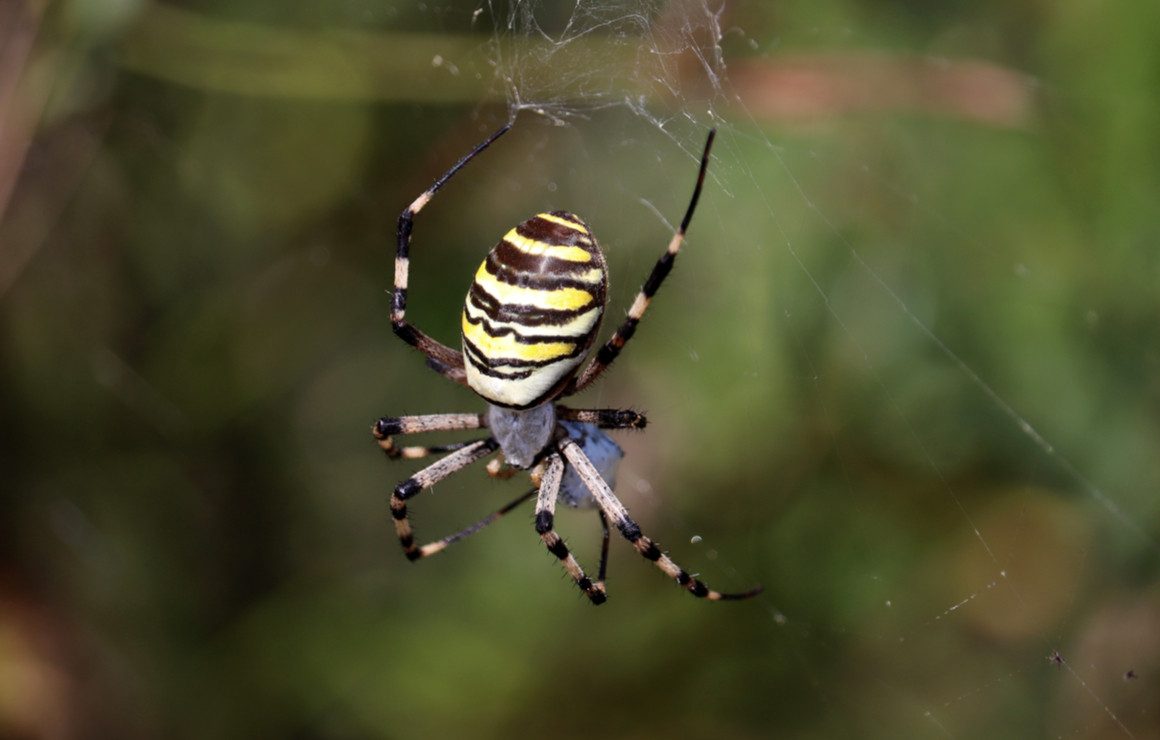
Walking through tall grass or along scrubby ground, you may already have come face to face with one of these motionless figures hanging in their web, striped in white, bright yellow and deep black. This is the wasp spider (Argiope bruennichi), known in French as the argiope frelon, a large spider that is harmless to humans. In the Northern Vosges Regional Nature Park, you can find it from summer to early autumn in unmown meadows, fallow land and sunny woodland edges.
Its name comes from the markings on its abdomen, which recall those of the European hornet (Vespa crabro) or the common wasp (Vespula vulgaris). In French it is also called épeire frelon or épeire fasciée. It is a fascinating creature whose biology intrigues and surprises. As children, we loved watching this species, which we had nicknamed the “bee spider”, and its spectacular hunting technique impressed us.
Where to find the wasp spider in the Northern Vosges
The wasp spider is a species of largely Mediterranean affinity. Long rare in central Europe, it greatly extended its range northwards during the 20th century and is still spreading. Today it is found across almost all of Europe.
In the Northern Vosges, look for it in unmown meadows, fallow land, waste ground and bushes, always on plots that get plenty of sun. The valley-floor meadows that are mown late in the season suit it well. This is where it spins its circular web, typical of orb weavers, perpendicular to the ground and less than a metre high: the centre is usually between 20 and 70 centimetres above the ground.
The young appear from May. Adults are seen mainly in July and August, and the females remain visible until October.
How to recognise the wasp spider
The female, which measures 10 to 20 millimetres, is the easiest to spot with her abdomen striped in yellow, white and black. The male, half her size (5 to 9 millimetres) and much duller, often goes unnoticed.
The web is another giveaway: a large round web crossed by a thick zigzag of white silk above and below the spider.
How does the spider find its way around its web?
The wasp spider’s web is, of course, a trap for catching prey. The spider sits at its centre, head down, its eight legs grouped in pairs, held very close together at the front and spread wider at the back. This position gives it both good balance and effective control over the whole hunting surface.
What long puzzled biologists is that the wasp spider, like other orb weavers such as the European garden spider (Araneus diadematus), finds the centre of its web in an instant despite having very poor eyesight. It can leave it and return straight away. Its highly sensitive legs pick up the vibrations and tensions running through the silk threads. One proposed explanation: the centre is the structure’s point of mechanical equilibrium, where all the threads pull outwards towards the edge of the circle.
How does the wasp spider hunt?
Bush crickets and grasshoppers are its most frequent prey, but other insects such as wasps and bees are also on the menu. When an insect gets tangled in the web, it struggles to free itself from the sticky grip of the threads. The vibrations travel to the centre and allow the wasp spider to rush to the point of capture in a flash.
It then wraps its prey in silk within a few seconds, before biting it to inject its venom. Some prey, such as butterflies, are bitten first and wrapped afterwards. The venom immobilises the prey, then enzymes liquefy its tissues, which the spider sucks up. The “mummified” prey is not always eaten on the spot: the silk cocoon preserves it. The wasp spider is particularly voracious and can feed on several prey a day, up to four bush crickets.
What is the zigzag in its web for?
The web has another interesting feature: the stabilimentum, a band of silk thicker than the rest of the web, which zigzags vertically above and below the spider. In young spiders it sometimes takes the form of a disc.
For a long time, biologists saw these patterns as reinforcements, hence their name. Yet the round webs of other orb weavers are just as strong without a stabilimentum, and this role is no longer considered the main one. Several competing theories try to explain the purpose of these additions.
The one we find most interesting is linked to the wasp spider’s very appearance. Its yellow and black stripes first have an effect that is classic in the animal world: a visual signal meant to deter predators, bright colours often being synonymous with danger. It is, in a way, the opposite of camouflage: the spider shows itself conspicuously, but in a threatening light.
These patterns may have another use. The silk of the stabilimentum strongly reflects ultraviolet light, to which many insects are sensitive. It would thus draw prey towards the trap, while blurring the outline of the spider at the centre of the web in the eyes of predators sensitive to ultraviolet. The wasp spider would then have put its stripes to work in both the visible and the invisible spectrum. This hypothesis is still debated: some studies confirm the strong ultraviolet reflection of the stabilimentum, others do not find it.
A high-risk mating season… for the male
Finally, a less appealing aspect. Mating takes place from late July to early August. The male approaches the female with caution, and with good reason: the wasp spider practises sexual cannibalism. The female, much larger, may try to devour the male as soon as mating begins.
The male’s copulatory organ has breaking points. In most cases its tip snaps off and remains in the female’s genital tract, which it blocks: this reduces the chances of the males that follow.
From late August, the female lays her eggs in an impressive brownish cocoon, shaped like an upside-down hot-air balloon or a small clay pot, closed by a lid and hung in the grass. It holds more than a hundred eggs. The young hatch before winter, spend it sheltered in the cocoon and only emerge in spring, when it is warm enough.
Why leave a patch of long grass in your garden?
The wasp spider has become relatively common in our latitudes, but it remains tied to sunny habitats covered with tall grassy or shrubby vegetation, rich in bush crickets. It benefits greatly from land left fallow and from late or differentiated mowing, which gives the grass time to grow and the bush crickets time to multiply.
If you keep a small patch of unmown grass in your garden, then as well as a whirl of insects, you may have the pleasure of welcoming a wasp spider in full colour, waiting impassively for prey to fly into its net.
The species is not dangerous to humans: its fangs are usually too short to pierce the skin, and a bite, which is rare, causes at worst some temporary swelling and redness. So let it bring its share of diversity to your garden.
My tip: in late summer, walk slowly along a woodland edge or an unmown meadow, looking at knee height. The white zigzag of the stabilimentum is often easier to spot than the spider itself.
The spiders of the Northern Vosges include other ambush hunters, but the Park is also home to more unexpected traps, such as the sand funnel of the antlion larva.
Good to know
Expected crowds this week: usual, busier at the weekend
In the Northern Vosges
- 25 December Christmas Day, public holiday in France (long weekend)
- 26 December St Stephen’s Day (Alsace-Moselle), public holiday in France
- 1 January New Year's Day, public holiday in France (long weekend)
- 20 December – 3 January French school holidays
Back home: the Netherlands
- 25 December Christmas Day
- 26 December St. Stephen's Day
- 19 December – 3 January Christmas Holidays
- 13 February – 21 March Spring Holidays (depending on region)
Getting here
- From Belgium and the Netherlands by car: via Luxembourg and Metz, or via Germany towards Karlsruhe and Wissembourg.
- By train: high-speed trains to Strasbourg (via Paris) or to Karlsruhe (via Germany), then regional trains.
- On site: a car is the easiest way to get around.
Holidays: Nager.Date and OpenHolidays.