
Sweet woodruff: queen of the woods and of Pays de Bitche liqueurs
In spring, sweet woodruff carpets some beech woods in the Northern Vosges. In the Pays de Bitche it flavours Waldmeister, a liqueur celebrated every year in Montbronn.

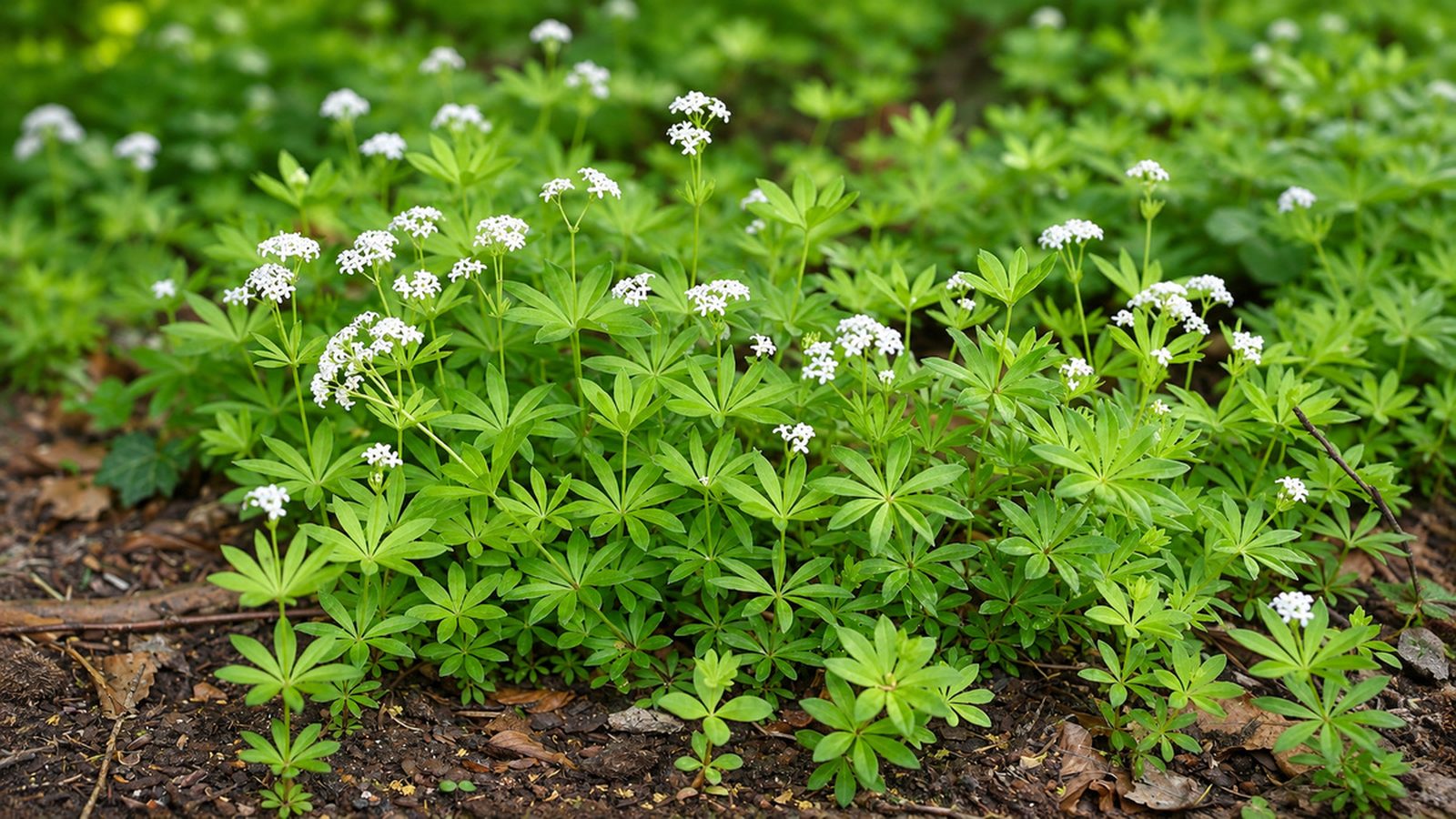
Sweet woodruff is a small plant of beech woodland that flowers in spring, from April to June. Fresh, it barely smells of anything; dried, it gives off a scent of hay, honey and vanilla. In the Pays de Bitche, in the Moselle, it flavours a liqueur, Waldmeister, and the village of Montbronn holds a festival in its honour every year.
What is sweet woodruff?
Sweet woodruff (Galium odoratum, formerly Asperula odorata), known in French as “reine des bois” (queen of the woods) or “petit muguet” (little lily of the valley), is a perennial herbaceous plant of the Rubiaceae family, the bedstraw family. It spreads through underground stems and forms large colonies that carpet the woodland floor.
You can recognise it by its narrow leaves, arranged in star-shaped whorls of six to eight around the stem, and by its small white, funnel-shaped, four-petalled flowers clustered at the top.
This woodland species likes shade or partial shade and cool, deep, humus-rich soils, preferably not too acidic. It is characteristic of a type of forest well known to botanists: woodruff beech forest.
Where and when can you see it in the Northern Vosges?
The forests of the Northern Vosges are mainly beech woods on sandstone, with acidic soils where woodruff is scarce. Woodruff beech forests cover only a small part of the woodland in the “Vosges du Nord” Natura 2000 site, on the richer soils. So look for it in patches, in cool valley bottoms and under beech trees, especially in the forests of the Pays de Bitche.
The best time is from April to June, when the carpets of woodruff are in flower. For the rest of the warmer months, its star-shaped foliage is still easy to spot.
Why does it smell of hay?
Woodruff has a unique scent: notes of hay with sweet, honeyed and vanilla accents. These aromas appear mainly when the plant dries or wilts. They come from coumarin, which is released as it dries. This is what made woodruff an aromatic herb, used to flavour drinks and desserts.
Waldmeister, the liqueur of the Pays de Bitche
In the Pays de Bitche, woodruff is used to make syrups, white-wine aperitifs and, above all, a green liqueur called Waldmeister, made from fruit brandy and woodruff. It is also produced and drunk in Germany. In Rhine Franconian, the local dialect, it is called Wàldmeischter, or “Waldi” for short. The liqueur is prized for its subtle aromas and delicate taste.
The Waldifescht in Montbronn
Every year, in late spring (late May or early June), Montbronn celebrates woodruff with the Waldifescht, the woodruff festival. Organised by the village’s association of local clubs, it takes place on the fitness trail in the forest. On the programme: tastings of woodruff specialities throughout the day, a dance, family games and a closing firework display.
It is a good opportunity to get to know the plant and its uses. The date is set each year by the organisers: check the village festivals calendar in spring.
Woodruff and coumarin: what precautions should you take?
Woodruff has traditionally been credited with various virtues, but none is well enough established to recommend it for medical use. Above all, be careful with the coumarin that gives it its scent.
In large doses, coumarin can cause headaches and, in some sensitive people, liver damage. The German Federal Institute for Risk Assessment (BfR) sets the tolerable daily intake at 0.1 milligrams per kilo of body weight. In Europe, isolated coumarin may not be added to food; only plants that contain it, such as woodruff, may be used for flavouring.
A badly dried plant can also go mouldy and produce dicoumarol, a substance that interferes with blood clotting. So dry woodruff in the open air, away from damp, and throw away any mouldy plants. If in doubt, if you are pregnant or taking medication, ask a health professional for advice before consuming it.
How can you pick it without damaging it?
Woodruff is delicate and does not tolerate being pulled up. To protect the colonies, take a sharp tool and cut only the upper part of the plant, the leaves and flowers. The roots stay in the ground and the plant can keep growing.
Pick in spring, in moderation, taking a few stems here and there rather than a whole clump. Check before picking in a nature reserve, where gathering is often regulated, and remember that a private forest belongs to its owner.
My tip: pick a stem, slip it into your pocket and smell it a few hours later. As it wilts, it will have taken on the hay-like scent it is famous for.
With its aromas and its place in Moselle traditions, sweet woodruff deserves to be discovered and protected, like the other aromatic plants in the forests of the Northern Vosges Regional Nature Park.
Good to know
Expected crowds this week: usual, busier at the weekend
In the Northern Vosges
- 25 December Christmas Day, public holiday in France (long weekend)
- 26 December St Stephen’s Day (Alsace-Moselle), public holiday in France
- 1 January New Year's Day, public holiday in France (long weekend)
- 20 December – 3 January French school holidays
Back home: the Netherlands
- 25 December Christmas Day
- 26 December St. Stephen's Day
- 19 December – 3 January Christmas Holidays
- 13 February – 21 March Spring Holidays (depending on region)
Getting here
- From Belgium and the Netherlands by car: via Luxembourg and Metz, or via Germany towards Karlsruhe and Wissembourg.
- By train: high-speed trains to Strasbourg (via Paris) or to Karlsruhe (via Germany), then regional trains.
- On site: a car is the easiest way to get around.
Holidays: Nager.Date and OpenHolidays.