Presskopf, Alsatian head cheese (brawn): the recipe
Presskopf is Alsatian head cheese: pork cooked for 3 hours, boned, then set overnight in its own reduced stock. A cold starter served in thick slices.

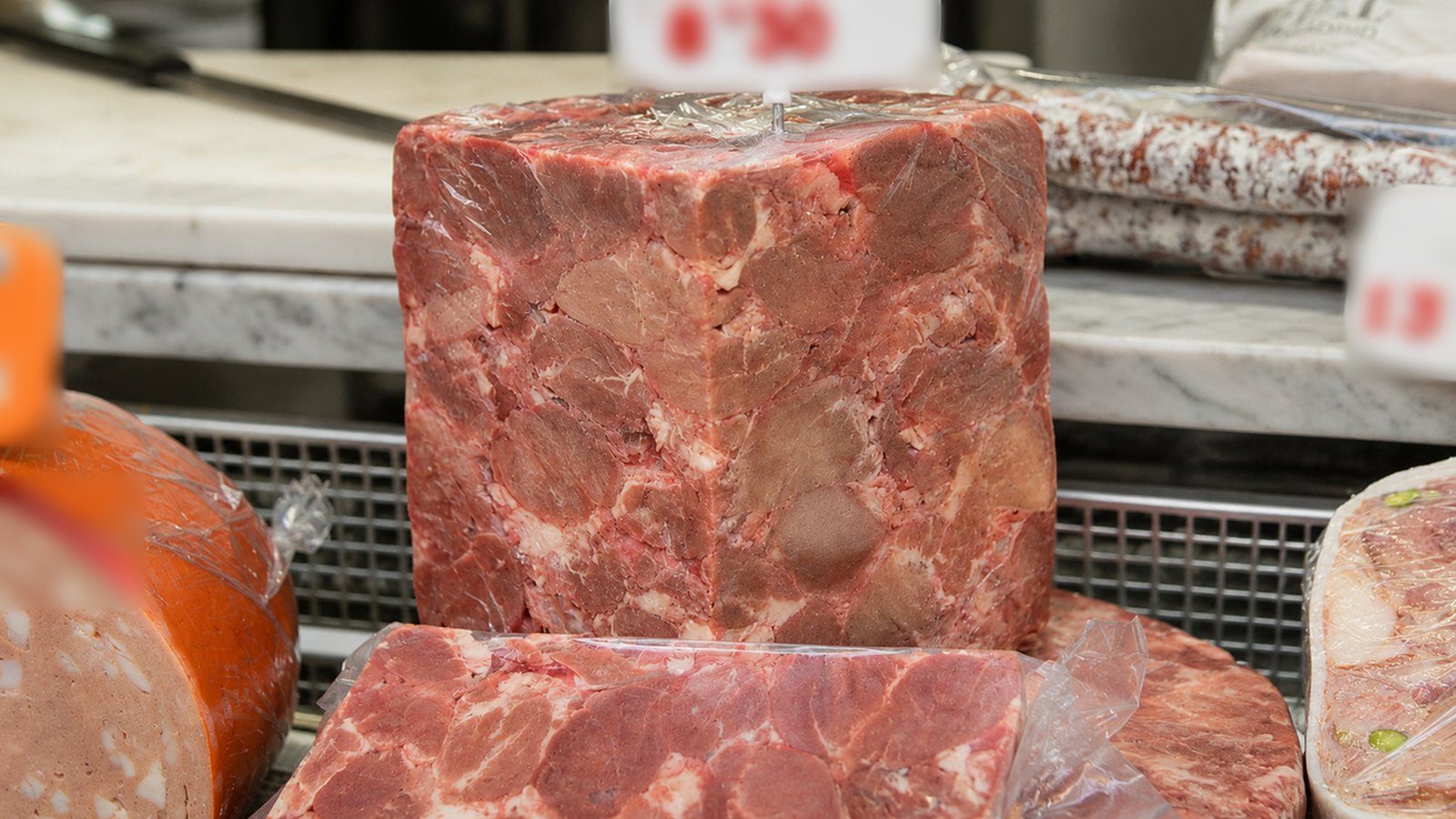
Presskopf is Alsatian head cheese (brawn): pig’s head, hock, cheek and trotter cooked for about 3 hours with aromatics, boned, cut into bite-sized pieces and then set in their reduced stock, which jellies as it cools. It is served cold, in thick slices, as a starter. The recipe calls for time rather than technique: allow a full day, including an overnight rest.
Preparation: 1 hour
Cooking: 3 hours
Resting: at least 12 hours
Makes 1 terrine
Ingredients
- 1 pig’s head
- 1 pork hock
- 200 g pork cheek
- 200 g pork tongue (optional)
- 1 pig’s trotter
- 1 bouquet garni (parsley, thyme, bay leaf)
- 2 large onions
- 4 garlic cloves
- 2 cloves
- 10 black peppercorns
- 1 tablespoon salt
- 1 teaspoon ground pepper
- 1 litre chicken or vegetable stock
- 3 tablespoons white vinegar
Method
- Clean the meat thoroughly in cold water, scrubbing the head, then cut it into large pieces of similar size.
- Put the meat in a large stockpot with the cold stock, topped up with cold water to cover. Bring to the boil and skim regularly.
- Add the bouquet garni, the onions studded with the cloves, the garlic, peppercorns and salt. Cook gently for about 3 hours, until the meat comes away easily from the bones.
- Lift out the meat with a slotted spoon, strain the stock and reduce it by half.
- Meanwhile, bone the meat and cut it into bite-sized pieces, mixing the different cuts. Season with the ground pepper.
- Arrange the meat in a terrine or mould. Add the vinegar to the reduced stock and pour it in while still hot, to cover the pieces.
- Leave to cool at room temperature, then refrigerate for at least 12 hours.
- Turn out by dipping the base of the mould in hot water for a few seconds and serve cold, in thick slices.
My tip: ask your butcher to split the head and cut the hock, otherwise nothing will fit in the pot. Then keep the stock at a bare simmer: a hard boil makes it cloudy and toughens the meat.
What is presskopf?
Presskopf is a head cheese, a cold charcuterie made of pieces of cooked pork set in their own jelly. Despite the French name, fromage de tête, it contains no dairy at all: the word “fromage” is said to come from the mould in which it was pressed in the Middle Ages. In German as in Alsatian, Presskopf means “pressed head”.
The jelly comes from the meat itself. The trotter and the rind of the head release their gelatine during the long cooking; reduced by half, the stock sets as it cools and holds the pieces together. The vinegar adds a touch of acidity that balances the fat.
Origins
Head cheese is a European charcuterie born of the principle of wasting nothing of the pig: cheeks, tongue, snout and pieces of the head. In Alsace it is called Presskopf or Presswurst. Alsatian cooking also has a version with parsley, set in an Alsace wine jelly rather than with vinegar.
In German-speaking Moselle, the same dish goes by another name, schwinnekääs. The Pays de Bitche, the Moselle part of the Park, belongs to that area: its traditional dialect is Rhine Franconian. Across the Rhine, it is called Presskopf in Bavaria and Sülze or Schwartenmagen elsewhere. Like black pudding with apples, it belongs to the cooking of the farm pig-slaughter, when every part was used.
What to serve it with
Serve presskopf well chilled as a starter, with jacket potatoes or an Alsatian potato salad, a lamb’s lettuce salad, gherkins and pickled pearl onions. A vinaigrette with raw onion livens up the slices. It is never reheated: the jelly would melt.
As for wine, choose something fresh and light that cuts through the fat without overpowering the meat. Wine guides recommend crisp whites and light reds with head cheese. In Alsace, a Sylvaner or Pinot Blanc does the job in white and a light Pinot Noir in red; all three are grown in the Cleebourg vineyards near Wissembourg. A lager works too.
Where to try it
Presskopf is sold by the slice at butcher-charcutiers in the Bas-Rhin and Moselle; ask for it by that name. You will also find it among the cold starters in some Alsatian restaurants. For another cold charcuterie starter, try cervelas salad.
Good to know
Expected crowds this week: usual, busier at the weekend
In the Northern Vosges
- 25 December Christmas Day, public holiday in France (long weekend)
- 26 December St Stephen’s Day (Alsace-Moselle), public holiday in France
- 1 January New Year's Day, public holiday in France (long weekend)
- 20 December – 3 January French school holidays
Back home: the Netherlands
- 25 December Christmas Day
- 26 December St. Stephen's Day
- 19 December – 3 January Christmas Holidays
- 13 February – 21 March Spring Holidays (depending on region)
Getting here
- From Belgium and the Netherlands by car: via Luxembourg and Metz, or via Germany towards Karlsruhe and Wissembourg.
- By train: high-speed trains to Strasbourg (via Paris) or to Karlsruhe (via Germany), then regional trains.
- On site: a car is the easiest way to get around.
Holidays: Nager.Date and OpenHolidays.