Kirsch soufflé: the recipe and the techniques for getting it right
Kirsch soufflé: a pastry cream flavoured with cherry brandy, lightened with whisked egg whites, baked for 12 to 15 minutes at 200 °C in ramekins and served straight from the oven.

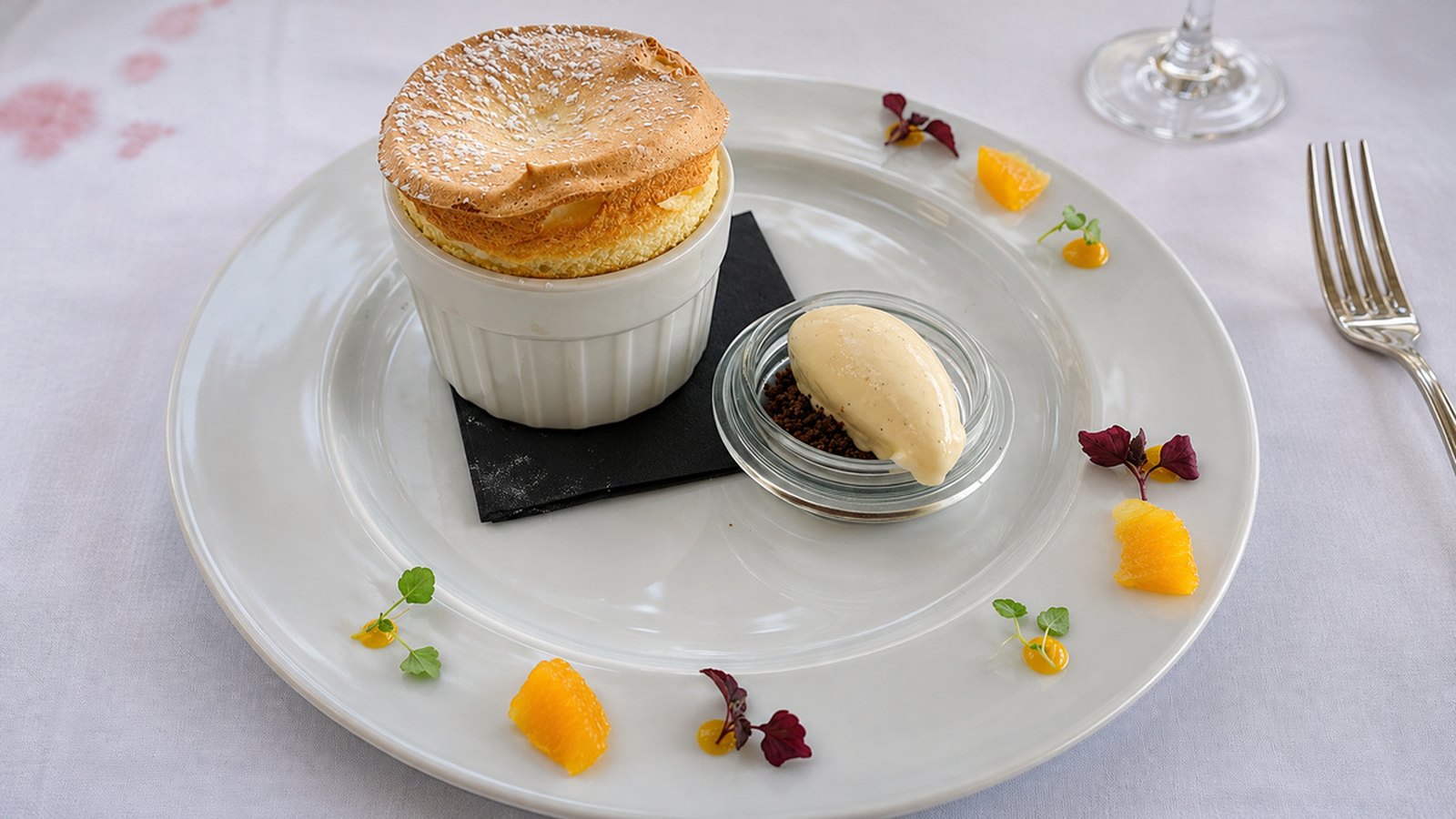
Kirsch soufflé is a hot dessert made from a pastry cream flavoured with kirsch and vanilla, lightened with whisked egg whites and baked for 12 to 15 minutes at 200 °C in ramekins. It is served the second it comes out of the oven. Kirsch, the cherry brandy, is one of the great fruit brandies of Alsace.
Baking: 12 to 15 minutes
Makes about 6 ramekins
Ingredients
- 4 egg whites
- 3 egg yolks
- 120 g sugar (60 g for the cream, 60 g for the egg whites)
- 30 g plain flour
- 250 ml milk
- 50 ml kirsch
- 1 teaspoon vanilla extract
- 1 pinch of salt
- Icing sugar to finish
- Butter and sugar for the ramekins
Method
- Bring the milk to a simmer. Whisk the egg yolks with 60 g of sugar until pale, then add the flour.
- Pour a little of the hot milk over this mixture to temper it, then the rest, stirring all the time. Return to the pan and cook over a low heat until thickened.
- Off the heat, add the kirsch and vanilla, then leave the cream to cool.
- Whisk the egg whites with the pinch of salt, gradually adding the rest of the sugar, until they form stiff peaks.
- Fold a third of the egg whites into the cooled cream first, then the rest, gently, with a spatula.
- Butter and sugar some ramekins or a soufflé dish, and fill them three-quarters full.
- Bake for 12 to 15 minutes in the oven preheated to 200 °C without opening the door. Dust with icing sugar and serve immediately.
My tip: make the pastry cream in advance and keep it in the fridge. When it is time to eat, all you have to do is whisk the egg whites, fold them in and put the soufflés in the oven while your guests finish the main course.
How to make a successful soufflé
A soufflé rises because the water it contains turns into steam in the oven and swells the air bubbles in the egg whites. Three things matter. Egg whites that are firm but not grainy, whisked in a clean, dry bowl. Gentle folding, lifting the mixture with a spatula so as not to knock the air out. Ramekins well buttered and sugared right up to the rim, so that the mixture grips the sides and rises straight.
While it bakes, the door stays shut: a draught of cold air will make it collapse. The soufflé is done when it has formed a golden crust and the centre still wobbles without being runny. It does not like to wait: time things so that it reaches the table straight out of the oven.
Origins
The soufflé is an invention of French cuisine. As early as the 1720s, the cook Massialot described a “crème soufflée de blancs d’œufs” (a cream puffed up with egg whites), and Antoine Beauvilliers, sometimes presented as its inventor, published savoury soufflés in 1814. Classic sweet soufflés are flavoured with spirits and liqueurs, such as Grand Marnier, Cointreau or rum.
Here, the kirsch adds the Alsatian touch. This brandy, made by fermenting and then distilling whole cherries, is produced in Alsace, Lorraine and Franche-Comté, as well as in Germany and Switzerland. Kirsch d’Alsace is recognised as a geographical indication: its cherries come from orchards in the region. It also turns up in kougelhopf, which is flavoured with kirsch or rum.
In the Northern Vosges, the traditional standard-tree orchards around the villages are part of the heritage the Park protects, together with local fruit-growers’ associations. Yet no source makes kirsch soufflé a speciality specific to northern Alsace or the Pays de Bitche: it is a classic of French cuisine, flavoured with the region’s brandy.
What to serve it with
The soufflé needs nothing else. To go with it, a scoop of vanilla ice cream or a few cherries in syrup echo the fruit of the kirsch.
As for wine, a dessert made with eggs and cream pairs with a late-harvest Gewurztraminer. For more freshness, choose a Crémant d’Alsace: the cooperative cellar of the Cleebourg vineyards, near Wissembourg, makes several. Avoid serving extra kirsch: the dessert already contains some.
Where to try it
A soufflé does not travel: it is eaten at home or in a restaurant, straight out of the oven, and you won’t find one in a shop window. For an outing, look to the cherry instead. On the edge of the Park, some fifteen kilometres from Saverne, the village of Westhoffen calls itself the cherry capital of Alsace: every June it holds a cherry festival, and it maintains a conservation orchard of many varieties, which you can reach on foot through the vineyards. Check the dates with the village and in the village festivals calendar.
Find more Alsatian and Lorraine desserts in the Recipes section.
Good to know
Expected crowds this week: usual, busier at the weekend
In the Northern Vosges
- 25 December Christmas Day, public holiday in France (long weekend)
- 26 December St Stephen’s Day (Alsace-Moselle), public holiday in France
- 1 January New Year's Day, public holiday in France (long weekend)
- 20 December – 3 January French school holidays
Back home: the Netherlands
- 25 December Christmas Day
- 26 December St. Stephen's Day
- 19 December – 3 January Christmas Holidays
- 13 February – 21 March Spring Holidays (depending on region)
Getting here
- From Belgium and the Netherlands by car: via Luxembourg and Metz, or via Germany towards Karlsruhe and Wissembourg.
- By train: high-speed trains to Strasbourg (via Paris) or to Karlsruhe (via Germany), then regional trains.
- On site: a car is the easiest way to get around.
Holidays: Nager.Date and OpenHolidays.