Schneckekueche, the Alsatian snail cake: the recipe
Schneckekueche is a brioche dough rolled into snails, filled with butter, sugar and cinnamon and baked packed tightly in a tin. The “chinois” of Alsace and Moselle bakeries, to make at home.

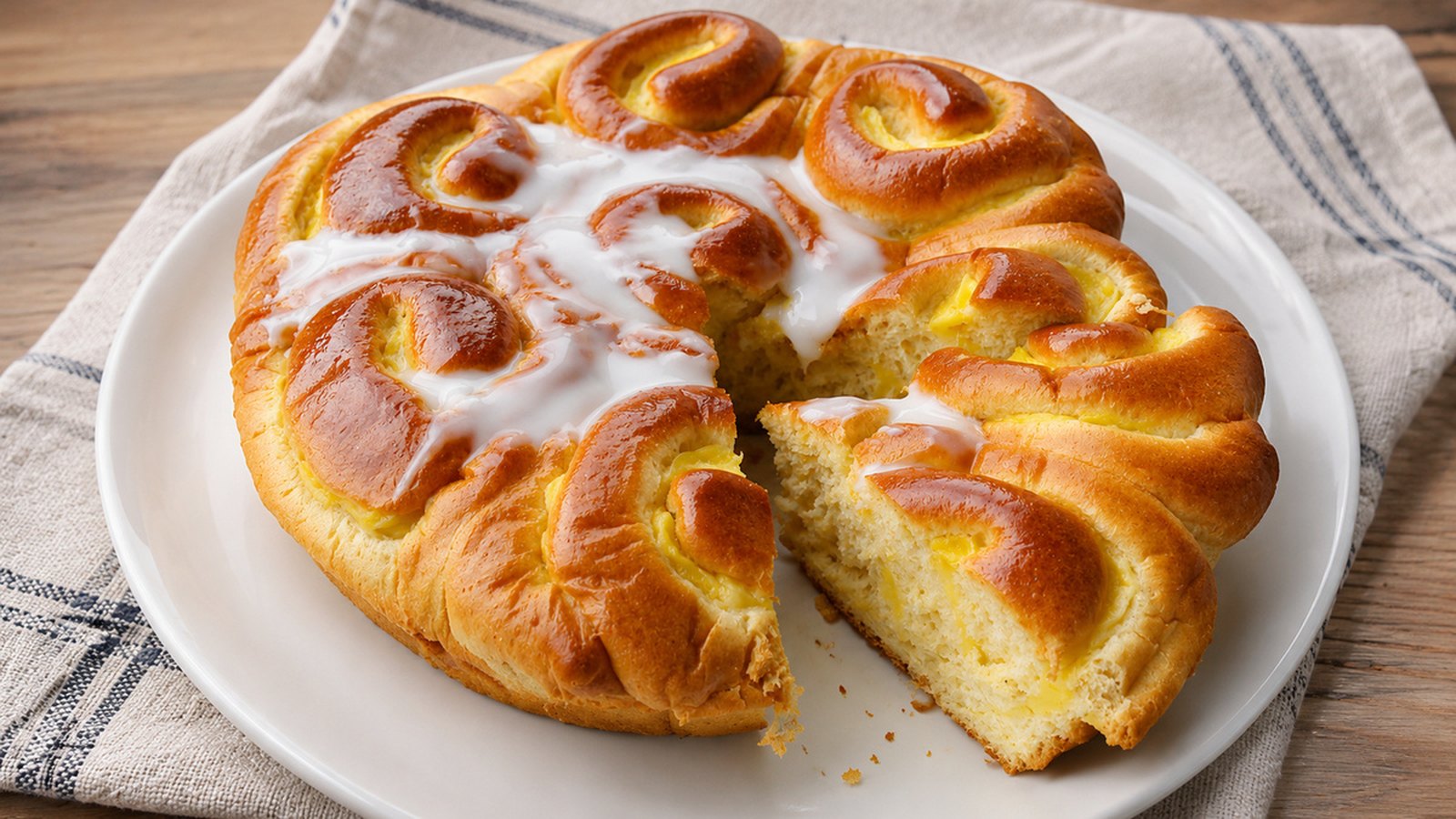
Schneckekueche, or “snail cake”, is a brioche dough rolled into spirals and baked packed tightly in a tin: each slice forms a snail, and together they make a cake to share. This version, filled with butter, sugar and cinnamon, bakes for 25 to 30 minutes at 180 °C after two provings. In bakeries in Alsace and Moselle alike, it is often sold as a “chinois”.
Resting: 1 hr 40 min (including proving)
Baking: 25 to 30 minutes
Ingredients
- 500 g plain flour
- 20 g fresh yeast
- 250 ml lukewarm milk
- 100 g sugar
- 100 g melted butter
- 2 eggs
- 1 pinch of salt
- For the filling: 150 g softened butter
- For the filling: 150 g sugar
- For the filling: 2 tablespoons cinnamon
- For the filling: 50 g raisins (optional)
Method
- Dissolve the yeast in the lukewarm milk with a spoonful of sugar and leave for about ten minutes.
- Mix the flour, salt and the rest of the sugar. Add the yeast mixture, the beaten eggs and the melted butter, then knead until the dough is smooth and supple.
- Cover with a cloth and leave to rise for about an hour, until the dough has doubled in size.
- Mix the softened butter, sugar and cinnamon, adding the raisins if you like.
- Roll the dough out into a rectangle on a floured surface and spread it with the filling. Roll it up into a log, then cut it into slices about 3 cm thick.
- Arrange the slices in a buttered tin, not too tightly, and leave to rise for 30 minutes. Preheat the oven to 180 °C.
- Bake for 25 to 30 minutes, until the snails are golden.
My tip: leave a small gap between the slices. During the second proving and then in the oven, they swell and join together: you get a single cake, which is pulled apart snail by snail when serving.
Origins
Schneckekueche is a brioche-dough pastry associated with Germany, Alsace and Moselle, with no way of deciding between the three. Its name describes its shape: Schnecke means snail, Kueche cake. In German, it is Schneckenkuchen. In the Pays de Bitche and the rest of German-speaking Moselle, where Rhine Franconian is spoken, it is called Schnèggekùùche.
In France, the same cake is known as a “chinois”. According to the linguist Pierre Rézeau, the word comes from “chinois”, small candied bitter oranges that appeared in an 1895 recipe; the story of an importer who failed to understand the German name is not backed by any source. The most widespread version is filled with crème pâtissière (pastry cream). Raisins and cinnamon are variations: this recipe gives the cinnamon version, which is simpler to make at home.
Variations
Replace the filling with a layer of pastry cream sprinkled with raisins to recreate the bakery chinois. Chopped walnuts make a good substitute for the raisins. To finish, an icing of icing sugar mixed with a little water or lemon juice, poured over the cake while still warm, gives a glossy finish.
Sweet yeast dough is the base of several Alsatian treats: kougelhopf, baked in its fluted mould, or Dampfnudle, served with a quetsch plum compote.
What to serve it with
Schneckekueche is eaten at breakfast or as an afternoon snack, warm or on the day it is baked, with a coffee, a tea or a hot chocolate.
Served as a dessert, it calls for a sweet Alsace white: a late-harvest (vendanges tardives) Gewurztraminer, with its spicy aromas, goes well with the cinnamon. The cooperative cellar of the Cleebourg vineyards, in northern Alsace near Wissembourg, produces Gewurztraminer and late-harvest wines.
Where to try it
Bakeries and pâtisseries in Alsace and Moselle sell this cake, often under the name chinois and in its pastry-cream version. If you see one filled with raisins or flavoured with cinnamon, it is a direct cousin of the recipe above. To try it during your stay, the simplest option is to stop at the village bakery in the morning.
For other classics of Alsatian and Lorraine baking, see the Recipes section.
Good to know
Expected crowds this week: usual, busier at the weekend
In the Northern Vosges
- 25 December Christmas Day, public holiday in France (long weekend)
- 26 December St Stephen’s Day (Alsace-Moselle), public holiday in France
- 1 January New Year's Day, public holiday in France (long weekend)
- 20 December – 3 January French school holidays
Back home: the Netherlands
- 25 December Christmas Day
- 26 December St. Stephen's Day
- 19 December – 3 January Christmas Holidays
- 13 February – 21 March Spring Holidays (depending on region)
Getting here
- From Belgium and the Netherlands by car: via Luxembourg and Metz, or via Germany towards Karlsruhe and Wissembourg.
- By train: high-speed trains to Strasbourg (via Paris) or to Karlsruhe (via Germany), then regional trains.
- On site: a car is the easiest way to get around.
Holidays: Nager.Date and OpenHolidays.