Alsatian quetsch plum tart: the recipe
Alsatian quetsch plum tart: sweet shortcrust pastry, halved quetsch plums packed tightly on a thin layer of ground almonds, 35 to 40 minutes in the oven. The September dessert of Alsace and Lorraine.

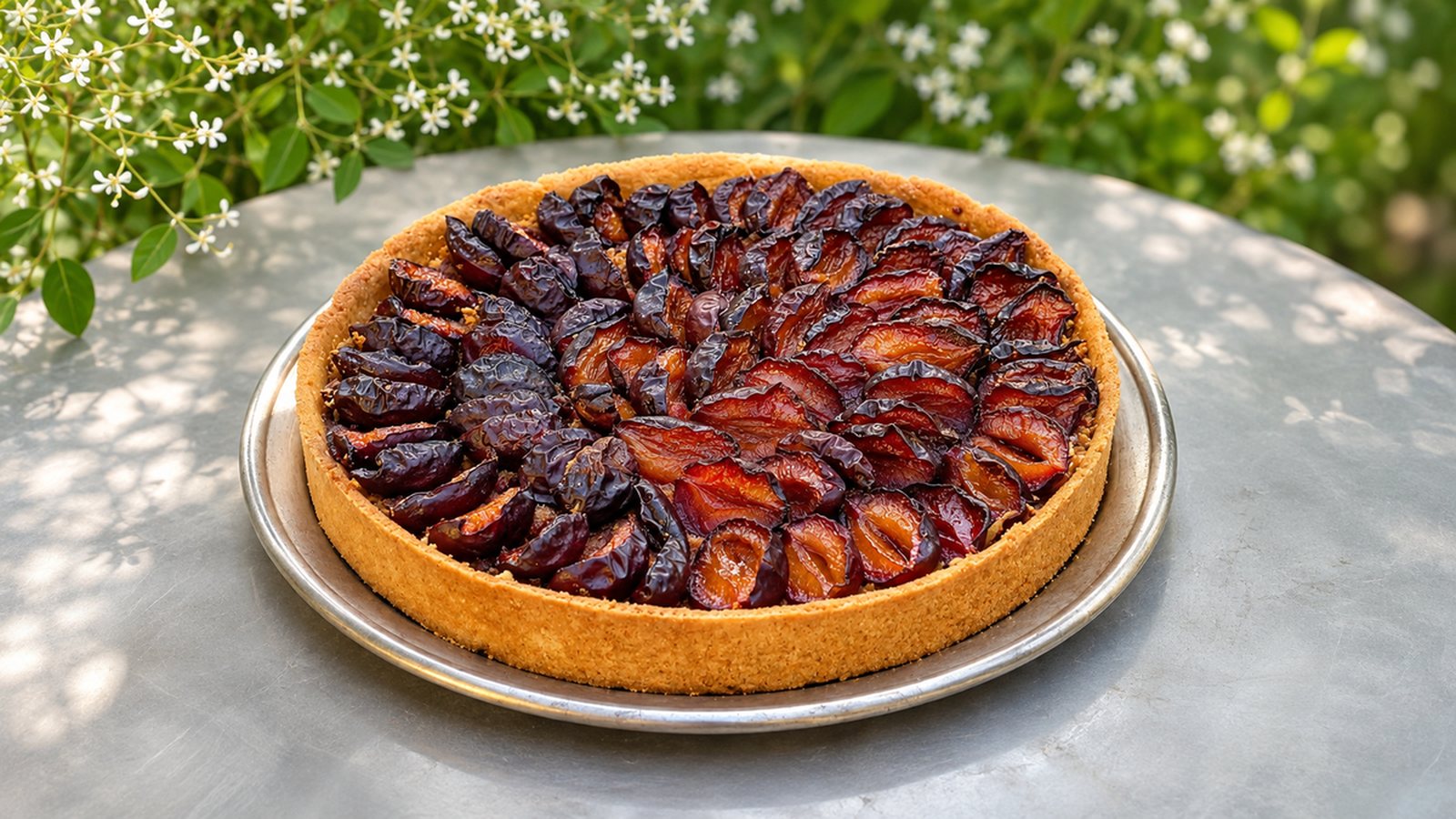
Alsatian quetsch plum tart is sweet shortcrust pastry topped with halved quetsch plums packed tightly together on a thin layer of ground almonds, baked for 35 to 40 minutes at 180 °C. It is made from late summer to October, when the quetsches are ripe. In the Northern Vosges, on the Bas-Rhin side as well as the Moselle side, it is the seasonal cake par excellence.
Preparation: 30 minutes
Resting: 30 minutes
Baking: 35 to 40 minutes
Serves 6
Ingredients
- 500 g quetsch plums, very ripe and juicy
- 200 g plain flour
- 100 g caster sugar (50 g for the pastry, the rest for the fruit)
- 100 g butter
- 1 egg
- 1 pinch of salt
- 2 tablespoons ground almonds (optional)
- 1 teaspoon cinnamon (optional)
Method
- Sift the flour, add 50 g of sugar and the salt, then rub in the butter pieces with your fingertips.
- Add the egg and mix without overworking. Shape into a ball, wrap in cling film and leave to rest in the fridge for at least 30 minutes.
- Wash the quetsches, cut them in half and remove the stones.
- Roll the pastry out to 3–4 mm and line a buttered and floured tin with it. Trim off the excess and prick the base with a fork.
- Sprinkle the base with ground almonds. Arrange the plum halves tightly in concentric circles, cut side up.
- Dust lightly with sugar and, if you like, with cinnamon.
- Bake for 35 to 40 minutes in the oven preheated to 180 °C (gas mark 4), until the pastry is golden. If the edges brown too quickly, cover them with a strip of foil.
- Leave to cool slightly before removing from the tin. Serve warm or cold.
My tip: don’t skip the ground almonds. They soak up the fruit juice during baking and keep the base crisp. Failing that, a spoonful of breadcrumbs does the same job.
Which quetsches to choose?
The quetsch is an oval plum (Prunus domestica) with a blue-violet skin covered in a fine bloom and orange flesh. Its taste balances sweetness and acidity, which means it holds up to baking without turning bland. Choose ripe fruit that gives slightly under your finger but is not soft: too firm, it stays sour; too ripe, it releases a lot of juice.
They are harvested mainly in September and October. Out of season, frozen stoned quetsches will do: put them on the pastry while still frozen and bake a few minutes longer, keeping an eye on the colour.
Origins
Quetsch plum tart is a speciality of eastern France. Alsace and Lorraine are the two great quetsch regions, where the fruit is also used for jams, compotes and brandy. The fruit’s name is often linked to the city of Damascus, but this origin is still debated. Across the Rhine, the same family of tarts is called Zwetschgenkuchen, and Zwetschgendatschi in Bavaria.
The Northern Vosges Regional Nature Park straddles both regions: the tart is made in the villages of the Bas-Rhin just as much as in the Pays de Bitche, in Moselle. The traditional standard-tree orchards around the villages are part of the heritage the Park protects, together with local fruit-growers’ associations. Quetsches also go into other desserts of the region, such as Dampfnudle with quetsch plum compote.
Variations
In Alsace, some families pour a migaine (eggs beaten with cream and sugar) over the fruit halfway through baking. Others replace the shortcrust with a yeast dough, closer to the German cake. The recipe above sticks to the simplest version, where the fruit takes centre stage. The same pastry is used for Alsatian apple tart, the other autumn tart.
What to serve it with
Warm, the tart needs nothing else. A spoonful of crème fraîche or a scoop of vanilla or cinnamon ice cream softens the acidity of the fruit.
As for wine, a sweet Alsace white goes well with cooked fruit: a late-harvest Gewurztraminer or Pinot Gris. These two grape varieties are grown at the very north of Alsace, in the Cleebourg vineyards, near Wissembourg. If you prefer beer, a not-too-bitter amber ale goes well with the cinnamon. In the afternoon, a coffee or a black tea is all you need.
Where to try it
From late summer into autumn, quetsch plum tart returns to the windows of bakeries and pâtisseries, and to the tables of village festivals. Further south in the Bas-Rhin, the village of Wittisheim, in the Ried, holds a traditional festival in its honour in mid-September: check the date with the village.
To find a foodie outing during your stay, check the village festivals calendar, and see the Recipes section for other classics of Alsatian and Lorraine cooking.
Good to know
Expected crowds this week: usual, busier at the weekend
In the Northern Vosges
- 25 December Christmas Day, public holiday in France (long weekend)
- 26 December St Stephen’s Day (Alsace-Moselle), public holiday in France
- 1 January New Year's Day, public holiday in France (long weekend)
- 20 December – 3 January French school holidays
Back home: the Netherlands
- 25 December Christmas Day
- 26 December St. Stephen's Day
- 19 December – 3 January Christmas Holidays
- 13 February – 21 March Spring Holidays (depending on region)
Getting here
- From Belgium and the Netherlands by car: via Luxembourg and Metz, or via Germany towards Karlsruhe and Wissembourg.
- By train: high-speed trains to Strasbourg (via Paris) or to Karlsruhe (via Germany), then regional trains.
- On site: a car is the easiest way to get around.
Holidays: Nager.Date and OpenHolidays.