Alsatian Potato Cakes (Grumbeerekiechle): the Recipe
Alsatian potato cakes, or grumbeerekiechle: grated raw potatoes, squeezed dry, bound with egg and flour and fried golden for 3 to 4 minutes on each side.

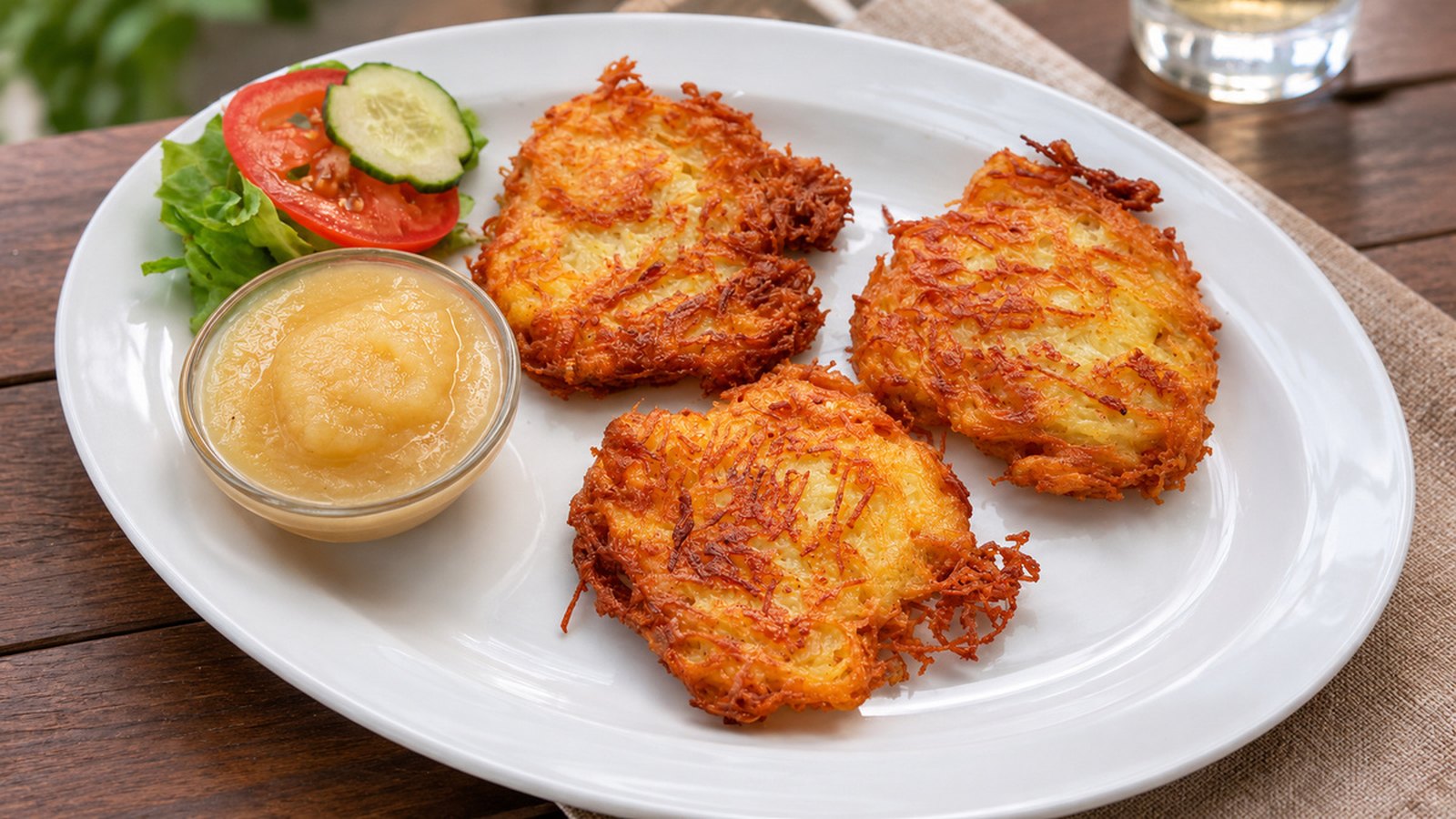
Potato cakes, or grumbeerekiechle in Alsatian, are made from grated raw potatoes, squeezed dry, bound with egg and flour, then fried golden in a pan for 3 to 4 minutes on each side. They are served as a side dish or as a main course with a green salad. They are made on both sides of the Northern Vosges, in the Bas-Rhin as well as in the Moselle.
Cooking: 3 to 4 minutes per side, per batch
Ingredients
- Floury potatoes (Bintje or Agria)
- Eggs
- Flour
- Salt and pepper
- Cooking oil
Method
- Peel the potatoes and grate them on the coarse side of a grater. Then squeeze them firmly by hand, or in a clean tea towel, to remove the excess liquid.
- In a large bowl, mix the grated potatoes with the eggs, flour, salt and pepper until evenly combined.
- Heat the oil well in a large frying pan over a medium heat.
- Drop spoonfuls of the mixture into the hot oil and flatten them slightly with the back of the spoon. Fry for 3 to 4 minutes on each side, until golden and crisp.
My tip: don’t squeeze the potatoes too early, and don’t grate them too far in advance either: they turn dark when exposed to the air. Grate, squeeze, mix and fry straight away. And don’t overcrowd the pan: too many cakes at once lower the temperature of the oil and the cakes soak up the fat.
Which potatoes, and in what proportions?
Floury varieties such as Bintje or Agria give cakes that are soft inside and crisp outside. Their starch helps the mixture hold together.
The recipe gives no fixed quantities: it all depends on how moist the potatoes are. Add the flour gradually: the mixture should hold on the spoon without being dry. The eggs bind it; too many and it becomes runny.
In Alsace, a grated onion and chopped parsley are often added to the mixture. This is the most common variation, worth trying once you have mastered the basic recipe.
Origins
The cake of grated raw potato is a popular dish throughout the Rhineland. In Alsace it is called grumbeerekiechle, literally “little potato cakes”. In German-speaking Moselle, and so in the Pays de Bitche, the local Rhine Franconian dialect calls them grùmbèrrekììschle or grùmbèrreponnkùùche. In Germany they are Reibekuchen or Kartoffelpuffer, and in neighbouring Saarland Grumbeerkichelcher.
Traditionally the cakes were eaten as a main course, or alongside meat or charcuterie. With cooked, mashed potatoes, Alsatian cooking makes another recipe, potato dumplings.
What to serve them with
As a main course, serve them with a well-dressed green salad; in Alsace they are also eaten with soup. As a side dish, they go with roast meat, a sausage or a plate of charcuterie. Some people prefer them sweet, with apple sauce, like German Kartoffelpuffer.
For a full seasonal meal, pair them with a dandelion salad with bacon in spring.
To drink, a dry Alsace white, sylvaner or pinot blanc, goes well with the crispness and richness of the frying. A lager also works.
Where to try them
Potato cakes are mostly home cooking: the surest option is to make them yourself, with potatoes bought from a grower or at a market in the Northern Vosges.
For more potato dishes, browse the Recipes section.
Good to know
Expected crowds this week: usual, busier at the weekend
In the Northern Vosges
- 25 December Christmas Day, public holiday in France (long weekend)
- 26 December St Stephen’s Day (Alsace-Moselle), public holiday in France
- 1 January New Year's Day, public holiday in France (long weekend)
- 20 December – 3 January French school holidays
Back home: the Netherlands
- 25 December Christmas Day
- 26 December St. Stephen's Day
- 19 December – 3 January Christmas Holidays
- 13 February – 21 March Spring Holidays (depending on region)
Getting here
- From Belgium and the Netherlands by car: via Luxembourg and Metz, or via Germany towards Karlsruhe and Wissembourg.
- By train: high-speed trains to Strasbourg (via Paris) or to Karlsruhe (via Germany), then regional trains.
- On site: a car is the easiest way to get around.
Holidays: Nager.Date and OpenHolidays.