
Visiting Hunspach, the Alsace Village of White Houses
In northern Alsace, Hunspach lines up whitewashed half-timbered houses, a world away from the colourful façades of the south. Just nearby, the Schoenenbourg fort tells the story of the Maginot Line.

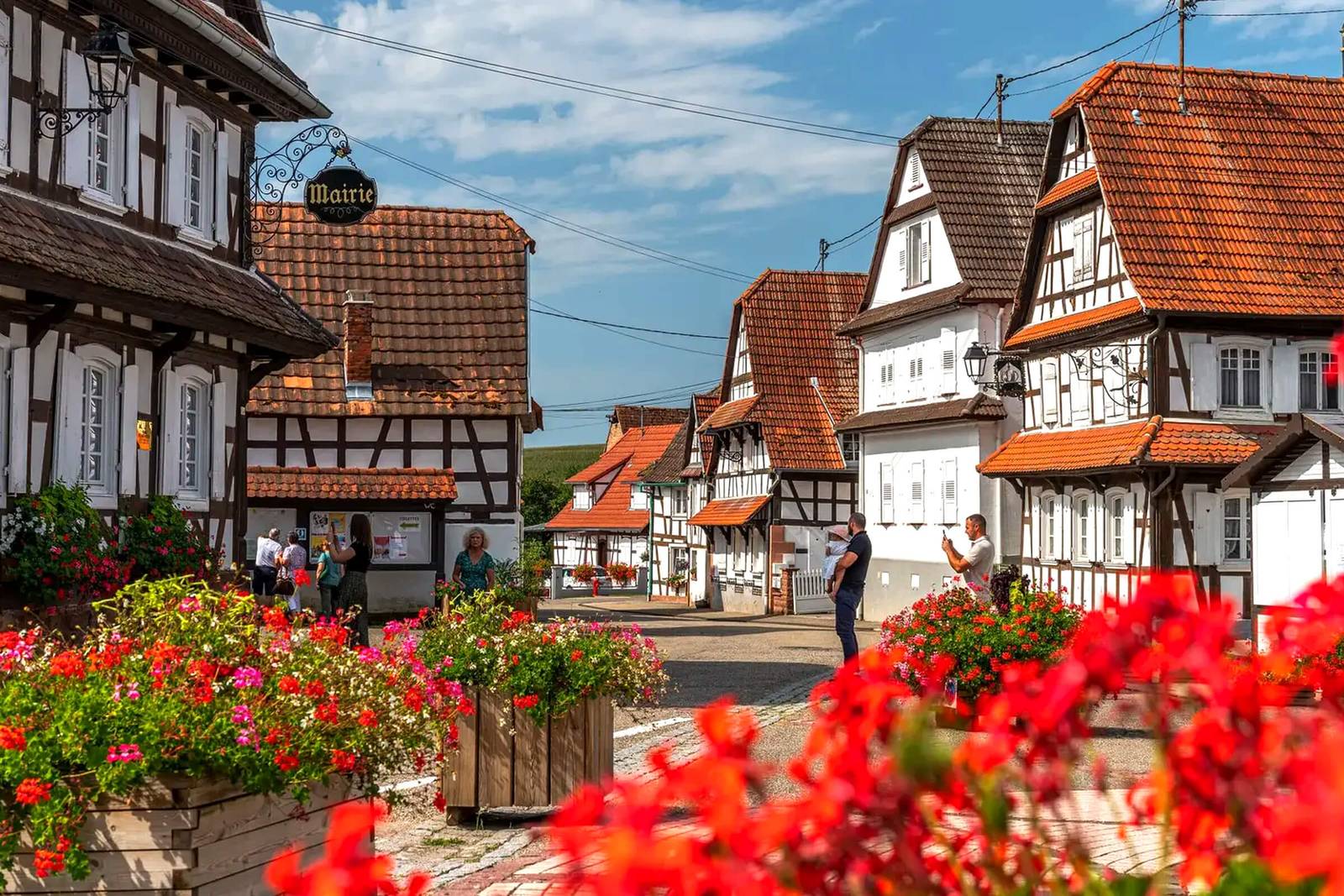
A village of the Outre-Forêt
Hunspach is a typical village of the Outre-Forêt, in northern Alsace, about ten kilometres south of Wissembourg. It has just over 600 inhabitants. It is a member of the Les Plus Beaux Villages de France (Most Beautiful Villages of France) association. In 2020, it was voted “France’s Favourite Village” on Stéphane Bern’s programme on France 3. The result was announced on 1 July, after a vote in which around 700,000 viewers and internet users took part.
The village is first mentioned in 1298. In 1633 it was attacked and destroyed by Imperial troops, then resettled by immigrants from Switzerland.
What gives Hunspach its look
The houses are whitewashed with lime, with half-timbering over wattle and daub and half-hipped roofs. They line flower-filled streets. This whiteness contrasts with the colourful façades of the villages of the Haut-Rhin.
Take a close look at the windows: many have curved panes. Their shape allowed residents to see out without being seen. They also give passers-by a distorted reflection.
The Protestant (Reformed) church was built in 1757. Its neo-Romanesque bell tower dates from 1874 and its organ from 1782.
The real interest lies in the whole rather than in any single house: the rows of white façades, half-timbering and flower gardens form a remarkably uniform village landscape.
Exploring the village
The village is best explored on foot. A self-guided historical trail takes about 45 minutes. The tourist office also offers guided tours by reservation. Parking is free all year round.
- Kelsch’Idée, housed in a former barn, combines a small museum, a second-hand shop and local crafts.
- Food: try the “dicke Kuche”, a brioche, and Fleischknepfle, meatballs, with a regional wine.
- Festivals: a folk festival takes place in August, and an old-fashioned Christmas market at the end of the year, in late November or December depending on the year. During the festive season, windows decorated on the theme of Christmas traditions form a trail through the village; the map is available at the tourist office.
My tip: come early in the morning or late in the day. The low light brings out the half-timbering, and the streets are quieter. Please be discreet: these are people’s homes, not a film set.
Schoenenbourg fort: the Maginot Line beneath your feet
Between Hunspach and Ingolsheim, the Schoenenbourg fort is the largest Maginot Line fortification open to the public in Alsace. Built in the 1930s, it comprises combat blocks, barracks and more than 3 km of galleries, 18 to 30 metres underground. In June 1940 it was never captured: its garrison surrendered only six days after the armistice.
The tour shows the daily life of soldiers underground, from the barracks to the combat blocks. It makes a good complement to a walk round the village: within a few kilometres you go from half-timbered houses to 20th-century military architecture. Allow at least two hours for the underground tour, and bring a jacket: it is 12 °C in the galleries. The fort has its own opening hours and prices. In winter it opens to individual visitors only on certain days, mainly at weekends and during the end-of-year holidays, so check its calendar before you come.
With children
The village trail is short and suits little legs. Turn it into a game: look for the curved windowpanes together, count them street by street and watch your distorted reflections. Kelsch’Idée, with its mix of museum and second-hand shop, also appeals to curious children. For older children, the Schoenenbourg fort often makes a bigger impression: the galleries and barracks fire the imagination.
Practical information
The Hunspach branch of the Alsace Verte tourist office is on route de Hoffen. It is open all year: daily from July to September, and Tuesday to Saturday or Friday the rest of the year, apart from a few exceptional closures. Wissembourg is about ten kilometres away. The visit combines easily with Lembach and Fleckenstein Castle, around fifteen kilometres away.
By train, Hunspach halt is no longer served. The nearest stop is Hoffen, on the Strasbourg – Wissembourg line, less than 3 km from the village centre as the crow flies.
For a guided tour of the village, book with the Alsace Verte tourist office (+33 3 88 80 89 70). At the end of the year, check the dates of the old-fashioned Christmas market, which change from year to year. The Schoenenbourg fort is on rue du Commandant-Martial-Reynier, on the way out of the village towards Ingolsheim.
A typical day: in the morning, the village and its historical trail; at lunchtime, a local restaurant; in the afternoon, the Schoenenbourg fort. If you still have energy left, carry on to Lembach for a second Maginot Line fortification, the Four-à-Chaux, which can only be visited with a guide.
Good to know
Expected crowds this week: usual, busier at the weekend
In the Northern Vosges
- 25 December Christmas Day, public holiday in France (long weekend)
- 26 December St Stephen’s Day (Alsace-Moselle), public holiday in France
- 1 January New Year's Day, public holiday in France (long weekend)
- 20 December – 3 January French school holidays
Back home: the Netherlands
- 25 December Christmas Day
- 26 December St. Stephen's Day
- 19 December – 3 January Christmas Holidays
- 13 February – 21 March Spring Holidays (depending on region)
Getting here
- From Belgium and the Netherlands by car: via Luxembourg and Metz, or via Germany towards Karlsruhe and Wissembourg.
- By train: high-speed trains to Strasbourg (via Paris) or to Karlsruhe (via Germany), then regional trains.
- On site: a car is the easiest way to get around.
Holidays: Nager.Date and OpenHolidays.