Alsace asparagus with parsley butter: the recipe
Alsace asparagus with parsley butter: peeled white asparagus cooked for 10 to 15 minutes in salted water, with lemon and parsley butter. The spring recipe, from April to mid-June.

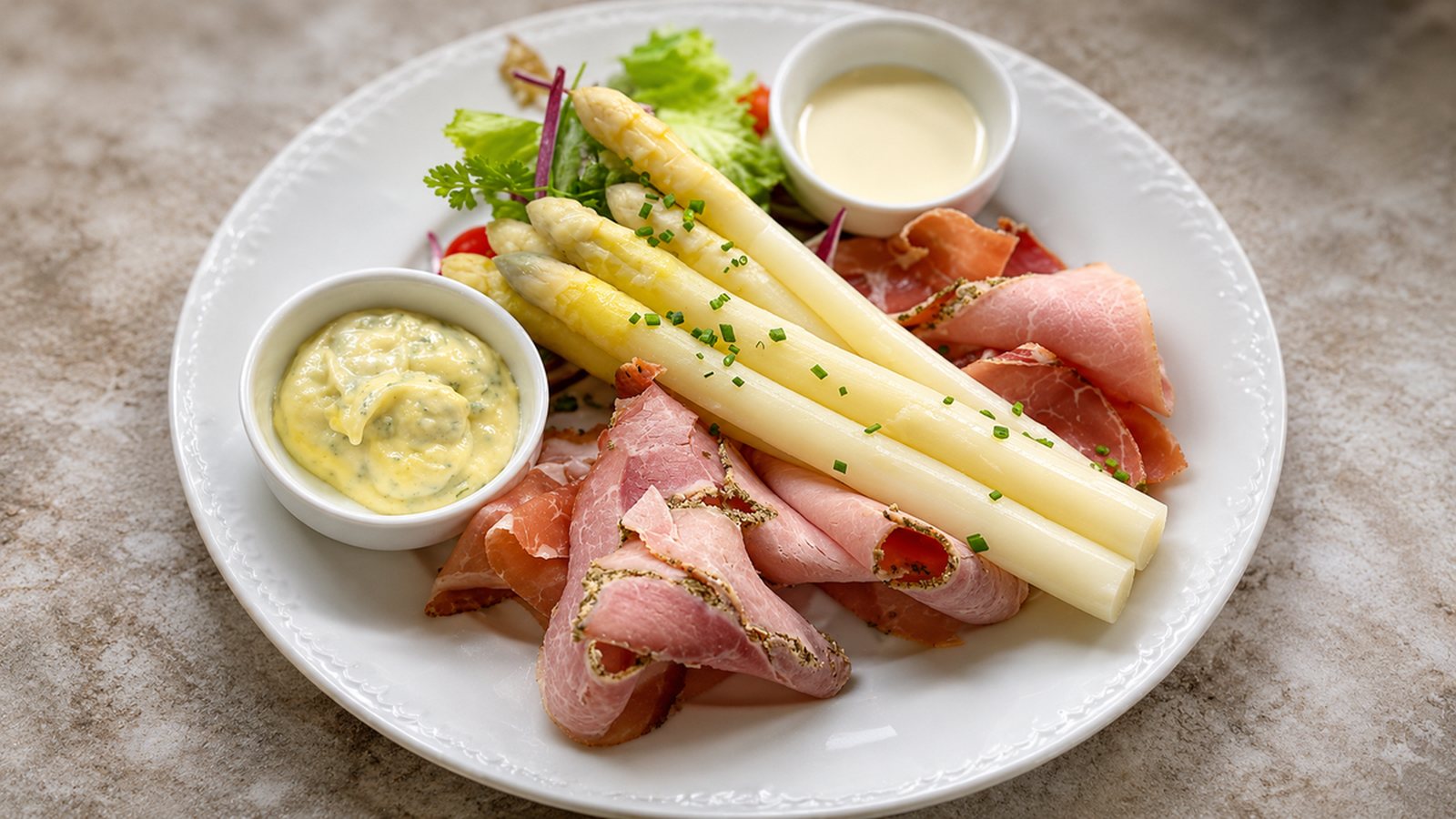
Alsace asparagus with parsley butter is the simplest way to serve white spring asparagus: peeled, cooked for about ten minutes in salted water, sprinkled with lemon and topped with parsley butter. The season runs from April to mid-June. In northern Alsace, people buy it direct from the growers of the Ried, south of Haguenau.
Preparation: 20 minutes
Cooking: 10 to 15 minutes
Serves 4 as a starter
Ingredients
- 1 kg Alsace asparagus
- 2 tablespoons butter
- 1 bunch of fresh parsley
- Juice of 1 lemon
- Salt and pepper
Method
- Wash the asparagus. Peel it with a vegetable peeler from 2 cm below the tip down to the base, taking care not to damage the head: white asparagus is peeled along the whole stem, green only at the base. Cut 1–2 cm off the woody end.
- Put the spears in a large pan of boiling salted water and allow about 10 minutes, up to 15 minutes for the thickest: the tip of a knife should slide into the stem without resistance while the asparagus stays firm.
- Meanwhile, melt the butter in a frying pan over a medium heat and gently fry the finely chopped parsley for a few minutes.
- Drain the asparagus carefully and arrange it on a serving dish. Sprinkle with lemon juice, then spoon over the parsley butter.
- Season with salt and pepper and serve straight away.
My tip: keep the peelings and trimmed ends. Simmered for twenty minutes in the asparagus cooking water, they make a fragrant stock for a soup or risotto the next day.
How to choose and store asparagus
Choose firm, smooth, glossy spears with tightly closed tips. A dry or split base shows that the asparagus was picked several days ago. Buy spears of similar thickness so they cook together.
Asparagus should be eaten as soon as possible after harvesting. If you have to wait, wrap it in a damp tea towel and keep it in the vegetable drawer of the fridge for two to three days at most.
Origins
Alsace asparagus is mainly white: it grows under mounds of earth and is harvested before the tip emerges into the light. Growing it took off in the late 19th century around Hoerdt, in the Ried north of Strasbourg. Its introduction is credited to the pastor Louis Gustave Heyler, who had seen it grown in Algeria and found favourable ground in the sandy soils of Hoerdt. The village adopted it as its emblem and is now home to an asparagus museum.
Since 1991, a growers’ association has promoted Alsace asparagus. Its members, in the Bas-Rhin and Haut-Rhin, farm around 350 hectares and produce most of Alsace’s white asparagus, the bulk of it sold direct, at the farm or at markets.
Across the border, at the foot of the Palatinate Forest, the Palatinate is also asparagus country (Spargel): the season there traditionally ends on St John’s Day, 24 June.
What to serve it with
Alsatian tradition serves asparagus as a full meal, with new potatoes, ham and three sauces: mayonnaise, vinaigrette and hollandaise. The parsley butter in this recipe is the light version. For a more substantial meal, add a few slices of ham and an Alsatian potato salad.
As for wine, a dry Alsace Muscat is the classic pairing: its fruit and aroma stand up to the bitterness of the asparagus. A Sylvaner or Pinot Blanc also works. The Cleebourg vineyards, in the north of Alsace, produce a Muscat and a Sylvaner.
Where to try it
From April to mid-June, white asparagus appears on the stalls of the markets and at farms that sell direct. The growers’ association website has a map to help you find them. Further south, outside the Park, Hoerdt traditionally holds an asparagus festival in May: check the date with the local council.
For more seasonal ideas, browse the Recipes section.
Good to know
Expected crowds this week: usual, busier at the weekend
In the Northern Vosges
- 25 December Christmas Day, public holiday in France (long weekend)
- 26 December St Stephen’s Day (Alsace-Moselle), public holiday in France
- 1 January New Year's Day, public holiday in France (long weekend)
- 20 December – 3 January French school holidays
Back home: the Netherlands
- 25 December Christmas Day
- 26 December St. Stephen's Day
- 19 December – 3 January Christmas Holidays
- 13 February – 21 March Spring Holidays (depending on region)
Getting here
- From Belgium and the Netherlands by car: via Luxembourg and Metz, or via Germany towards Karlsruhe and Wissembourg.
- By train: high-speed trains to Strasbourg (via Paris) or to Karlsruhe (via Germany), then regional trains.
- On site: a car is the easiest way to get around.
Holidays: Nager.Date and OpenHolidays.