Munster Fondue: Recipe and Origins
Munster fondue: 500 g of Munster melted in dry white wine, thickened with cornflour, seasoned with nutmeg and served in a caquelon with day-old bread. A winter dish for four.

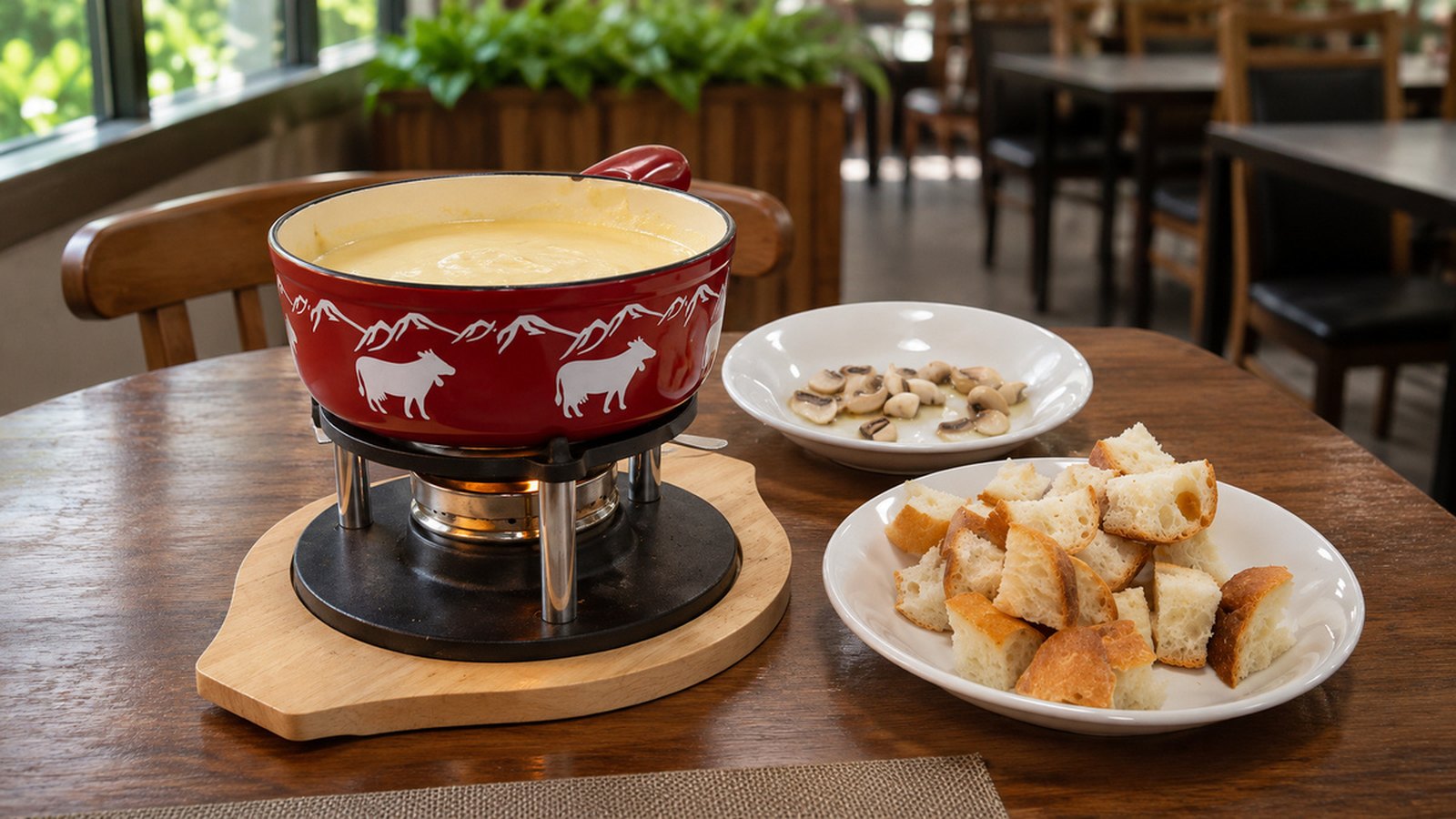
Munster fondue is cheese fondue made with the cheese of the Vosges: Munster melted in a little dry white wine, thickened with cornflour (cornstarch), seasoned with nutmeg and served in a caquelon (fondue pot) with cubes of bread. A winter dish for four to share, with the burner in the middle of the table. Munster is made on both sides of the Vosges mountains, including part of the Northern Vosges.
Serves 4
Ingredients
- 500 g Munster
- 150 ml dry white wine
- 1 tablespoon cornflour (cornstarch)
- 2 garlic cloves
- 1 pinch of nutmeg
- Pepper
- Country bread or day-old baguette, in small cubes
Method
- Cut the Munster into small pieces.
- Rub the inside of the caquelon with a garlic clove cut in half.
- Pour the white wine into the caquelon and bring it to the boil over a medium heat.
- Add the Munster a handful at a time, stirring constantly with a wooden spoon, until the mixture is smooth.
- Add the cornflour mixed with a little white wine, then the nutmeg and pepper. Stir well.
- Keep the fondue at a steady temperature on a burner and serve with the cubes of bread.
My tip: keep the burner on a low flame throughout the meal and stir from time to time. Too hot and the cheese separates and turns oily; too cool and it sets. If the fondue thickens, loosen it with a splash of white wine.
Which Munster to choose?
Munster, or Munster-Géromé, has been a protected designation of origin since 1969, and protected at European level (PDO) since 1996. It is a soft cow’s-milk cheese with a washed rind, ranging in colour from ivory-orange to orange-red. Its smell is powerful, but the paste stays mild, with notes of milk, hay and nuts. It is matured for at least 21 days, or 14 days for the small size. Some are sprinkled with caraway seeds.
For fondue, pick a ripe Munster that gives slightly under your finger. With the rind, the fondue is stronger; without it, milder. Choose according to your guests.
Origins
Cheese fondue comes from Switzerland. The oldest written recipe resembling it, “Käss mit Wein zu kochen” (to cook cheese with wine), appears in a Zurich manuscript from 1699. Rubbing the pot with garlic and adding starch to stabilise the mixture both come from that tradition. Munster fondue is a recent regional variation: no source describes it as an old Alsatian recipe.
The cheese itself has a long history. Its origins are linked to the abbeys founded on the edges of the Vosges mountains in the 7th and 8th centuries; the “monasterium” of the Fecht valley gave its name to the town of Munster, in the Haut-Rhin. In Lorraine it was called géromé, after Gérardmer, where it was sold. Through wars and migrations, cheesemaking spread to the foothills and the plain.
The designated area covers parts of seven départements, including the Bas-Rhin and the Moselle. In the Northern Vosges it includes, for example, La Petite-Pierre, Wingen-sur-Moder, Lichtenberg, Ingwiller, Bouxwiller and Cleebourg, and on the Moselle side Phalsbourg, Dabo and Lutzelbourg. The Pays de Bitche is not part of it.
The “Alsatian fondue” variation
Some families mix the Munster with a milder cheese, such as tomme de Savoie, or even a little Gruyère, and add a dash of kirsch along with the nutmeg, as in Swiss fondue. It is then served with steamed potatoes, gherkins, pickled pearl onions and a little charcuterie on the side. The method stays the same: garlic, hot wine, and cheese added gradually while stirring.
What to serve it with
Serve the dry white wine you cooked with. An Alsace riesling, sylvaner or pinot blanc brings the freshness that balances the cheese. These grapes are grown at the very northern tip of Alsace, in the Cleebourg vineyard near Wissembourg. Gewurztraminer, the classic match for Munster on its own, is best kept for the cheeseboard.
For an alcohol-free option, apple juice brings the same acidity. A green salad and a few steamed potatoes make the meal lighter. For another way to serve the cheese hot, try breaded Munster or Munster baeckeoffe.
Where to try it
Munster fondue is mostly a home-cooked dish for cold evenings. The easiest option is to buy a PDO Munster from a cheesemonger or at the market and make it yourself. The markets calendar shows where and when to find one during your stay.
For more Alsatian and Lorraine classics, browse the Recipes section.
FAQ
What is Alsatian fondue?
Alsatian fondue is a cheese fondue made with Munster melted in dry Alsace white wine, thickened with cornflour and seasoned with nutmeg. Some families mix the Munster with tomme de Savoie or a little Gruyère and add a dash of kirsch.
Which Munster should you use for fondue?
Choose a ripe PDO Munster that gives slightly under your finger. With the rind, the fondue is stronger; without it, milder.
Which wine goes with Munster fondue?
Serve the dry white wine you cooked with: an Alsace riesling, sylvaner or pinot blanc, whose freshness balances the cheese. For an alcohol-free option, apple juice brings the same acidity.
What should you do if Munster fondue turns oily or too thick?
Keep the burner low and stir from time to time: too hot and the cheese separates and turns oily; too cool and it sets. If the fondue thickens, loosen it with a splash of white wine.
Is Munster fondue a traditional Alsatian recipe?
No: cheese fondue comes from Switzerland, where a Zurich manuscript from 1699 already describes cheese cooked in wine. Munster fondue is a recent regional variation; it is Munster cheese, a PDO since 1996, that has a long history in the Vosges.
Good to know
Expected crowds this week: usual, busier at the weekend
In the Northern Vosges
- 25 December Christmas Day, public holiday in France (long weekend)
- 26 December St Stephen’s Day (Alsace-Moselle), public holiday in France
- 1 January New Year's Day, public holiday in France (long weekend)
- 20 December – 3 January French school holidays
Back home: the Netherlands
- 25 December Christmas Day
- 26 December St. Stephen's Day
- 19 December – 3 January Christmas Holidays
- 13 February – 21 March Spring Holidays (depending on region)
Getting here
- From Belgium and the Netherlands by car: via Luxembourg and Metz, or via Germany towards Karlsruhe and Wissembourg.
- By train: high-speed trains to Strasbourg (via Paris) or to Karlsruhe (via Germany), then regional trains.
- On site: a car is the easiest way to get around.
Holidays: Nager.Date and OpenHolidays.