Alsatian bretzel (pretzel): a homemade recipe
Homemade Alsatian bretzel (pretzel): a yeast dough knotted into three loops, poached for 30 seconds in bicarbonate water, sprinkled with coarse salt and baked for 12 to 15 minutes at 220 °C.

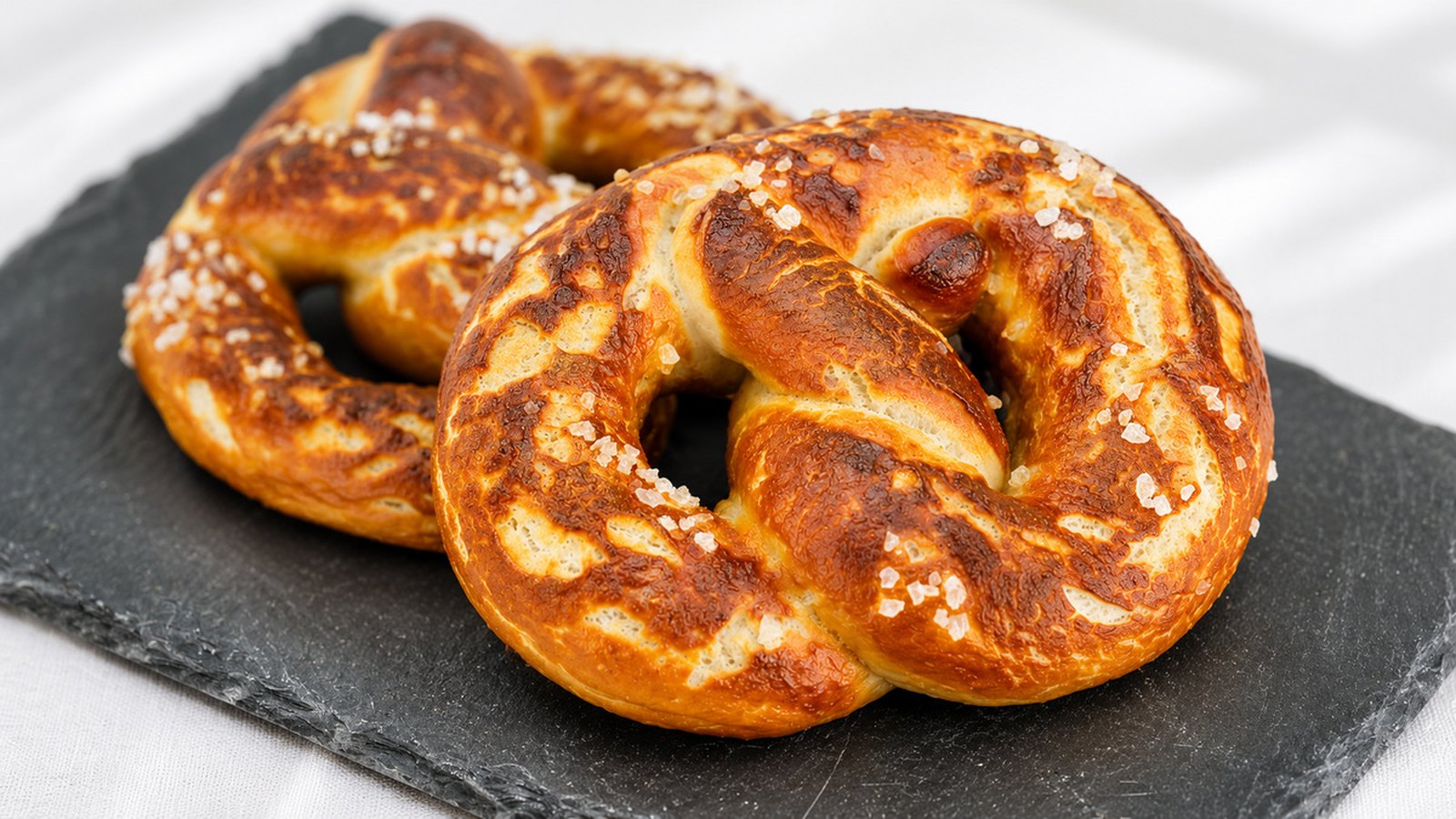
The Alsatian bretzel (pretzel) is a knot-shaped bread with a shiny brown crust, sprinkled with coarse salt. Its secret comes down to one step: a 30-second bath in water with bicarbonate of soda before it goes into the oven. Allow about two hours, rising included, for eight pretzels to eat the same day, with drinks or as an afternoon snack.
Preparation: 40 minutes
Rising: 1 hour
Baking: 12 to 15 minutes
Makes 8 pretzels
Ingredients
- 500 g flour
- 300 ml lukewarm water
- 1 sachet instant dried yeast
- 1 tablespoon sugar
- 1 teaspoon salt
- 2 tablespoons bicarbonate of soda (baking soda)
- Coarse salt for topping
- Melted butter (optional)
Method
- Mix the lukewarm water, sugar and yeast, then leave for about 5 minutes until the mixture is frothy.
- In another bowl, mix the flour and salt. Make a well, pour in the activated yeast and mix until you have a smooth dough.
- Knead for about 10 minutes on a floured surface until the dough is soft and elastic.
- Place the dough in an oiled bowl, cover with a damp tea towel and leave to rise for about 1 hour somewhere warm: it should double in size.
- While the dough is rising, bring 2 litres of water to a simmer and add the 2 tablespoons of bicarbonate of soda.
- Knock back the dough, divide it into 8 pieces and roll each one into a rope about 50 cm long.
- Form a loop, twist the ends together twice, then fold them down, pressing lightly.
- Dip each pretzel in the bicarbonate water for about 30 seconds, lift it out with a slotted spoon to drain and place it on a baking tray lined with baking paper.
- Preheat the oven to 220 °C. Sprinkle the pretzels with coarse salt and bake for 12 to 15 minutes, until nicely golden.
- As they come out of the oven, brush them with melted butter if you like.
My tip: roll each rope a little thicker in the middle than at the ends. The pretzel’s “belly” stays soft while the arms turn crisp. And eat them the same day: pretzels go stale quickly.
Why poach pretzels in bicarbonate water?
This bath is what makes a pretzel. Dough poached in an alkaline solution (Lauge in German, hence the name Laugenbrezel) takes on its mahogany-brown colour, thin shiny crust and distinctive flavour as it bakes. Skip this step and you get a golden bread roll, not a pretzel.
Stick to the 30 seconds: the dough should only firm up on the surface. Drain each piece well before placing it on the tray, then salt it straight away, while the surface is still damp: the coarse salt sticks better.
The same technique is used for mauricettes, small Alsatian rolls that are also poached before going into the oven.
Variations
Before baking, you can replace the coarse salt with sesame or poppy seeds, or a little grated cheese. The plain pretzel with coarse salt remains the classic version.
Origins
The pretzel is a very old bread from the German-speaking world. Its name comes from the German Brezel, itself linked to the Latin bracchium, arm: its shape recalls two crossed arms. It is recorded as early as the 8th century in monastic culture. The Hortus deliciarum, an illuminated manuscript produced in Alsace in the 12th century, already shows one. In Alsatian it is called Bredschdel. It is one of the oldest symbols of Alsace and often appears on bakery signs, here as on the other side of the Rhine.
Northern Alsace lays claim to its legend. Bouxwiller, the former capital of the Counts of Hanau-Lichtenberg, on the edge of the Park, tells how in the 15th century a local baker, condemned for speaking ill of Count Jacques de Lichtenberg’s mistress, was pardoned on one condition: he had to invent a cake through which the sun could be seen three times. The pretzel’s three openings are said to be his answer. The Musée du Pays de Hanau in Bouxwiller even presents the pretzel as originating from this area. An almost identical story is told in Swabia: it is a legend, not proof, and the pretzel’s true origin remains unknown.
What to serve it with
The pretzel is eaten on its own, with drinks or as an afternoon snack, or split in two and spread with butter. It also goes well with cold meats, cheese or a salad. With drinks, it pairs nicely with a savoury kougelhopf with bacon and walnuts cut into cubes.
As for drinks, an Alsatian lager is the simplest match: its freshness balances the coarse salt. For a festive aperitif, serve a crémant d’Alsace. The Cleebourg vineyards, in the far north of Alsace near Wissembourg, produce several.
Where to try it
All year round, in bakeries across the Northern Vosges, on the Bas-Rhin side as well as the Moselle side: it is the region’s savoury snack. You will also find it at village fête stalls and at the Christmas markets during Advent.
For the region’s other savoury and sweet classics, browse the Recipes section.
Good to know
Expected crowds this week: usual, busier at the weekend
In the Northern Vosges
- 25 December Christmas Day, public holiday in France (long weekend)
- 26 December St Stephen’s Day (Alsace-Moselle), public holiday in France
- 1 January New Year's Day, public holiday in France (long weekend)
- 20 December – 3 January French school holidays
Back home: the Netherlands
- 25 December Christmas Day
- 26 December St. Stephen's Day
- 19 December – 3 January Christmas Holidays
- 13 February – 21 March Spring Holidays (depending on region)
Getting here
- From Belgium and the Netherlands by car: via Luxembourg and Metz, or via Germany towards Karlsruhe and Wissembourg.
- By train: high-speed trains to Strasbourg (via Paris) or to Karlsruhe (via Germany), then regional trains.
- On site: a car is the easiest way to get around.
Holidays: Nager.Date and OpenHolidays.