Mauricettes: recipe for Alsatian pretzel-dough rolls
Mauricettes, small Alsatian rolls made from pretzel dough: logs of yeast dough dipped for 30 seconds in a bicarbonate of soda bath, then baked for 15 to 20 minutes at 200 °C.

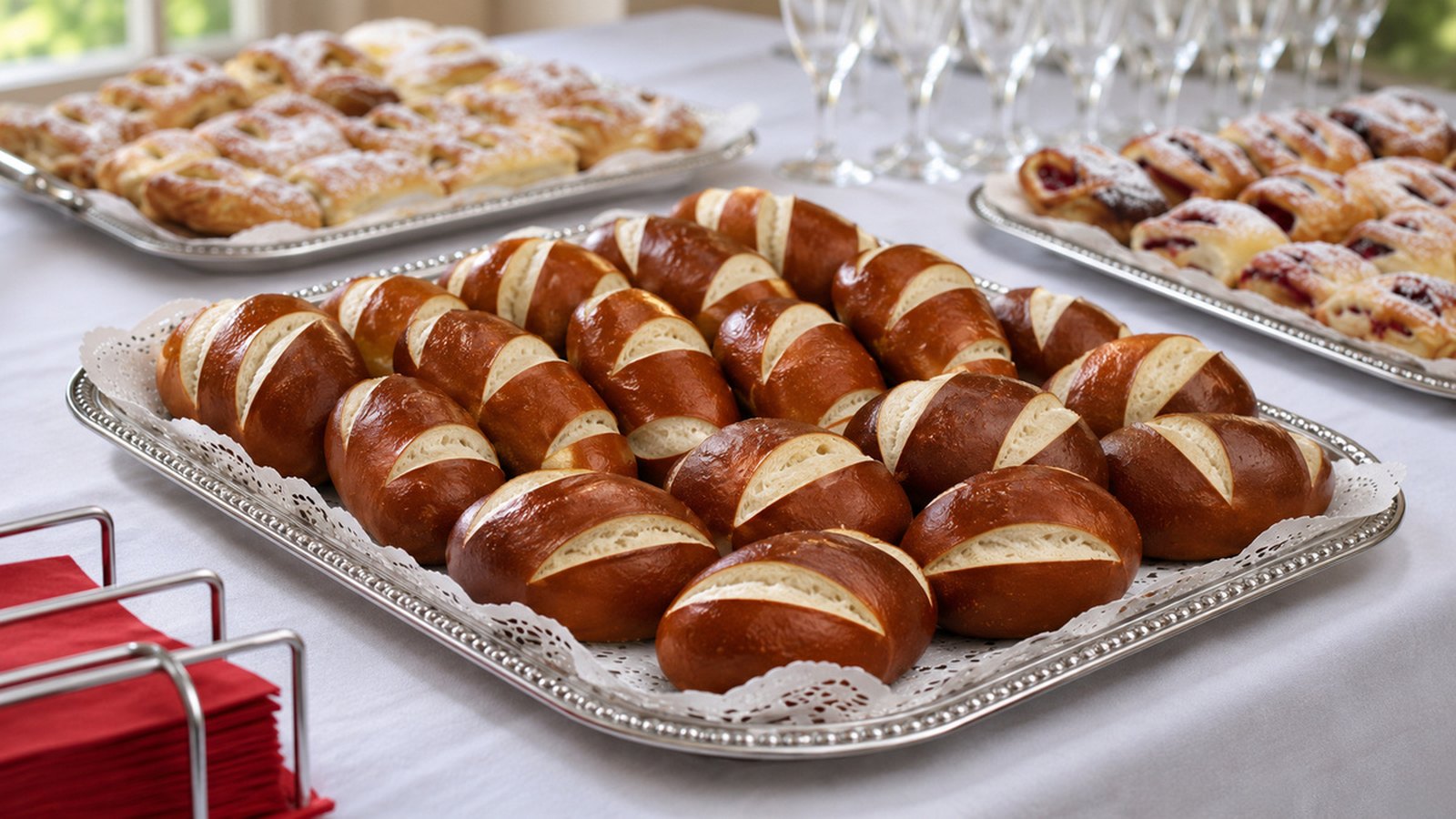
The mauricette is a small Alsatian bread roll made from pretzel dough: a buttery yeast dough rolled into a log, dipped for 30 seconds in a bicarbonate of soda bath, then baked for 15 to 20 minutes at 200 °C. The bath gives it its glossy brown crust. Plain, it goes with soup; split open, it can be filled like a sandwich.
Preparation: about 40 minutes
Resting: 1 hour 30 minutes
Baking: 15 to 20 minutes
Makes about a dozen mauricettes
Ingredients
- 500 g flour
- 10 g salt
- 10 g sugar
- 25 g fresh baker’s yeast
- 250 ml lukewarm water
- 70 g softened butter
- For the bath: 1 litre hot water and 40 g bicarbonate of soda (baking soda)
- Coarse salt or sesame seeds (optional)
Method
- Mix the flour, salt and sugar. Make a well, crumble in the yeast with a little lukewarm water and leave it to dissolve for a few minutes.
- Gradually add the rest of the water, work in the softened butter and knead for 10 to 15 minutes, by hand or in a stand mixer fitted with a dough hook, until the dough is elastic and no longer sticks to your fingers.
- Shape into a ball, cover with a tea towel and leave to rise for about 1 hour, until doubled in size.
- Knock back the dough, divide it into pieces of about 70 g and roll them into logs 15 to 20 cm long.
- Place the logs on a baking tray lined with baking paper, cover with a tea towel and leave to rest for 30 minutes.
- Preheat the oven to 200 °C. Dissolve 40 g of bicarbonate of soda in 1 litre of hot water. Dip each log in it for about 30 seconds, lift it out with a slotted spoon, drain and put it back on the tray.
- Sprinkle with coarse salt or sesame if you like and bake for 15 to 20 minutes, until the mauricettes are a deep golden brown. Leave to cool on a wire rack.
My tip: slash each log lengthways with a single stroke of the blade just before baking. The crumb opens up in the oven and the roll is easier to split for filling.
Why a bicarbonate of soda bath?
This is the step that sets pretzel dough apart from ordinary bread dough. Before baking, the dough is poached in an alkaline solution: the surface reacts to the heat of the oven and develops a thin, shiny brown crust, with the slightly salty taste you recognise from the first bite. Bicarbonate of soda is the simple option for home cooking. Stick to the dipping time: too short, and the crust stays pale.
Once the bath is ready, work quickly: the logs should go into the oven as soon as they have been drained and salted.
Origins
The mauricette was born in Mulhouse. According to the most widely told story, the baker Paul Poulaillon developed it in 1973 in Dornach, a district of the city, inspired by the Swiss bretzeli, a sandwich made with pretzel dough. He registered the name “Moricette” in 1985. Other bakeries sell similar rolls under other spellings: mauricette, pain mauricette and, in the Haut-Rhin, where a similar recipe already existed, malicette.
The mauricette is therefore a recent speciality from southern Alsace, far from the Northern Vosges. It builds on a much older dough: that of the pretzel, a traditional symbol of Alsatian baking found throughout the region. If you enjoy the dipping step, try our homemade pretzels too, which use the same technique.
What to serve with it
Split in half, the mauricette can be filled with ham, cheese, raw vegetables, salmon, egg or chicken. Plain and still warm, it goes with a soup such as beer soup, or with a cervelas sausage salad for a simple meal.
To drink, pretzel dough calls for an Alsace lager. With a ham or cheese filling, a dry white such as Sylvaner or Pinot Blanc also works.
Where to try it
Small pretzel-dough rolls, plain or filled, are sold in bakeries across Alsace under names that vary from one shop to the next. They are eaten cold, at any time of day, as a snack or on a picnic: handy before a hike in the Northern Vosges. The stalls at local markets and the Recipes section will give you more ideas for filling your basket.
Good to know
Expected crowds this week: usual, busier at the weekend
In the Northern Vosges
- 25 December Christmas Day, public holiday in France (long weekend)
- 26 December St Stephen’s Day (Alsace-Moselle), public holiday in France
- 1 January New Year's Day, public holiday in France (long weekend)
- 20 December – 3 January French school holidays
Back home: the Netherlands
- 25 December Christmas Day
- 26 December St. Stephen's Day
- 19 December – 3 January Christmas Holidays
- 13 February – 21 March Spring Holidays (depending on region)
Getting here
- From Belgium and the Netherlands by car: via Luxembourg and Metz, or via Germany towards Karlsruhe and Wissembourg.
- By train: high-speed trains to Strasbourg (via Paris) or to Karlsruhe (via Germany), then regional trains.
- On site: a car is the easiest way to get around.
Holidays: Nager.Date and OpenHolidays.