
Riewele soup: the recipe for Alsatian egg-noodle broth
Riewele soup: a broth of carrots, leek and celery in which tiny Alsatian noodles made from flour and egg are cooked. A family soup ready in under an hour.

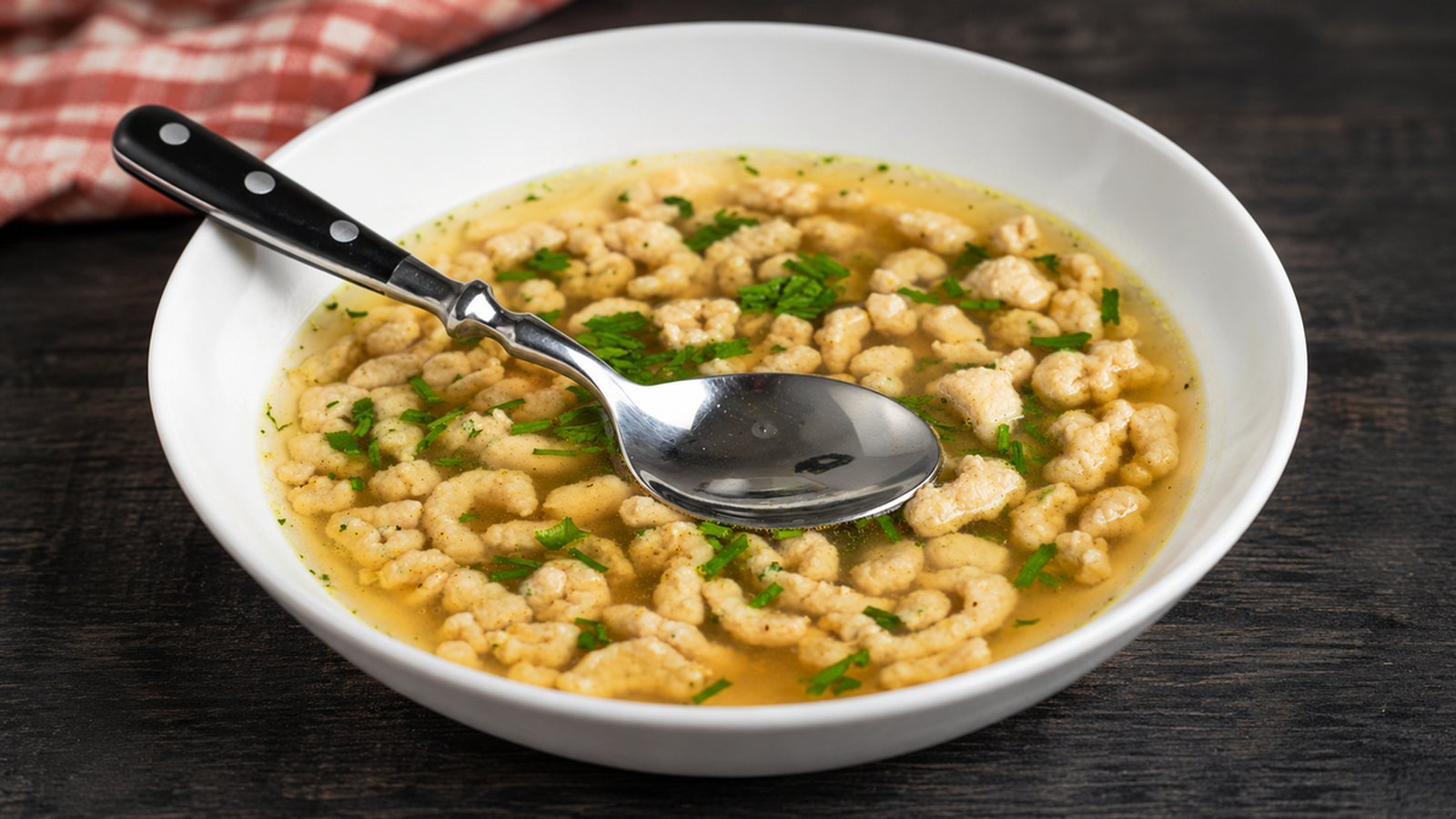
Riewele soup is a vegetable broth (carrots, leek, celery) in which Riewele are cooked: tiny Alsatian noodles made from a firm dough of flour and egg. Three ingredients are all you need for the noodles, and the soup is ready in just under an hour. It is a simple, filling family soup.
Preparation: 20 minutes
Cooking: 30–35 minutes
Serves 4
Ingredients
- 1 litre chicken or vegetable stock
- 2 carrots
- 1 leek
- 1 onion
- 2 garlic cloves
- 1 celery stick
- A drizzle of oil
- Fresh parsley
- Salt and pepper
- 100 g flour (for the Riewele)
- 1 egg (for the Riewele)
- 1 pinch of salt (for the Riewele)
Method
- Peel and finely slice the carrots, leek, onion and garlic. Dice the celery.
- In a large saucepan, fry the onion and garlic in a drizzle of oil, then add the carrots, leek and celery and let them sweat for a few minutes.
- Pour in the stock, bring to the boil and simmer gently for about 20 minutes.
- Meanwhile, mix the flour, egg and salt, then knead until you have an even dough that is not sticky.
- Shape small balls or little cylinders about 1 cm long and place them on a floured tray.
- Cook the Riewele in the broth for about 10 minutes, then add the chopped parsley before serving.
My tip: the dough must stay firm. If it sticks to your fingers, add a spoonful of flour; if it crumbles too much, a few drops of water. The smaller the Riewele, the faster they cook: taste one after 7 or 8 minutes.
What are Riewele?
Riewele are small crumbs of egg pasta. Their dough of flour, egg and salt is firmer than spätzle dough: stiff enough to be rubbed into crumbs between the palms or grated, then dropped into the broth. Here they are shaped into small balls or little cylinders, which gives slightly larger, more even noodles.
The name seems to come from that gesture: it recalls the German reiben, “to rub” or “to grate”. The same noodles exist across the Rhine under other names: Riebele in Swabia, where they are grated on a coarse grater, and Riwwel in the Odenwald, where they are cooked in milk.
Variations
For a more substantial soup, add diced ham or cooked chicken at the same time as the Riewele. The vegetables change with the seasons: a turnip or a potato in winter, peas in spring. A pinch of nutmeg in the broth goes well with the egg dough.
Origins
Riewelesupp, “soup with little noodles and eggs”, is one of the traditional soups of Alsatian cooking, alongside toasted flour soup and beer soup. The name is so well known that a packet soup was once sold as “Riewele Supp à l’alsacienne”.
It is a home recipe, a cousin of other Alsatian egg noodles such as spätzle, which are poached in water and served as a side dish. No source links it to the Northern Vosges in particular; it belongs to the family cooking of the whole of Alsace.
What to serve it with
Serve the soup piping hot, with toasted country bread and a green salad for a complete supper.
For wine, a crisp, dry Alsace white, Pinot Blanc or Riesling, goes well with the broth and vegetables. The Cleebourg vineyards, near Wissembourg, grow both varieties in the far north of Alsace. If you prefer beer, a light lager works well.
Where to try it
Riewele soup is a home-cooked dish for the cold months. The easiest way is to make it yourself, with homemade stock if you have some: as far as we know, no festival or market in the area is devoted to it.
For other classics of Alsatian and Lorraine cooking, from broth to dessert, browse the Recipes section.
Good to know
Expected crowds this week: usual, busier at the weekend
In the Northern Vosges
- 25 December Christmas Day, public holiday in France (long weekend)
- 26 December St Stephen’s Day (Alsace-Moselle), public holiday in France
- 1 January New Year's Day, public holiday in France (long weekend)
- 20 December – 3 January French school holidays
Back home: the Netherlands
- 25 December Christmas Day
- 26 December St. Stephen's Day
- 19 December – 3 January Christmas Holidays
- 13 February – 21 March Spring Holidays (depending on region)
Getting here
- From Belgium and the Netherlands by car: via Luxembourg and Metz, or via Germany towards Karlsruhe and Wissembourg.
- By train: high-speed trains to Strasbourg (via Paris) or to Karlsruhe (via Germany), then regional trains.
- On site: a car is the easiest way to get around.
Holidays: Nager.Date and OpenHolidays.