Alsatian spätzle: the recipe for fresh egg noodles
Alsatian spätzle: a batter of flour, eggs and water, scraped or pressed into boiling water, cooked in 3 minutes, then tossed in butter. The classic side for dishes in sauce and game.

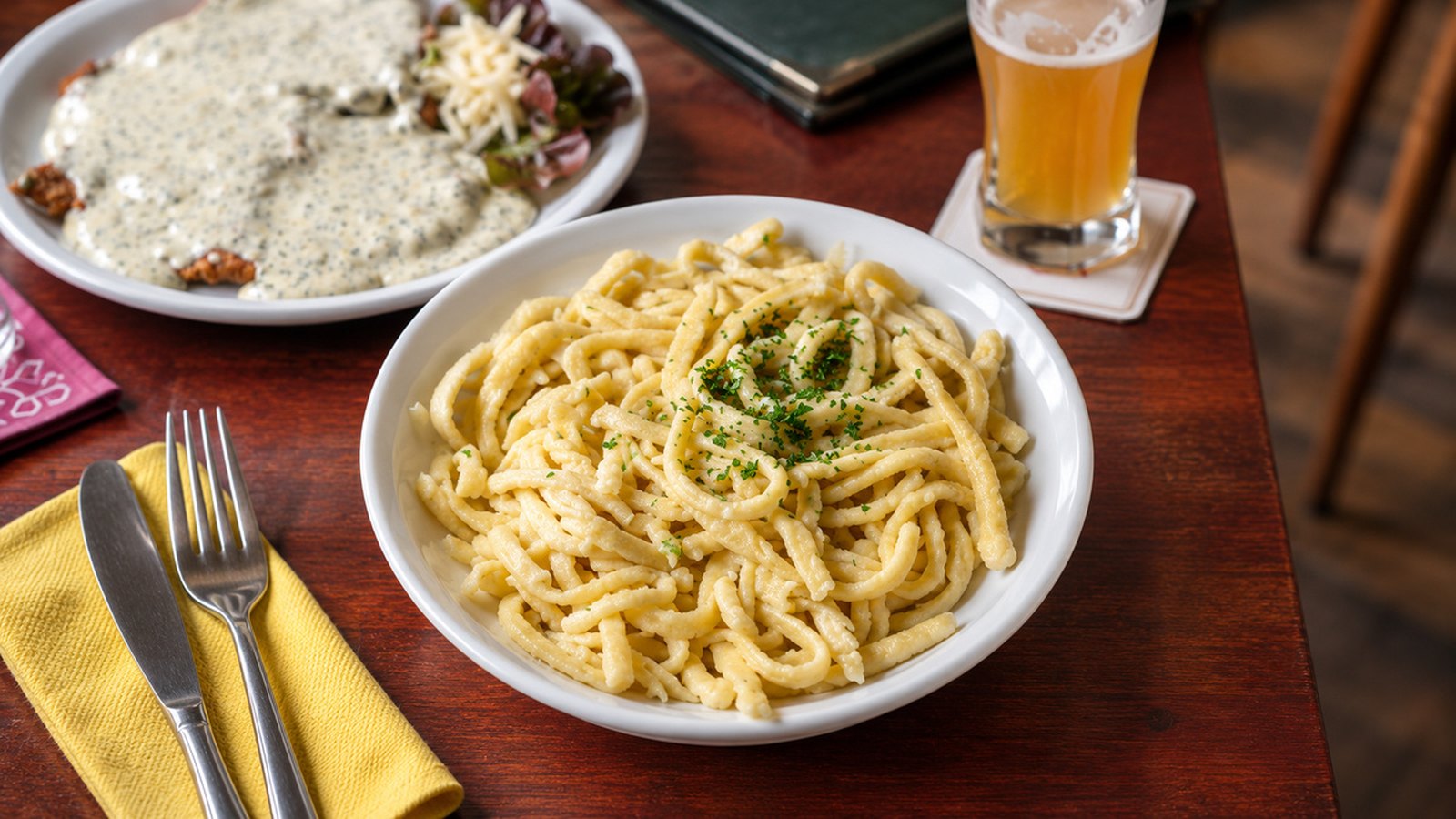
Spätzle are small fresh egg noodles made from a batter of flour, eggs and water, dropped in little pieces into boiling salted water. They cook in 2–3 minutes and are served with butter or with meat in a sauce. Originally from Swabia, they are firmly rooted in Alsace and the Moselle, on both sides of the Northern Vosges.
Resting: 30 minutes
Cooking: 2–3 minutes per batch
Ingredients
- 300 g wheat flour
- 3 eggs
- 100 ml water
- 1 pinch of salt
- 1 tablespoon vegetable oil (optional)
Method
- Mix the flour and salt in a large bowl, make a well, break in the eggs and gradually add the water, stirring as you go.
- Beat the batter until it is smooth, elastic and slightly sticky.
- Leave the batter to rest for about 30 minutes.
- Bring a large pan of salted water to the boil and form the spätzle into it with a spätzle maker, or by scraping the batter off a board with a knife.
- Lift the spätzle out with a slotted spoon as soon as they rise to the surface (2–3 minutes) and drain them.
- If you like, toss them in a frying pan with a little butter before serving.
My tip: beat the batter with a wooden spoon until it forms bubbles and falls from the spoon in a thick ribbon. Too runny and it breaks up in the water; too stiff and it will not go through the spätzle maker. Adjust with a spoonful of water or flour.
Board, grater or press: how to shape spätzle
The oldest method is the wooden board (Spätzlebrett): spread a little batter on the edge of the wet board and scrape thin strips off it with a knife, straight into the water. It takes a bit of practice, but gives the longest, most irregular spätzle.
Easier still, the spätzle grater is a perforated plate with a small hopper of batter that slides across it: moving it back and forth produces small, even lumps, close to Swabian Knöpfle. The press, which looks like a potato ricer, gives longer noodles. With no special equipment, a colander with large holes and the back of a spoon will do.
Work in small batches so the water never stops boiling. Once drained, spätzle keep for a day in the fridge: simply reheat them in butter in a frying pan just before serving.
Origins
Spätzle come from Swabia, in what is now Baden-Württemberg in Germany. The name is often linked to the word Spatz, “sparrow”, which their irregular shape is said to recall; other linguists connect it with the idea of a lump of dough, and the etymology is still debated. The earliest written mentions date from the early 18th century, but the dough is probably older. Since 2012, “Schwäbische Spätzle” have been a protected geographical indication in the European Union.
In France, spätzle are part of the cooking of Alsace and the Moselle. Dried spaetzle are even one of the shapes covered by Pâtes d’Alsace, a PGI that requires fresh eggs and production in Alsace. In the Northern Vosges, the German border is never far away: the Pfälzerwald (Palatinate Forest), in the neighbouring Palatinate, forms a cross-border biosphere reserve with the Park, and the cooking on both sides is very similar.
Spätzle have cousins in Alsatian and Lorraine cooking: flour dumplings, such as Mehlknepple mit Eiersoss, and potato dumplings are made in the same spirit.
Variations
For cheese spätzle (Käsespätzle), layer hot spätzle and grated cheese in a dish, then top with onions fried in butter. You can also flavour the batter with a pinch of nutmeg or some chopped parsley.
What to serve them with
Spätzle go with dishes in sauce: their soft dough soaks up the juices. In Alsace they are served with coq au Riesling, game stews or braised meat. Tossed in butter, they can also be eaten on their own with a green salad.
The wine is chosen for the main dish. With coq au Riesling, serve the Riesling used in the cooking; the Cleebourg vineyards, near Wissembourg, produce it in the far north of Alsace. With a game stew, choose an Alsace Pinot Noir. If you prefer beer, a lager or a mildly bitter amber ale works well.
Where to try them
Spätzle are served all year round, but they are at their best in autumn and winter, with the game dishes of the hunting season. In the Northern Vosges, look for them on the menus of restaurants serving regional cooking, alongside meat in sauce and game. At the market or in grocery shops, look for fresh or dried spaetzle with the Pâtes d’Alsace label for busy days. For the dishes in sauce that go with them, browse the Recipes section.
Good to know
Expected crowds this week: usual, busier at the weekend
In the Northern Vosges
- 25 December Christmas Day, public holiday in France (long weekend)
- 26 December St Stephen’s Day (Alsace-Moselle), public holiday in France
- 1 January New Year's Day, public holiday in France (long weekend)
- 20 December – 3 January French school holidays
Back home: the Netherlands
- 25 December Christmas Day
- 26 December St. Stephen's Day
- 19 December – 3 January Christmas Holidays
- 13 February – 21 March Spring Holidays (depending on region)
Getting here
- From Belgium and the Netherlands by car: via Luxembourg and Metz, or via Germany towards Karlsruhe and Wissembourg.
- By train: high-speed trains to Strasbourg (via Paris) or to Karlsruhe (via Germany), then regional trains.
- On site: a car is the easiest way to get around.
Holidays: Nager.Date and OpenHolidays.