Mehlknepple mit Eiersoss: Alsatian flour dumplings in egg sauce
Mehlknepple mit Eiersoss are poached flour-and-milk dumplings coated in an egg, cream and onion sauce. A farmhouse dish from Alsace to the Pays de Bitche.

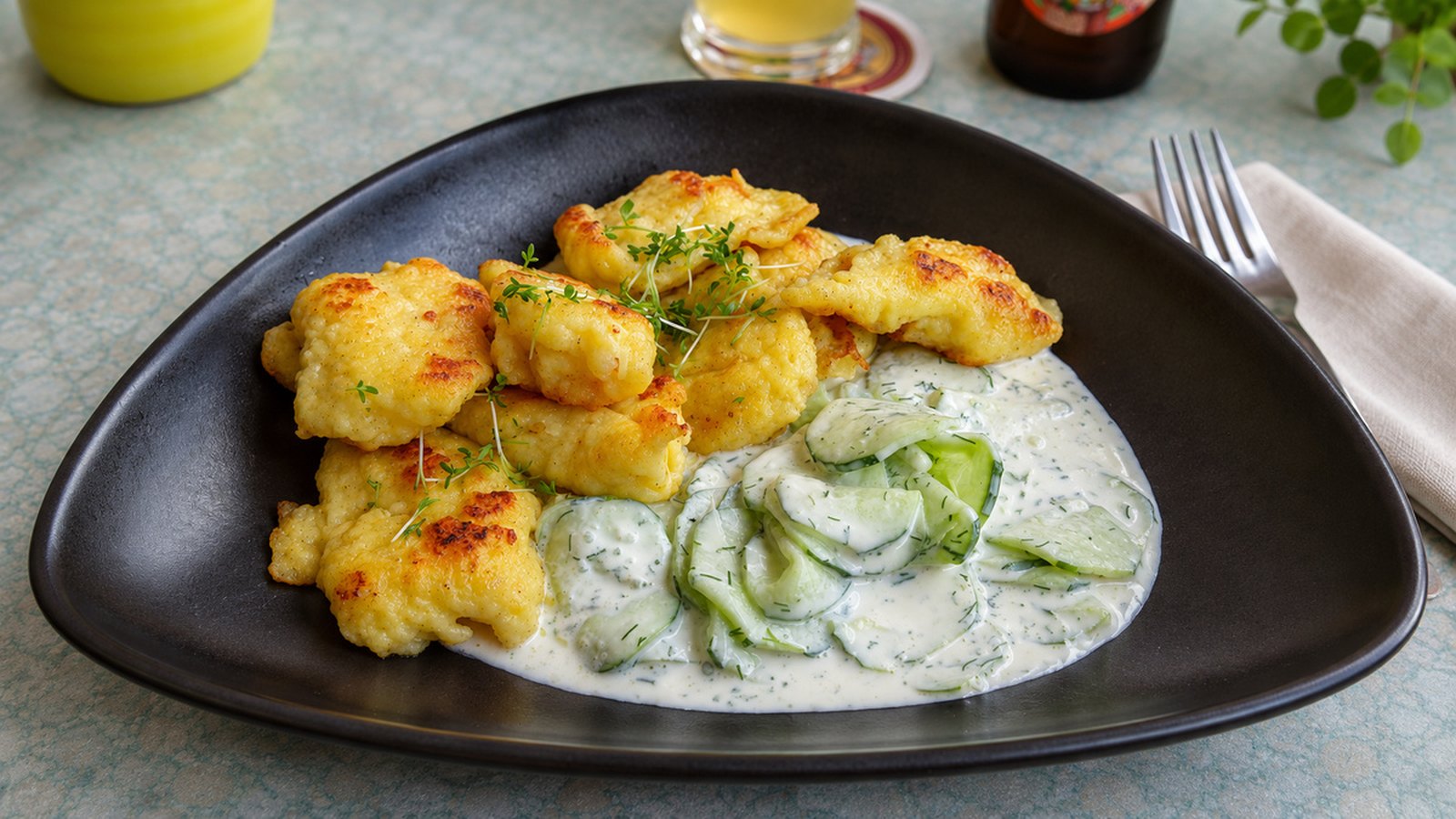
Mehlknepple mit Eiersoss are dumplings made from flour, eggs and milk, shaped with a spoon and poached in salted water, then coated in an egg and cream sauce built on softened onion. It is a store-cupboard dish, made from flour, eggs, milk and cream. It belongs to the Knepfle family, cooked in Alsace as well as in German-speaking Moselle, the Pays de Bitche included.
Cooking time: 15 minutes for the dumplings, about 5 minutes for the sauce
Serves 4
Ingredients
- 500 g flour
- 2 eggs (for the dough)
- 250 ml milk
- 1 pinch of nutmeg
- 4 eggs (for the sauce)
- 200 ml crème fraîche
- 1 onion
- 50 g butter
- Chopped parsley
- Salt and pepper
Method
- Mix the flour, the 2 eggs, the milk, salt, pepper and nutmeg into a smooth dough.
- Bring a large pan of salted water to the boil.
- Using a spoon, shape walnut-sized dumplings and slide them into the boiling water.
- Cook the dumplings for about 15 minutes, until they rise to the surface, then drain them and keep them warm.
- Melt the butter in a frying pan and cook the sliced onion until translucent.
- Beat the 4 eggs with the crème fraîche, salt and pepper. Pour over the onion and cook over a low heat, stirring, for about 5 minutes, until it thickens slightly.
- Add the chopped parsley, spoon the hot sauce over the dumplings in soup plates and serve straight away.
My tip: dip the spoon in hot water between dumplings so the dough slides off without sticking. Never let the sauce boil: the eggs would curdle and the sauce would turn grainy.
What are Mehlknepple?
“Mehl” means flour, and “Knepple” means dumplings. The word changes from place to place: Knepfla in the Haut-Rhin, Knepfle in the Bas-Rhin, Knepple in Alsace Bossue and the Pays de Bitche. The title of this recipe keeps the northern form, the one used in the villages close to the Northern Vosges.
Mehlknepfle are flour dumplings. In their small form they are also called spätzle. Here, each dumpling is shaped with a spoon to the size of a walnut, which makes for a more generous mouthful.
Origins
Knepfle belong to the family of poached doughs, like gnocchi. They are found from Lorraine and Alsace all the way to Slovakia, by way of the German-speaking countries and Hungary.
In German-speaking Moselle they are called Knepp or Kneddeln, and Knepple in the Pays de Bitche. There the dough is made with milk rather than water, as in this recipe. According to Jean-Louis Kieffer, they are usually served there with fried croutons and crème fraîche.
The egg and cream sauce follows the same logic as that Moselle topping: a rich garnish on a very simple dough. It does not appear in regional descriptions of Knepfle, so think of it as a home-style version to adapt to your taste.
What to serve with it
This is a rich dish. A green salad with a sharp vinaigrette balances it, with a few butter-fried croutons scattered over the sauce, Moselle style. The dumplings can also accompany a meat dish in sauce, without the egg sauce.
For wine, an Alsace Pinot Blanc pairs well with spätzle and dishes in white sauce, such as blanquette. In the Cleebourg vineyards, near Wissembourg, it comes as Auxerrois. A dry Riesling also works. If you prefer beer, go for a lager with little bitterness.
Where to try it
Mehlknepple remain family cooking, far more often made at home than ordered in a restaurant. The simplest option is therefore to make them yourself, with eggs and cream bought from a local producer.
More pasta and dumplings from the region await you in the Recipes section, such as potato dumplings.
Good to know
Expected crowds this week: usual, busier at the weekend
In the Northern Vosges
- 25 December Christmas Day, public holiday in France (long weekend)
- 26 December St Stephen’s Day (Alsace-Moselle), public holiday in France
- 1 January New Year's Day, public holiday in France (long weekend)
- 20 December – 3 January French school holidays
Back home: the Netherlands
- 25 December Christmas Day
- 26 December St. Stephen's Day
- 19 December – 3 January Christmas Holidays
- 13 February – 21 March Spring Holidays (depending on region)
Getting here
- From Belgium and the Netherlands by car: via Luxembourg and Metz, or via Germany towards Karlsruhe and Wissembourg.
- By train: high-speed trains to Strasbourg (via Paris) or to Karlsruhe (via Germany), then regional trains.
- On site: a car is the easiest way to get around.
Holidays: Nager.Date and OpenHolidays.