Foie gras brioche: a homemade Alsatian recipe
Homemade foie gras brioche: a butter brioche dough filled with sliced raw duck foie gras, baked for 25 to 30 minutes at 180°C and served warm. A festive starter for the holidays.

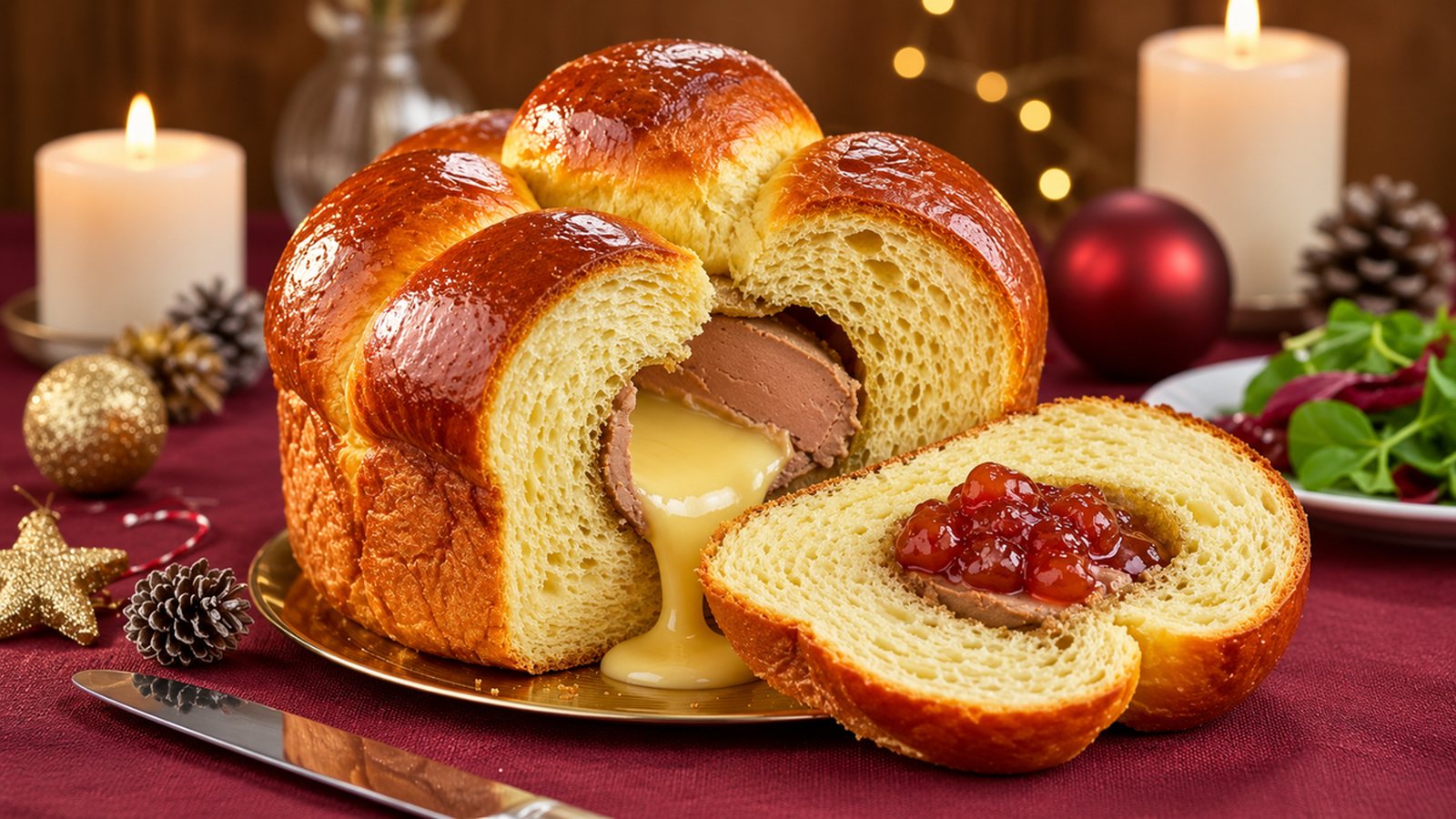
Foie gras brioche is a homemade butter brioche dough filled with seasoned slices of raw duck foie gras, glazed with egg yolk and baked for 25 to 30 minutes at 180°C. It is served warm, in thick slices, as an aperitif or a starter. In Alsace, where foie gras in pastry made Strasbourg famous, it is a classic starter for Christmas Eve and New Year’s Eve dinners.
Preparation: 30 minutes
Resting: 3 hours
Baking: 25 to 30 minutes
Makes 1 large brioche (loaf tin)
Ingredients
- 500 g plain white flour (French type 45)
- 20 g fresh baker’s yeast
- A little lukewarm water
- 10 g salt
- 60 g caster sugar
- 6 eggs
- 250 g butter, at room temperature
- 1 egg yolk for glazing
- 500 g raw duck foie gras, deveined
- Salt and pepper
- 1 tsp Espelette pepper (optional)
Method
- Dissolve the yeast in a little lukewarm water. In a large mixing bowl, combine the flour, salt and sugar, then add the eggs one at a time while kneading, and work in the yeast.
- Gradually add the butter in pieces and knead for 15 to 20 minutes, until the dough is smooth and elastic.
- Cover and leave to rest for at least 2 hours at room temperature, until the dough has doubled in size.
- Knock back the dough, divide it in two and shape each half into a rectangle the length of the tin. Leave to rest for 1 hour under a tea towel.
- Season the foie gras with salt, pepper and Espelette pepper, then cut it into thin slices.
- Roll out one half of the dough, arrange the foie gras in the centre, cover with the other half, seal the edges firmly and place the brioche in the tin.
- Brush with egg yolk and bake at 180°C (350°F) for 25 to 30 minutes, until a blade inserted into the crumb, next to the foie gras, comes out dry.
- Leave to cool slightly before turning out and serve warm or at room temperature, in thick slices.
My tip: seal the edges of the dough by pinching them firmly, and leave a gap of two fingers’ width between the foie gras and the edge. The foie gras melts a little as it bakes: if it is well enclosed, it enriches the crumb instead of running into the tin.
How to make a good brioche dough
This is a rich dough: six eggs and 250 g of butter for 500 g of flour. Kneading takes a while, 15 to 20 minutes, and a stand mixer fitted with a dough hook makes the job easier. Only add the butter once the dough comes away from the sides of the bowl: it should be smooth and elastic, not sticky.
The dough can be left to rise for longer somewhere cool. A night in the fridge makes it firmer and easier to roll out; let it come back to room temperature before shaping.
Variations
For a buffet, small individual moulds give you bite-sized brioches; the baking time is then shorter, so keep an eye on the colour. Goose foie gras is an excellent substitute for duck. For a version with ready-cooked foie gras, slip slices of terrine into the dough: make it with our recipe for semi-cooked goose foie gras. If you would prefer a savoury brioche without foie gras, savoury kougelhopf is the other Alsatian classic.
Origins
Foie gras and pastry came together in Strasbourg in the late 18th century. Around 1780, Jean-Pierre Clause, cook to Marshal de Contades, is said to have created the foie gras pâté in pastry that made the city famous; the anecdote may be partly legend, but the recipe does date from that period. In the early 20th century, Auguste Escoffier included in his Guide culinaire a foie gras baked in brioche, known as “à la strasbourgeoise”.
The version given here, with sliced raw duck foie gras, is a family recipe that is simpler than the grand truffled classic. It keeps the core idea: wrapping the foie gras in a dough that protects it during baking and soaks up its fat.
What to serve it with
Serve the brioche warm, in thick slices, with a lamb’s lettuce salad or an onion compote. It can also be cut into cubes for the aperitif.
As for wine, the Alsace wine trade body recommends Pinot Gris with foie gras; a late-harvest (vendanges tardives) Gewurztraminer works if you serve the brioche at the end of the aperitif or with a sweet compote. For a standing aperitif, a well-chilled Crémant d’Alsace refreshes the palate between bites. The Cleebourg vineyards, near Wissembourg, produce all three wines.
Where to try it
Foie gras brioche is mostly made at home for the end-of-year holidays: December is when raw foie gras is easiest to find. During Advent, the Christmas markets calendar for the Northern Vosges lists the places to look for foie gras and festive produce.
Good to know
Expected crowds this week: usual, busier at the weekend
In the Northern Vosges
- 25 December Christmas Day, public holiday in France (long weekend)
- 26 December St Stephen’s Day (Alsace-Moselle), public holiday in France
- 1 January New Year's Day, public holiday in France (long weekend)
- 20 December – 3 January French school holidays
Back home: the Netherlands
- 25 December Christmas Day
- 26 December St. Stephen's Day
- 19 December – 3 January Christmas Holidays
- 13 February – 21 March Spring Holidays (depending on region)
Getting here
- From Belgium and the Netherlands by car: via Luxembourg and Metz, or via Germany towards Karlsruhe and Wissembourg.
- By train: high-speed trains to Strasbourg (via Paris) or to Karlsruhe (via Germany), then regional trains.
- On site: a car is the easiest way to get around.
Holidays: Nager.Date and OpenHolidays.