Choucroute garnie: Alsatian sauerkraut with meats, the recipe
Choucroute garnie à l’alsacienne: raw sauerkraut simmered for two hours in white wine with juniper, pork belly, smoked shoulder, bacon and sausages. Alsace’s great winter dish, step by step.

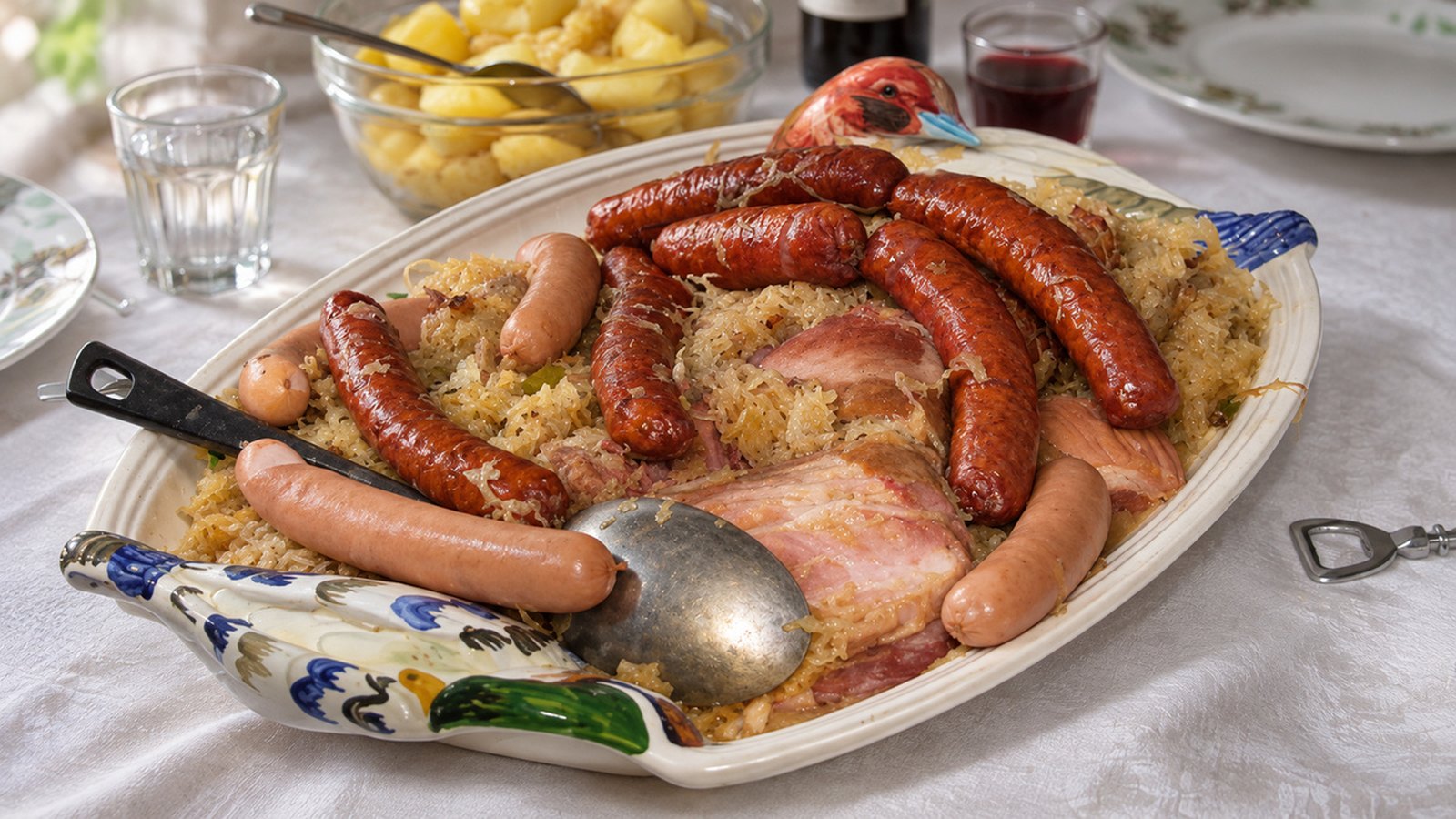
Choucroute garnie à l’alsacienne – Alsatian sauerkraut with meats – is raw fermented cabbage, rinsed and then simmered for about two hours in Alsace white wine with juniper, salted pork belly, smoked pork shoulder and bacon, and finished with sausages and potatoes. It is the great winter dish of Alsace. In the Northern Vosges, on the Bas-Rhin and Moselle sides alike, it comes back to the table with the first cold days.
Preparation: 30 minutes
Cooking: about 2 hours 35 minutes
Serves 4
Ingredients
- 1 kg raw sauerkraut
- 500 g salted pork belly
- 500 g smoked pork shoulder
- 4 Strasbourg sausages
- 4 Montbéliard sausages
- 6 slices of smoked bacon
- 4 potatoes
- 2 onions
- 2 garlic cloves
- 200 ml Alsace white wine
- 10 juniper berries
- 10 black peppercorns
- 2 bay leaves
- 2 cloves
- Salt and pepper
- Sunflower oil
Method
- Rinse the raw sauerkraut in cold water, warm it for 15 minutes in a large pan of water, then drain.
- In a large casserole, brown the salted belly and smoked shoulder in a little sunflower oil, then set aside.
- In the same casserole, soften the sliced onions and crushed garlic until translucent.
- Build up the layers: sauerkraut, belly and shoulder, sauerkraut, smoked bacon and Montbéliard sausages, then a final layer of sauerkraut.
- Add the juniper, peppercorns, bay leaves and cloves, pour in the white wine and top up with water almost to the level of the sauerkraut.
- Cover and cook over a low heat for about 2 hours.
- Add the Strasbourg sausages and cook for another 20 minutes; meanwhile, boil the potatoes in salted water.
- Pile the sauerkraut onto a large serving dish with the meats on top and the potatoes around it; serve hot with mustard.
My tip: keep the heat very low for the whole two hours. The sauerkraut should barely simmer, never boil: that is what makes the cabbage meltingly tender and keeps the meat succulent. Made the day before and gently reheated, it is even better.
Which sauerkraut and which meats?
Use raw sauerkraut, sold by weight at the butcher’s, at markets or in bags. The label “Choucroute d’Alsace” with the PGI logo guarantees cabbage grown and fermented in Alsace, in the Bas-Rhin or Haut-Rhin. Rinsing removes excess salt and acidity; don’t overdo it, or the cabbage loses its flavour.
The garnish combines salted or smoked meats that cook for a long time with the cabbage, and sausages added later. The Strasbourg sausage, slim and smoked, only needs heating through: 20 minutes is enough, and if overheated it bursts. The Montbéliard sausage, thicker and flavoured with cumin, comes from Franche-Comté; it is protected by a PGI and has become a fixture of choucroute garnie.
Variations
Depending on the family, the cabbage is cooked in goose fat or lard rather than oil. Others add a spoonful of caraway seeds with the juniper, or cook the potatoes directly in the casserole, adding them after an hour. Sometimes ham hock or Kassler, smoked pork loin, goes in too. The lighter fish version has its own recipe: smoked haddock choucroute.
Origins
The word “choucroute” comes from the Alsatian Sürkrüt, “sour cabbage”, close to the German Sauerkraut. Preserving cabbage by lactic fermentation is a very old practice and its origins are still debated. The dish spread through Alsace in the 18th century, as it did in parts of Lorraine and in neighbouring Baden. Until the 19th century it was often eaten with freshwater fish, a habit linked to the Rhine boatmen; the version with pork and sausages took over later.
Today Alsace produces most of France’s sauerkraut. The specification for “Choucroute d’Alsace” was approved in France in 2012, and the European protected geographical indication (PGI) was granted in 2018.
The Northern Vosges Regional Nature Park straddles northern Alsace and the Moselle. Choucroute is made on both sides, in the villages of the Bas-Rhin as in the Pays de Bitche in the Moselle. Fermented cabbage can also be eaten cold: try the sauerkraut salad with roasted cervelas.
What to serve it with
Serve the choucroute piping hot, with strong or wholegrain mustard and, if you like, a few gherkins. Steamed or boiled potatoes are all the side you need.
As for wine, choose a dry Alsace white, ideally the one used in the cooking: a Riesling or a Sylvaner. Their acidity balances the richness of the meat. These grape varieties are grown in the far north of Alsace, in the Cleebourg vineyards near Wissembourg, along with Pinot Blanc and Auxerrois, which also work well. An Alsace lager is the other classic pairing.
Where to try it
Choucroute is mostly eaten from autumn to the end of winter. In the villages of the Park it is on the menu at winstubs and regional restaurants, and it often features at meals organised by local associations: check the village festivals calendar during your stay.
Elsewhere in Alsace, Krautergersheim, south-west of Strasbourg, bills itself as the sauerkraut capital and celebrates the cabbage harvest every year at the end of September. For other winter dishes, browse the Recipes section.
Good to know
Expected crowds this week: usual, busier at the weekend
In the Northern Vosges
- 25 December Christmas Day, public holiday in France (long weekend)
- 26 December St Stephen’s Day (Alsace-Moselle), public holiday in France
- 1 January New Year's Day, public holiday in France (long weekend)
- 20 December – 3 January French school holidays
Back home: the Netherlands
- 25 December Christmas Day
- 26 December St. Stephen's Day
- 19 December – 3 January Christmas Holidays
- 13 February – 21 March Spring Holidays (depending on region)
Getting here
- From Belgium and the Netherlands by car: via Luxembourg and Metz, or via Germany towards Karlsruhe and Wissembourg.
- By train: high-speed trains to Strasbourg (via Paris) or to Karlsruhe (via Germany), then regional trains.
- On site: a car is the easiest way to get around.
Holidays: Nager.Date and OpenHolidays.