Alsatian winegrower’s pie (tourte vigneronne): the recipe
Alsatian winegrower’s pie: a filling of pork, lardons and mushrooms cooked in white wine, enclosed in two sheets of puff pastry and baked golden for 35–40 minutes. Served hot with salad.

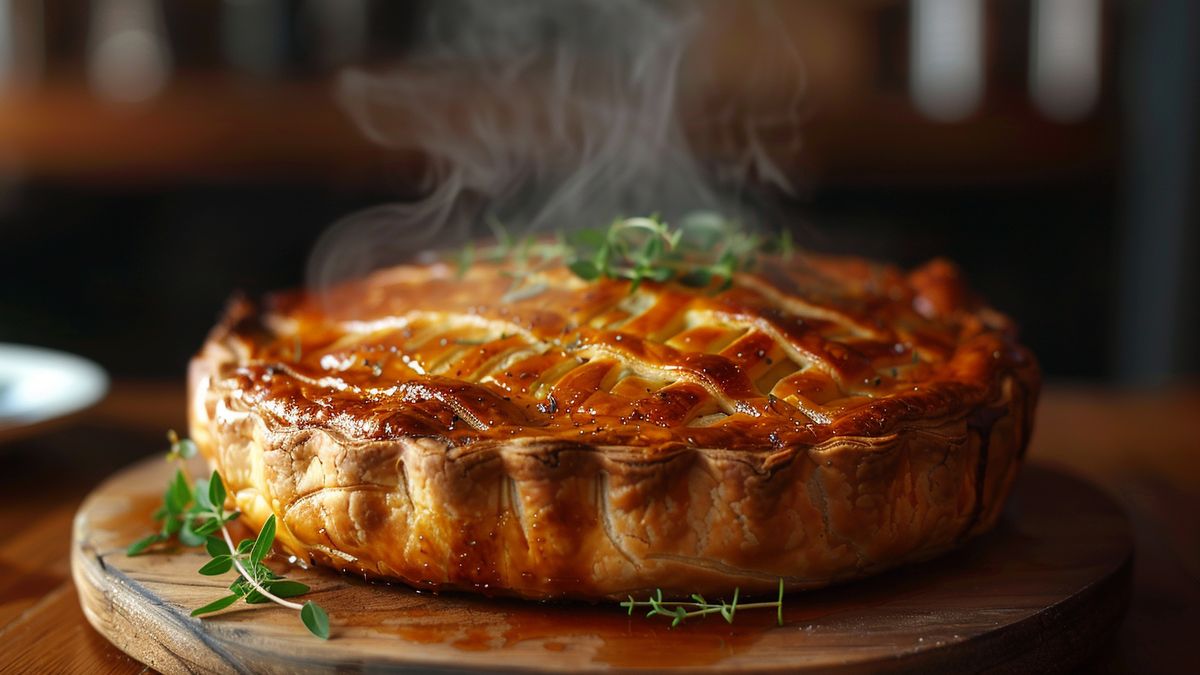
Tourte vigneronne, the winegrower’s pie, is an Alsatian meat pie: two sheets of puff pastry enclose a filling of minced pork, lardons and mushrooms cooked in dry white wine. It spends 35–40 minutes in the oven and is served hot, with a green salad. It is a dish for sharing, made for a family gathering round the table.
Cooking: 10 minutes for the filling, 35–40 minutes in the oven
Serves 4 to 6
Ingredients
- 2 sheets of puff pastry
- 500 g minced pork
- 200 g button mushrooms
- 1 onion
- 2 garlic cloves
- 200 ml dry white wine
- 100 g smoked lardons
- 2 tablespoons flour
- 1 bouquet garni (thyme, bay leaf, parsley)
- Salt and pepper
- 1 egg yolk for glazing
Method
- Finely slice the onion and garlic; clean the mushrooms and cut them into thin slices.
- Brown the lardons in a frying pan, add the onion and garlic, then the minced pork, and cook until it is cooked through and lightly browned.
- Deglaze with the white wine, add the mushrooms, then the flour and the bouquet garni, and cook for about ten minutes more until the sauce thickens; season with salt and pepper and remove the bouquet garni.
- Preheat the oven to 180 °C (gas mark 4); line a tart tin with one sheet of puff pastry and prick the base.
- Pour in the filling, cover with the second sheet of pastry and seal the edges well.
- Glaze with beaten egg yolk and lightly score the top.
- Bake for 35–40 minutes, then leave to rest for a few minutes before cutting; serve hot with a green salad.
My tip: let the filling cool before filling the pastry. Poured in piping hot, it softens the puff pastry on the base, which then bakes badly. Also make a small steam vent in the centre of the lid with a roll of baking paper: the steam escapes without lifting the pastry.
Which wine should go in the filling?
A dry Alsace white, the one you will drink at the table: a Riesling or a Sylvaner. Avoid sweet wines, whose sugar makes the sauce heavy. The wine should reduce a little before the mushrooms go in, so that the filling keeps the flavour of the wine without its acidity.
The flour binds the cooking juices. If the filling still looks runny after ten minutes, keep cooking it uncovered: a filling that is too wet makes the pastry soggy.
Origins
Meat pie belongs to Alsace’s tradition of charcuterie in pastry: pork or veal pies and pâtés en croûte, whose filling simmers for a long time before being enclosed in pastry and baked golden. Alsatian cooking has several versions: the winegrower’s pie, the marcaire pie and the Munster Valley pie, served as the starter of the marcaire meal in the farm inns of the High Vosges.
The name tourte vigneronne refers to the wine villages and to the white wine in the filling, but no reliable source dates the recipe or links it to a particular village. In many traditional pie recipes, the meat is diced rather than minced and marinated overnight in white wine with onion, garlic and shallot. The recipe above is quicker: the minced meat cooks directly in the wine.
In Lorraine, the tourte lorraine is based on the same principle: pork and veal marinated in white wine and enclosed in pastry. In the Northern Vosges, which straddle the Bas-Rhin and the Moselle, the two traditions meet. Wine is also what it shares with the winegrower’s salted pork shoulder, a dish in the same vein.
Variations
For a pie closer to the traditional recipes, replace half the pork with diced veal, marinate it overnight in white wine, then, ten minutes before the end of baking, pour a mixture of one egg and cream in through the steam hole. A shortcrust base with a puff pastry lid makes a firmer pie that is easier to slice.
What to serve it with
A sharply dressed green salad is all you need: it balances the pastry and the filling. In winter, a red cabbage or potato salad makes it a more complete meal.
For wine, serve the same dry white as in the filling: Riesling, Sylvaner or Pinot Blanc. These grapes are grown in the far north of Alsace, in the Cleebourg vineyards, near Wissembourg, where Pinot Blanc also comes as Auxerrois. If you prefer red, a light Alsace Pinot Noir works. For beer, a mildly bitter lager.
Where to try it
Meat pies are sold all year round at Alsatian butcher-charcutiers, by the slice or whole, alongside pâtés en croûte. To enjoy one with local wine, go to a wine festival or an open day in the vineyards: check the calendar of wine events. We have not found any festival devoted to the pie in the Park.
FAQ
What is tourte vigneronne?
Tourte vigneronne is an Alsatian meat pie: a filling of minced pork, lardons and mushrooms cooked in dry white wine, enclosed between two sheets of puff pastry and baked until golden. Its name refers to the wine villages and to the wine in the filling.
How long does a winegrower’s pie take to bake?
The winegrower’s pie bakes for 35–40 minutes at 180 °C (gas mark 4), after the filling has cooked for about ten minutes in a frying pan. Let it rest for a few minutes before cutting.
Which wine goes in a winegrower’s pie?
A dry Alsace white, the one you will drink at the table: a Riesling or a Sylvaner. Avoid sweet wines, whose sugar makes the sauce in the filling heavy.
How do you stop the base of the pie going soggy?
Let the filling cool before pouring it onto the pastry and, if it still looks runny after ten minutes, keep cooking it uncovered: a filling that is too wet makes the puff pastry soggy. A shortcrust base also gives a firmer pie.
What do you serve with a winegrower’s pie?
Serve the winegrower’s pie hot with a sharply dressed green salad; in winter, a red cabbage or potato salad rounds off the meal. For wine, an Alsace Riesling, Sylvaner or Pinot Blanc.
Good to know
Expected crowds this week: usual, busier at the weekend
In the Northern Vosges
- 25 December Christmas Day, public holiday in France (long weekend)
- 26 December St Stephen’s Day (Alsace-Moselle), public holiday in France
- 1 January New Year's Day, public holiday in France (long weekend)
- 20 December – 3 January French school holidays
Back home: the Netherlands
- 25 December Christmas Day
- 26 December St. Stephen's Day
- 19 December – 3 January Christmas Holidays
- 13 February – 21 March Spring Holidays (depending on region)
Getting here
- From Belgium and the Netherlands by car: via Luxembourg and Metz, or via Germany towards Karlsruhe and Wissembourg.
- By train: high-speed trains to Strasbourg (via Paris) or to Karlsruhe (via Germany), then regional trains.
- On site: a car is the easiest way to get around.
Holidays: Nager.Date and OpenHolidays.