Anisbredele: Alsatian Aniseed Christmas Biscuits Recipe
Little Christmas biscuits flavoured with green aniseed, made from whisked eggs and sugar and flour, dried overnight before gentle baking.

Anisbredele are little Christmas biscuits flavoured with green aniseed, made from just three basic ingredients: eggs, sugar and flour. Their secret lies in the drying: piped the day before, they form a crust that lifts during baking to reveal a little “foot”. This recipe makes about 70 bredele.
Preparation: 30 minutes
Resting: 12 hours (air drying)
Baking: 12 to 15 minutes per tray
Makes about 70 bredele
Ingredients
- 3 eggs, at room temperature
- 200 g caster sugar
- 220 g plain wheat flour
- 1 level tablespoon green aniseed
- A little butter and flour for the baking trays (or baking paper)
Method
- Lightly crush the aniseed in a mortar or under the flat of a knife to release its aroma.
- Whisk the eggs and sugar with an electric mixer for 10 to 15 minutes, until the mixture is very pale and thick and leaves a ribbon trail.
- Sift the flour over the mixture, add the aniseed and fold in gently with a spatula, lifting the mixture as you go.
- Butter and flour two baking trays, or line them with baking paper.
- Using a piping bag fitted with an 8 to 10 mm plain nozzle, pipe small rounds 2 to 3 cm across, well spaced apart.
- Leave the trays to dry in the open air overnight – about 12 hours – in a cool, draught-free room.
- The next day, check that a thin crust has formed: when you touch a biscuit with your fingertip, it should no longer be sticky.
- Preheat the oven to 150 °C. Bake for 12 to 15 minutes: the tops should stay white, with only the foot taking on a light colour.
- Leave to cool on the tray before lifting off the bredele, then store them in a biscuit tin.
My tip: don’t skimp on the whisking. It is the air trapped in the eggs that makes anisbredele rise, since there is neither raising agent nor butter. If the batter runs when you pipe the rounds, it has not been whisked enough or the flour was folded in too vigorously.
Getting the little foot right
The foot is the signature of anisbredele. While they dry, the surface hardens into a shell. In the oven, the batter underneath puffs up, lifts this shell and spills out slightly: that is what forms the foot. Without enough drying, the biscuit spreads and stays flat.
The room matters as much as the recipe. A warm or humid kitchen stops the crust from forming; a cool, dry room is ideal. Do not cover the trays. If the crust has not set by morning, wait a few more hours.
The oven must be gentle. Above 160 °C, the tops turn yellow and the shell cracks. If your oven runs hot, wedge the door slightly open with the handle of a wooden spoon.
Variations
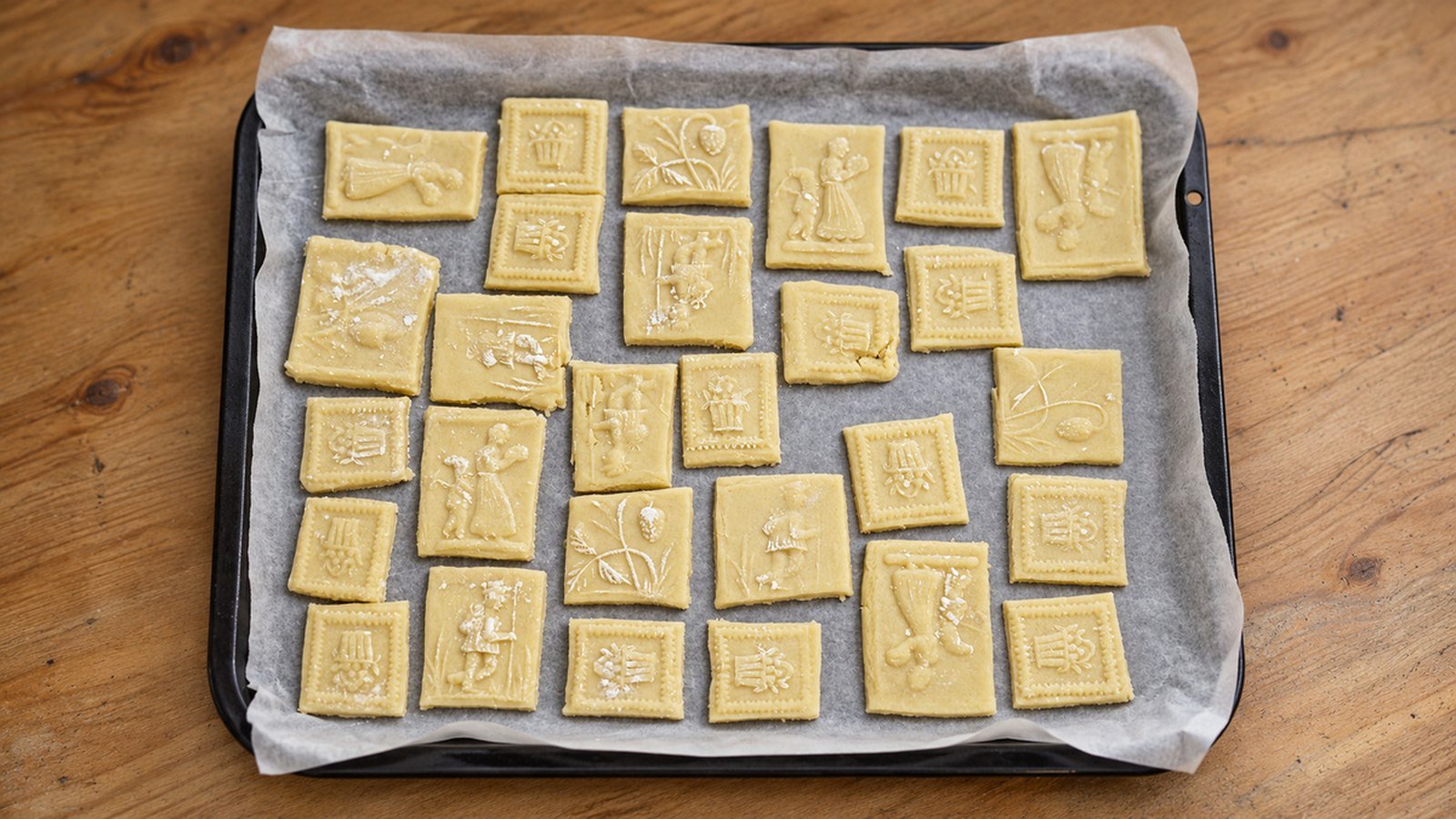
Some families replace the seeds with a few drops of aniseed extract or essential oil, for a completely white, smooth biscuit. Others sprinkle the buttered trays with aniseed before piping, so the seeds stick to the bottom of the bredele. You can also use carved wooden moulds, as for springerle, as long as you flour the dough well.
Origins
Anisbredele are among the most classic bredele of Alsace, alongside butterbredele, schwowebredele and cinnamon stars. They are described as biscuits made with egg white and green aniseed, but many family recipes use whole eggs. The history of bredele is little known: the only early evidence is moulds, the oldest of which dates from the 14th century.
The same biscuits exist in Germany under the name Anisplätzchen. They are made before Christmas from a batter of eggs, sugar and flour in almost equal parts, piped into small rounds and dried until they form a firm skin. Recipes appear in 19th-century German cookbooks.
What to serve them with
Anisbredele are dry and crunchy. They are made for dunking in coffee, tea or a glass of milk. Their aniseed flavour contrasts with richer bredele: serve them alongside buttery butterbredele and almond schwowebredele.
For a festive glass, a sweet wine suits them well. The late-harvest gewurztraminer from Cleebourg goes with Christmas biscuits without overpowering them. In winter, mulled wine is another option.
Kept in a biscuit tin, they harden a little over the first few days. Many people prefer them that way. To soften them, slip a wedge of apple into the tin for a day, then take it out.
Where to taste them
During Advent, bakeries in Alsace and Moselle sell bredele by weight or in mixed bags, and anisbredele are often among them. The Christmas markets of the Northern Vosges also have their food stalls, in Wissembourg, La Petite-Pierre or Bouxwiller. Dates change every year: check the Christmas markets calendar. For more Advent recipes, browse the Recipes section.
Good to know
Expected crowds this week: usual, busier at the weekend
In the Northern Vosges
- 25 December Christmas Day, public holiday in France (long weekend)
- 26 December St Stephen’s Day (Alsace-Moselle), public holiday in France
- 1 January New Year's Day, public holiday in France (long weekend)
- 20 December – 3 January French school holidays
Back home: the Netherlands
- 25 December Christmas Day
- 26 December St. Stephen's Day
- 19 December – 3 January Christmas Holidays
- 13 February – 21 March Spring Holidays (depending on region)
Getting here
- From Belgium and the Netherlands by car: via Luxembourg and Metz, or via Germany towards Karlsruhe and Wissembourg.
- By train: high-speed trains to Strasbourg (via Paris) or to Karlsruhe (via Germany), then regional trains.
- On site: a car is the easiest way to get around.
Holidays: Nager.Date and OpenHolidays.