Butterbredele: the recipe for Alsatian Christmas butter biscuits
Butterbredele: Alsatian Christmas butter biscuits made with egg yolks, cut out with cookie cutters and baked for 10 to 12 minutes. A simple dough to decorate as you like.

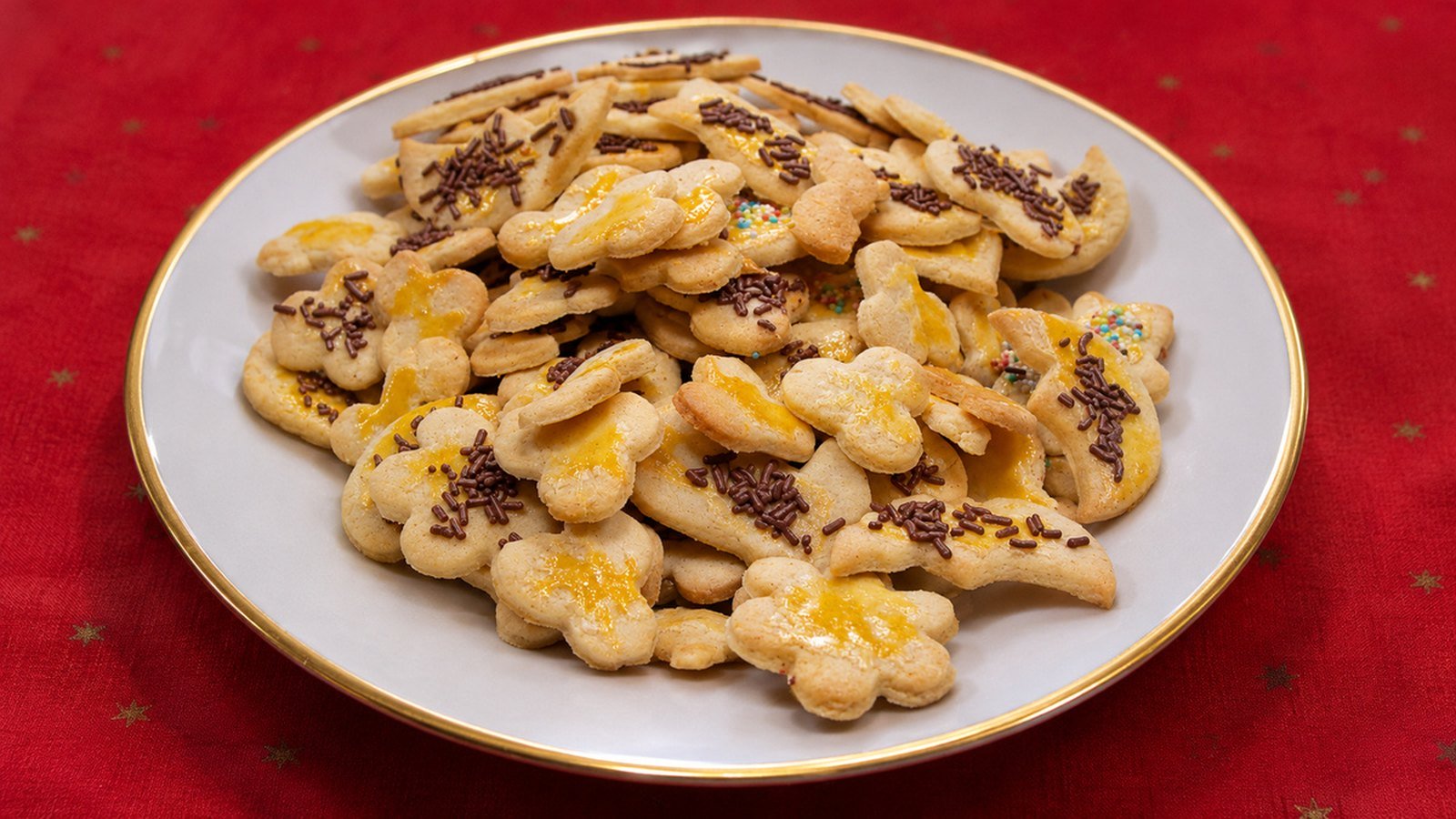
Butterbredele are the butter biscuits of Christmas in Alsace: flour, butter, sugar and egg yolks, with no raising agent and no spices, cut out with cookie cutters and baked for 10 to 12 minutes at 180 °C. They are the simplest kind of bredele, and the one people most like to decorate. The recipe below makes a big batch, enough to fill several tins for Advent.
Preparation: 30 minutes
Resting: 1 hour
Baking: 10 to 12 minutes per tray
Makes about 100 biscuits
Ingredients
- 500 g plain flour
- 250 g butter
- 250 g sugar
- 4 egg yolks
- 1 sachet of vanilla sugar
- 1 pinch of salt
Method
- Beat the softened butter with the sugar and vanilla sugar until creamy.
- Add the egg yolks one at a time, mixing well after each one.
- Add the sifted flour and the salt. Mix until the dough is smooth, shape it into a ball, wrap it in cling film and chill for at least 1 hour.
- Preheat the oven to 180 °C (gas mark 4) and let the dough come back to room temperature for a few minutes.
- Roll the dough out to about 5 mm on a floured surface, cut out shapes with cookie cutters and place them on a tray lined with baking paper.
- Bake for 10 to 12 minutes, until the biscuits are lightly golden, then leave them to cool on a wire rack.
My tip: don’t throw away the four egg whites. With icing sugar and a few drops of lemon juice, they make the royal icing used to decorate these very biscuits. Any left over will keep for a few days in the fridge in a closed jar.
How to decorate Butterbredele
The dough, neutral and rich in butter, suits any decoration. Before baking, you can brush the biscuits with beaten egg yolk and sprinkle them with pearl sugar or coloured sugar. After baking, once the biscuits are cold, pipe patterns in royal icing with a paper cone or a fine piping bag, or dip half of each biscuit in melted chocolate and leave it to set on a wire rack.
To vary them without changing the method: a teaspoon of cinnamon or gingerbread spice in the dough, 100 g of ground almonds, or the grated zest of an unwaxed orange. With spices, you get spiced bredele, the other great classic.
How to get Butterbredele right and store them
The butter gives these biscuits all their flavour: use good-quality butter, well softened for the first step. Don’t cut the chilling time short: it is what lets you roll out the dough without it sticking and keeps the outlines sharp. Work the dough in portions, leaving the rest in the fridge.
Store the cooled biscuits in an airtight tin, with baking paper between the layers, in a cool, dry place but not in the fridge. They will keep for several weeks this way.
Origins
Butterbredele belong to the bredele family, the little Christmas biscuits of Alsace; “Butter” simply means butter. They are among the most common kinds, along with almond Schwowebredle, Anisbredele and cinnamon stars. The origin of these biscuits is hard to date. The oldest clues are moulds, the earliest known of which goes back to the 14th century, and the first written mention dates from 1570, in Strasbourg. Bredele spread in the 18th century and multiplied in the early 19th, with the arrival of cookie cutters, the very ones used for Butterbredele.
The word is pronounced braedele in the Bas-Rhin as in Moselle. In the Northern Vosges, which straddle the two départements, the tradition is therefore found around La Petite-Pierre just as much as in the Pays de Bitche, in German-speaking Moselle.
What to serve them with
Simple and buttery, Butterbredele go with a coffee, a black tea or a hot chocolate in the afternoon. For a more festive moment, serve them with a sweet Alsace wine, Gewurztraminer or Pinot Gris: two grape varieties grown in the Cleebourg vineyards, at the very north of Alsace. A medium-dry Crémant d’Alsace also works.
Where to try them
During Advent, Butterbredele can be found in bakeries, often in assortments with other bredele, and at Christmas markets. In the Park, La Petite-Pierre holds a Christmas market where bredele are among the specialities. Wissembourg, Hunspach and, on the edge of the Park, Haguenau have their own too. Dates change every year: check the Christmas markets calendar or the tourist office before you set off.
Good to know
Expected crowds this week: usual, busier at the weekend
In the Northern Vosges
- 25 December Christmas Day, public holiday in France (long weekend)
- 26 December St Stephen’s Day (Alsace-Moselle), public holiday in France
- 1 January New Year's Day, public holiday in France (long weekend)
- 20 December – 3 January French school holidays
Back home: the Netherlands
- 25 December Christmas Day
- 26 December St. Stephen's Day
- 19 December – 3 January Christmas Holidays
- 13 February – 21 March Spring Holidays (depending on region)
Getting here
- From Belgium and the Netherlands by car: via Luxembourg and Metz, or via Germany towards Karlsruhe and Wissembourg.
- By train: high-speed trains to Strasbourg (via Paris) or to Karlsruhe (via Germany), then regional trains.
- On site: a car is the easiest way to get around.
Holidays: Nager.Date and OpenHolidays.