Spiced bredele: the recipe for Alsatian Christmas biscuits
Spiced bredele: a buttery shortbread dough flavoured with cinnamon, cut out with cookie cutters and baked for 10 to 12 minutes. The Christmas biscuits of Alsace and Moselle.

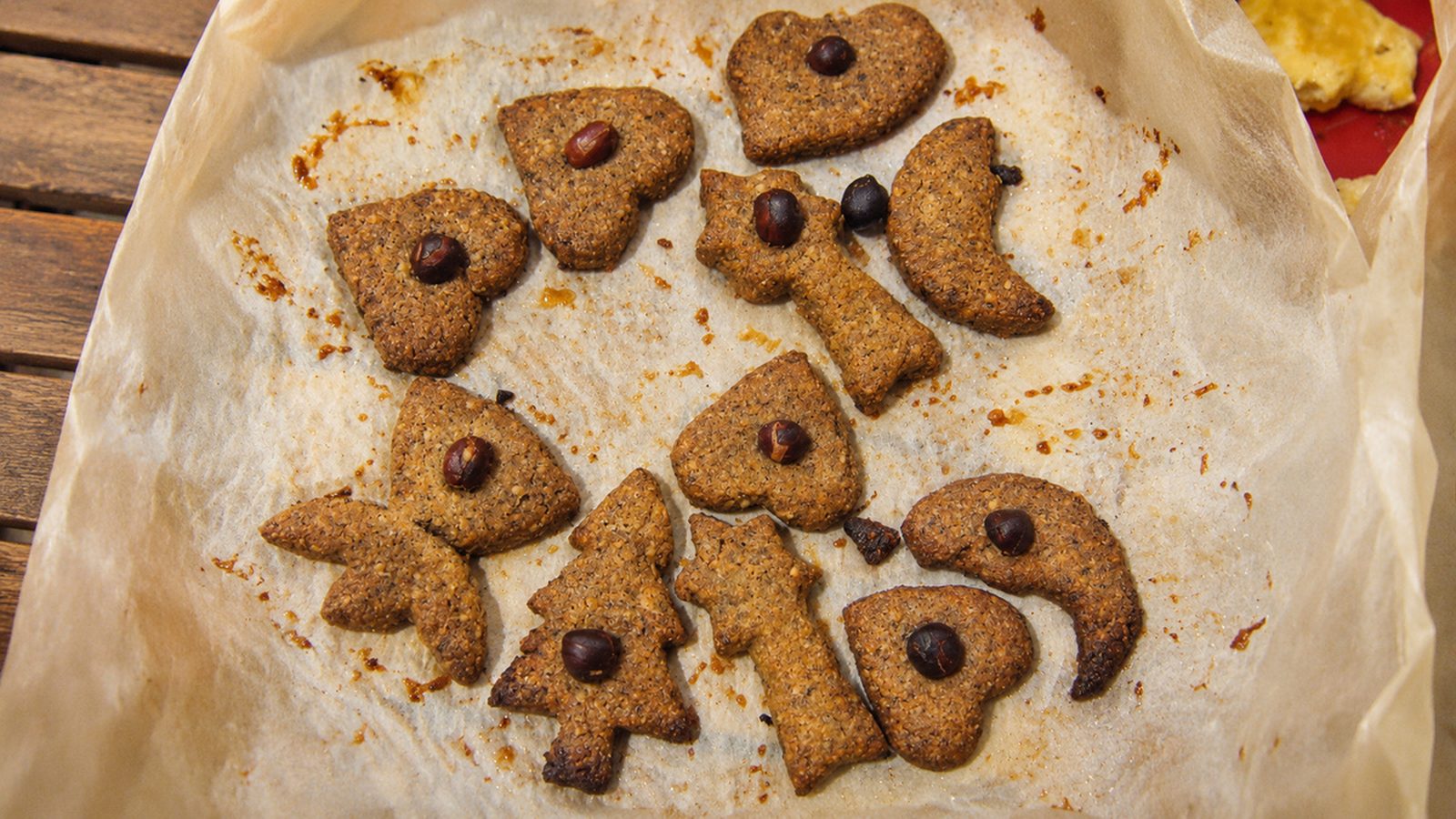
Bredele are the Christmas biscuits of Alsace: a buttery shortbread dough flavoured with cinnamon, nutmeg or anise, cut out with cookie cutters and baked for 10 to 12 minutes at 180 °C. They are made during Advent, in several batches, to give as presents and to serve right up to the holidays. In the Northern Vosges, on the Bas-Rhin side as well as the Moselle side, every household has its tin filled with bredele in December.
Preparation: 30 minutes
Resting: 1 hour
Baking: 10 to 12 minutes per tray
Makes about 40 biscuits
Ingredients
- 250 g plain flour
- 125 g softened butter
- 100 g sugar
- 1 egg
- 1 teaspoon baking powder
- Spices: cinnamon, nutmeg, anise, to taste
- Chopped almonds or hazelnuts for decoration
Method
- In a large bowl, mix the flour, baking powder and spices. Add the butter in small pieces and rub it in with your fingertips until the mixture looks like sand.
- Stir in the sugar, then the egg, and knead until the dough is smooth.
- Shape it into a ball, wrap it in cling film and leave it to rest in the fridge for at least 1 hour.
- Preheat the oven to 180 °C (gas mark 4). Roll the dough out to about 5 mm thick on a floured surface and cut out shapes with cookie cutters: stars, fir trees, hearts.
- Space the biscuits out on a tray lined with baking paper and bake for 10 to 12 minutes, until the edges are lightly golden.
- Leave to cool on a wire rack, then decorate: icing sugar, melted chocolate or jam, and a few chopped almonds or hazelnuts.
My tip: if the dough is sticky, add a spoonful of flour; if it crumbles, a tablespoon of cold milk or water. Bake one tray at a time, on the middle shelf: thin biscuits brown quickly, so keep an eye on them from 9 minutes.
Which spices to choose?
Cinnamon gives the most classic taste of Christmas. Go carefully with nutmeg: a pinch is enough. Anise adds a fresh note reminiscent of Anisbredele. You can also try vanilla, ginger, cardamom or some grated orange or lemon zest in the dough. For a different texture, replace part of the flour with ground almonds: you then come close to almond Schwowebredle.
How to store bredele
Once they have cooled completely, store them in an airtight tin, ideally a metal one, with a sheet of baking paper between the layers. Keep one tin for each kind: crisp biscuits go soft next to softer ones. Kept away from damp and heat, they last several weeks, so you can bake them from the very start of Advent.
Origins
The word comes from the Alsatian “Bredle”; depending on the area, people say braedele in the Bas-Rhin and Moselle, bredala in the Haut-Rhin and bredle in Strasbourg. The Larousse dictionary accepted it in 2018 and the Petit Robert in 2019. The exact origin of these biscuits is hard to pin down. The oldest clues are moulds, the earliest known of which dates from the 14th century. The first written mention goes back to 1570 in Strasbourg, when the city magistrate abolished the St Nicholas market. Bredele spread in the 18th century and multiplied in the early 19th, when cookie cutters became widespread.
The tradition is not only Alsatian: it is shared by German-speaking Moselle, which includes the Pays de Bitche. The Northern Vosges Regional Nature Park, which straddles the Bas-Rhin and Moselle, therefore knows it on both sides.
Other kinds of bredele
There are dozens of kinds, and every family has its favourites. The most common: Butterbredele, butter shortbread without spices; Schwowebredele, with almonds, hazelnuts or walnuts; Anisbredele, made with egg white and green anise; Zimtsterne, cinnamon stars; and Leckerli, small spiced cakes close to gingerbread. The recipe above is the simplest: a spiced shortbread dough you can vary as you like.
What to serve them with
Bredele go with afternoon coffee or tea throughout Advent. With a spiced mulled wine, they make the classic Christmas market snack. For children, a hot chocolate or a warm apple juice does the job.
As for wine, a Gewurztraminer or a medium-sweet Pinot Gris stands up to the spices and butter. Both grape varieties are grown at the very north of Alsace, in the Cleebourg vineyards, near Wissembourg. A medium-dry Crémant d’Alsace also works for a festive aperitif.
Where to try them
During Advent, bredele are sold in bakeries and at Christmas markets. In the Outre-Forêt, the Hunspach Christmas market is held in the village farmyards, with bredele among the treats; some years have included a baking workshop. La Petite-Pierre and Wissembourg also have their own Christmas markets, and Haguenau, on the edge of the Park, sets up its stalls in the town centre. Dates change every year: check the Christmas markets calendar or the tourist office before you set off.
Good to know
Expected crowds this week: usual, busier at the weekend
In the Northern Vosges
- 25 December Christmas Day, public holiday in France (long weekend)
- 26 December St Stephen’s Day (Alsace-Moselle), public holiday in France
- 1 January New Year's Day, public holiday in France (long weekend)
- 20 December – 3 January French school holidays
Back home: the Netherlands
- 25 December Christmas Day
- 26 December St. Stephen's Day
- 19 December – 3 January Christmas Holidays
- 13 February – 21 March Spring Holidays (depending on region)
Getting here
- From Belgium and the Netherlands by car: via Luxembourg and Metz, or via Germany towards Karlsruhe and Wissembourg.
- By train: high-speed trains to Strasbourg (via Paris) or to Karlsruhe (via Germany), then regional trains.
- On site: a car is the easiest way to get around.
Holidays: Nager.Date and OpenHolidays.