Truite au bleu (blue trout): the court-bouillon recipe
Truite au bleu: a very fresh trout, gutted without rinsing, cooked whole in a vinegar court-bouillon that turns its skin blue, then served with beurre blanc.

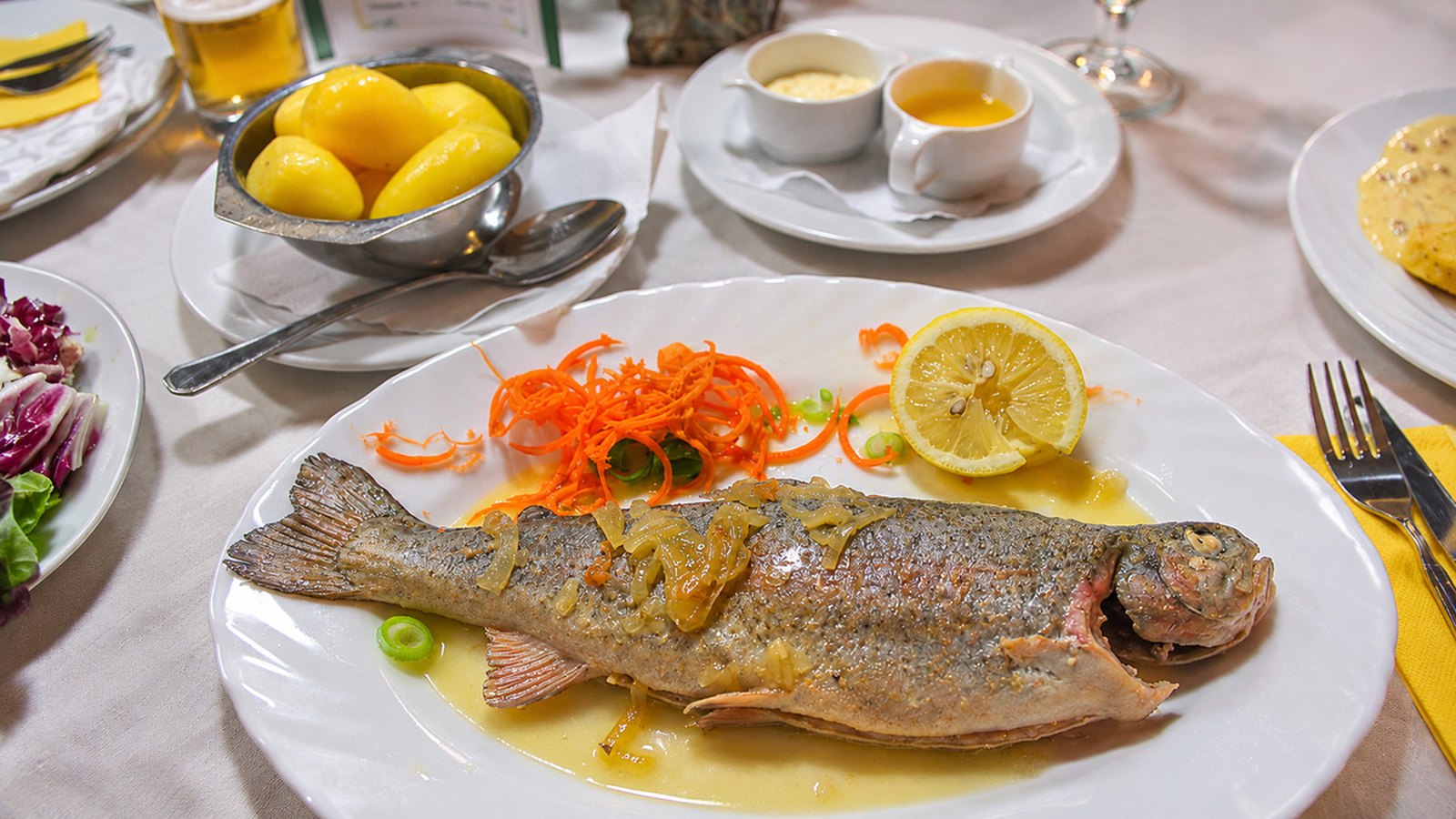
Truite au bleu (blue trout) is a very fresh trout, gutted without being rinsed and cooked whole in a vinegar court-bouillon: on contact with the vinegar, the slime on its skin takes on a bluish tint. It is served with beurre blanc and steamed potatoes. It is an old river-fish dish, known in Alsace as well as in Franche-Comté and in Germany, where it is called “Forelle blau”.
Preparation: 15 minutes
Cooking: 35 minutes (including the court-bouillon)
Ingredients
- Very fresh trout, one per person
- 2 litres water
- 1 glass white wine vinegar
- 1 onion
- 1 carrot
- 1 celery stick
- 1 bouquet garni (parsley, thyme, bay leaf)
- A few peppercorns
- Salt
- 100 g butter (for the beurre blanc)
- 1 shallot, finely chopped
- 1/2 glass dry white wine
- 1 tablespoon crème fraîche
- Salt and pepper (for the sauce)
Method
- Peel and slice the onion and carrot. Cut the celery into small pieces.
- Pour the water and vinegar into a large saucepan and add the vegetables, bouquet garni, peppercorns and salt. Bring to the boil, then simmer for 20 minutes.
- Gut the trout without rinsing or wiping it, so as to keep the slime on its skin.
- Bring the court-bouillon to a gentle boil and slide in the trout: it turns blue straight away. Cook for 10 to 15 minutes depending on its size, at a bare simmer, without turning it.
- For the beurre blanc, soften the shallot in a knob of butter, add the white wine and reduce by half. Stir in the cream, then whisk in the rest of the butter. Season with salt and pepper.
- Lift out the trout with a slotted spoon. Plate it with steamed potatoes or vegetables, coat with beurre blanc and garnish with parsley or lemon.
My tip: handle the fish as little as possible, from the shop to the pan. Every touch removes a little slime and the skin turns less blue. Ask for a whole trout, unscaled, and cook it the same day.
Why does the trout turn blue?
The colour comes from the layer of slime that covers the trout’s skin. On contact with hot vinegar, this slime turns pale blue. The acidity helps fix the colour, hence the glass of vinegar in the court-bouillon.
Three things matter: a very fresh fish, killed shortly before cooking; a trout carefully gutted, without being scaled, rinsed or wiped; and a court-bouillon that is barely simmering, not at a rolling boil, so that the flesh stays whole.
Cooking “au bleu” is not limited to trout: it also applies to other freshwater fish cooked whole, such as carp, tench or eel. It is with trout, however, that the dish is best known.
Origins
Truite au bleu is mentioned as early as the 17th century by Nicolas de Bonnefons in Les Délices de la campagne, where he applies the same method to salmon, pike and carp. Several regions with trout rivers claim it: Alsace, Franche-Comté and Germany, where “Forelle blau” often appears on restaurant menus.
In Alsace, trout is one of the freshwater fish caught or farmed locally, prepared au bleu, with almonds, smoked or in a sauce, like trout in Riesling. In the Northern Vosges, a fish farm at Petit-Wingen, in the commune of Wingen (Bas-Rhin), raises and smokes trout in the water of the Heimbach, a small first-category (trout) stream in the Wissembourg and Outre-Forêt area.
What to serve it with
Steamed potatoes and beurre blanc: the classic pairing, which keeps the fish centre stage. A squeeze of lemon or melted butter can replace the sauce.
As for wine, a crisp dry white suits both the fish and the butter: an Alsace Riesling or Sylvaner. In northern Alsace, the Cleebourg wine cooperative near Wissembourg makes both. Ideally, use the same wine for the beurre blanc. If you prefer beer, choose a light lager.
Where to try it
Truite au bleu needs a fish killed just before cooking, so in restaurants you are more likely to find it in places with a fish tank. It is also easy to cook at home if you buy trout caught that day.
To buy trout in the Park, ask at the Petit-Wingen fish farm, about fifteen kilometres from Wissembourg. For another freshwater fish in sauce, try pike in Riesling, and find the Alsatian and Lorraine classics in the Recipes section.
Good to know
Expected crowds this week: usual, busier at the weekend
In the Northern Vosges
- 25 December Christmas Day, public holiday in France (long weekend)
- 26 December St Stephen’s Day (Alsace-Moselle), public holiday in France
- 1 January New Year's Day, public holiday in France (long weekend)
- 20 December – 3 January French school holidays
Back home: the Netherlands
- 25 December Christmas Day
- 26 December St. Stephen's Day
- 19 December – 3 January Christmas Holidays
- 13 February – 21 March Spring Holidays (depending on region)
Getting here
- From Belgium and the Netherlands by car: via Luxembourg and Metz, or via Germany towards Karlsruhe and Wissembourg.
- By train: high-speed trains to Strasbourg (via Paris) or to Karlsruhe (via Germany), then regional trains.
- On site: a car is the easiest way to get around.
Holidays: Nager.Date and OpenHolidays.