Alsatian onion tart: the recipe
Alsatian onion tart: slowly softened onions bound with cream and eggs in a shortcrust case, baked for 35–40 minutes. The Alsatian Zewelwaï, a cousin of the Palatinate Zwiebelkuchen.

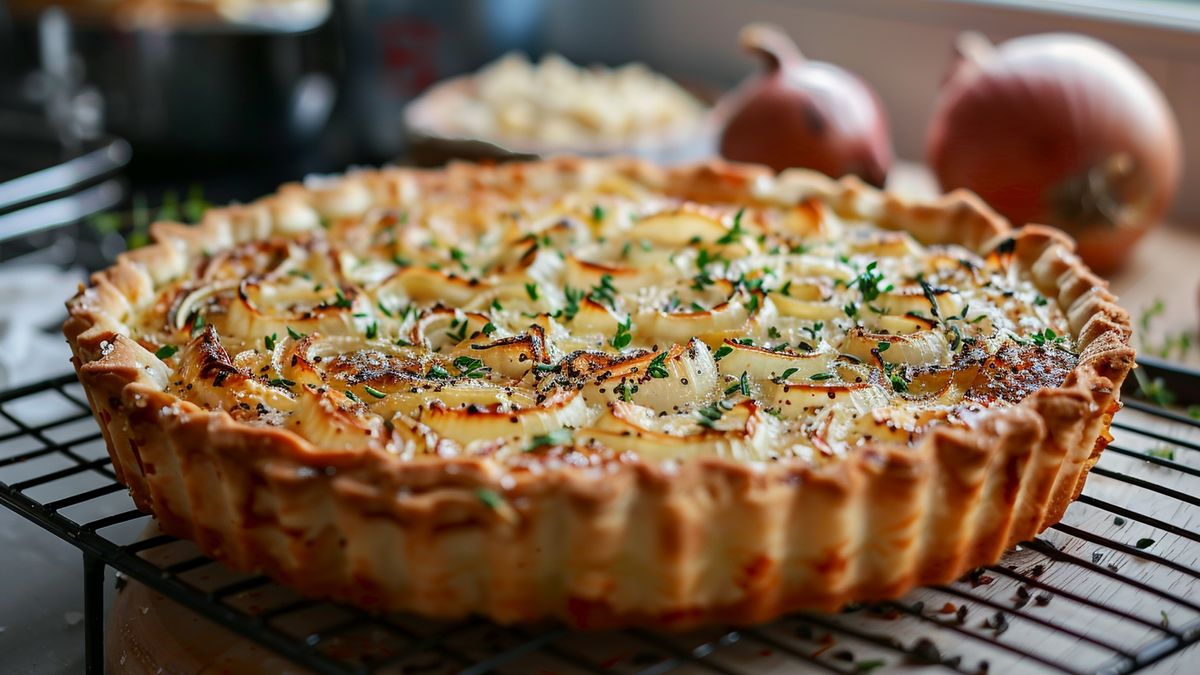
Alsatian onion tart is a shortcrust case filled with onions softened in a frying pan, bound with eggs, cream and grated cheese, then baked for 35–40 minutes at 180 °C. It is served hot or warm, as a starter or as a main course with a green salad. In dialect it is called Zewelwaï or Zwiwwelkuech; just across the border, in the Palatinate, it is the autumn Zwiebelkuchen.
Preparation: 15 minutes
Resting: 30 minutes (homemade pastry)
Cooking: 55 minutes
Serves 4
Ingredients
- 1 sheet of shortcrust pastry (homemade or shop-bought)
- 500 g onions
- 2 tablespoons olive oil
- 2 eggs
- 200 ml crème fraîche
- 100 g grated cheese (Gruyère, Comté or Emmental)
- Salt and pepper
- 1 pinch of nutmeg (optional)
- For homemade pastry: 250 g flour
- For homemade pastry: 125 g cold butter, diced
- For homemade pastry: 1 pinch of salt
- For homemade pastry: 50 ml cold water
Method
- Homemade pastry (optional): mix the flour and salt, rub in the butter with your fingertips, then add the water a little at a time. Shape into a ball, wrap it in cling film and chill for 30 minutes.
- Peel the onions and slice them thinly.
- Cook the onions in the olive oil over a medium heat for about 15 minutes, stirring, until translucent and lightly golden. Season with salt and pepper and add the nutmeg.
- Beat the eggs with the crème fraîche, add the grated cheese, season, then stir in the cooked onions.
- Preheat the oven to 180 °C (gas mark 4). Roll out the pastry, line a tart tin with it and prick the base with a fork.
- Pour the filling into the pastry case and spread it evenly.
- Bake for 35–40 minutes, until the tart is nicely golden.
- Leave to rest for a few minutes before removing from the tin. Serve hot or warm, with a green salad.
My tip: do not rush the onions. If they colour too quickly, turn down the heat and add a spoonful of water: they should melt, not fry. Really tender onions make a soft, sweet filling with no bitterness.
Origins
Onion tart is an Alsatian speciality, known in dialect as Zewelwaï and Zwiwwelkuech. The principle hardly changes from one household to another: finely sliced onions cooked slowly in fat (butter, oil or lard), bound with cream and eggs on a shortcrust base. Many cooks add bacon.
The same tart is made throughout southern Germany and Switzerland under the name Zwiebelkuchen, often on a yeast dough and sometimes seasoned with caraway. In the Palatinate it traditionally goes with Federweißer, the new wine that is still fermenting, in September and October. The Palatinate begins on Wissembourg’s doorstep: the German Wine Route starts in the border village of Schweigen, and the Pfälzerwald, the Palatinate Forest, forms a cross-border biosphere reserve recognised by UNESCO together with the Northern Vosges.
With or without cheese?
The recipe above adds 100 g of grated cheese, which brings it closer to a quiche. Classic descriptions of the Alsatian tart and of Zwiebelkuchen mention only onions, cream, eggs and bacon. For a more traditional version, leave out the cheese, soften the onions in butter and add lardons browned in a frying pan. In spring, a variation replaces the onions with chives.
Do not confuse it with tarte flambée: that is made on a very thin bread dough, spread with cream, onions and lardons, and baked in a few minutes at a very high temperature.
What to serve it with
A well-dressed green salad is all you need: it brings the freshness that a creamy filling lacks.
For wine, choose a dry, fruity white. In Alsace, a Sylvaner, a Pinot Blanc or an Edelzwicker work well; a Pinot Noir rosé is also a good match. In the north of Alsace, near Wissembourg, the Cleebourg vineyards produce Sylvaner, Pinot Blanc and Auxerrois. In autumn, do as they do in the Palatinate: have a glass of new wine, the cloudy, sweet, low-alcohol fermenting must that is also served at Alsatian harvest festivals and is called Federweißer across the Rhine.
Where to try it
Onion tart is on the menu all year round in winstubs and Alsatian restaurants, usually as a starter. It is also eaten cold, on a picnic or a hike.
During the grape harvest, from mid-September to the end of October, the wine villages of the Palatinate hold Federweißer festivals where Zwiebelkuchen is served with the new wine. The nearest are about ten kilometres north of Wissembourg, for example in Kapellen-Drusweiler, or in Klingenmünster, where the Pfälzerwald hiking club holds its own around a hut reached on foot. The dates change every year, so check them before you set off.
On the French side, the village festivals calendar lists autumn communal meals and festivities, and the Recipes section brings together the other classics of Alsatian and Lorraine cooking.
Good to know
Expected crowds this week: usual, busier at the weekend
In the Northern Vosges
- 25 December Christmas Day, public holiday in France (long weekend)
- 26 December St Stephen’s Day (Alsace-Moselle), public holiday in France
- 1 January New Year's Day, public holiday in France (long weekend)
- 20 December – 3 January French school holidays
Back home: the Netherlands
- 25 December Christmas Day
- 26 December St. Stephen's Day
- 19 December – 3 January Christmas Holidays
- 13 February – 21 March Spring Holidays (depending on region)
Getting here
- From Belgium and the Netherlands by car: via Luxembourg and Metz, or via Germany towards Karlsruhe and Wissembourg.
- By train: high-speed trains to Strasbourg (via Paris) or to Karlsruhe (via Germany), then regional trains.
- On site: a car is the easiest way to get around.
Holidays: Nager.Date and OpenHolidays.