Alsatian semolina dumplings (Griessknepfle): the recipe
Semolina dumplings, or Griessknepfle, are made with fine semolina cooked in milk and butter, bound with eggs and then poached. An Alsatian side dish, savoury, baked au gratin or sweet.

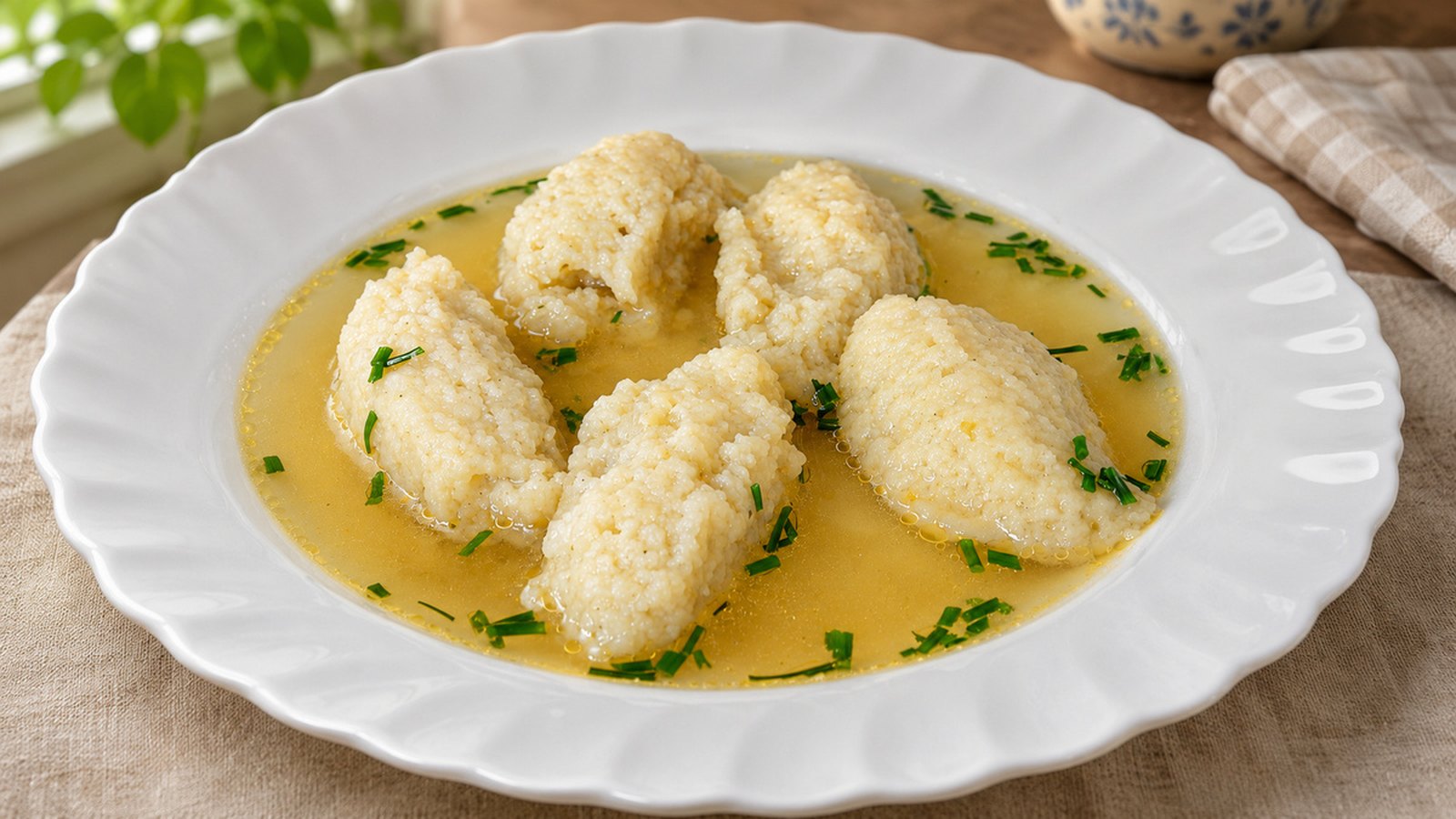
Semolina dumplings, known in Alsace as Griessknepfle, are made with fine wheat semolina cooked in milk and butter, bound with eggs and flavoured with nutmeg. They are shaped between two spoons, then poached for a few minutes in simmering salted water. Serve them with meat in a sauce, bake them au gratin, or enjoy a sweet version with stewed fruit.
Cooking time: 10 to 15 minutes, plus 15 to 20 minutes in the oven for the gratin version
Serves 4 as a side dish
Ingredients
- 100 g fine wheat semolina
- 500 ml milk
- 25 g butter
- 2 eggs
- 1 pinch of nutmeg
- Salt and pepper
Method
- Heat the milk over a medium heat with the butter, nutmeg, salt and pepper until the butter has melted.
- Sprinkle in the semolina while stirring, lower the heat and cook for 2 to 3 minutes, until thickened.
- Remove from the heat and leave to cool slightly. Beat in the eggs one at a time until you have a smooth, slightly sticky dough.
- Shape the dumplings using two tablespoons.
- Slide them into a large pan of simmering salted water and cook for 5 to 10 minutes, until they rise to the surface. Drain.
- For a gratin version, cover them with béchamel or tomato sauce, sprinkle with grated cheese and bake for 15 to 20 minutes at 180 °C (350 °F, gas mark 4).
My tip: poach a single dumpling first to test the dough. If it falls apart in the water, add a spoonful of semolina to the dough and let it firm up for a few minutes before carrying on. Keep the water barely simmering: a rolling boil damages the dumplings.
What are Griessknepfle?
“Griess” means semolina, and in Alsace “Knepfle” refers to dumplings and quenelles. Griessknepfle are therefore semolina dumplings. Depending on the family and the part of Alsace, they are also called Griesknepfle or Griespflutta.
They are cousins of Mehlknepple, flour dumplings, and of liver dumplings.
Origins
Griessknepfle belong to the large family of Knepfle, poached dumplings known from Lorraine and Alsace all the way to Central Europe. Wheat semolina, cooked in milk and bound with egg, makes them a mild and inexpensive version.
In Austria and Bavaria, semolina dumplings (Grießnockerl) are mainly served in a clear broth, as a soup. In Alsace, they are usually eaten on their own: savoury, with meat, or sweet, with stewed apples, pears or quetsch plums, sometimes rolled in sugar and cinnamon.
For the sweet version, in late summer and autumn, the quetsch plum compote served with Dampfnudle works just as well.
What to serve with them
Savoury semolina dumplings go with meat in a sauce: coq au Riesling, roast pork or a blanquette. They can also be added to a beef broth, the Austrian way. Baked au gratin with béchamel, they make a complete meal with a green salad.
As for wine, it all depends on the main dish. For the gratin version, an Alsace Pinot Blanc, which pairs easily with baked dishes, is a good match. The Cleebourg vineyards, near Wissembourg, make it in the form of Auxerrois. With the sweet version, an apple or pear juice from the orchard is all you need.
Where to try them
Semolina dumplings are home cooking: they are made in family kitchens far more often than they appear on menus. The simplest option is to make them yourself, buying eggs, milk and fruit at the local markets.
Find the other Alsatian and Lorraine classics in the Recipes section.
Good to know
Expected crowds this week: usual, busier at the weekend
In the Northern Vosges
- 25 December Christmas Day, public holiday in France (long weekend)
- 26 December St Stephen’s Day (Alsace-Moselle), public holiday in France
- 1 January New Year's Day, public holiday in France (long weekend)
- 20 December – 3 January French school holidays
Back home: the Netherlands
- 25 December Christmas Day
- 26 December St. Stephen's Day
- 19 December – 3 January Christmas Holidays
- 13 February – 21 March Spring Holidays (depending on region)
Getting here
- From Belgium and the Netherlands by car: via Luxembourg and Metz, or via Germany towards Karlsruhe and Wissembourg.
- By train: high-speed trains to Strasbourg (via Paris) or to Karlsruhe (via Germany), then regional trains.
- On site: a car is the easiest way to get around.
Holidays: Nager.Date and OpenHolidays.