Coq à la Bière: Cockerel Braised in Dark Beer
Coq à la bière: a cockerel browned in a casserole, then braised for two hours in dark beer with lardons, carrots and herbs. A cousin of coq au riesling, with twenty minutes’ preparation.

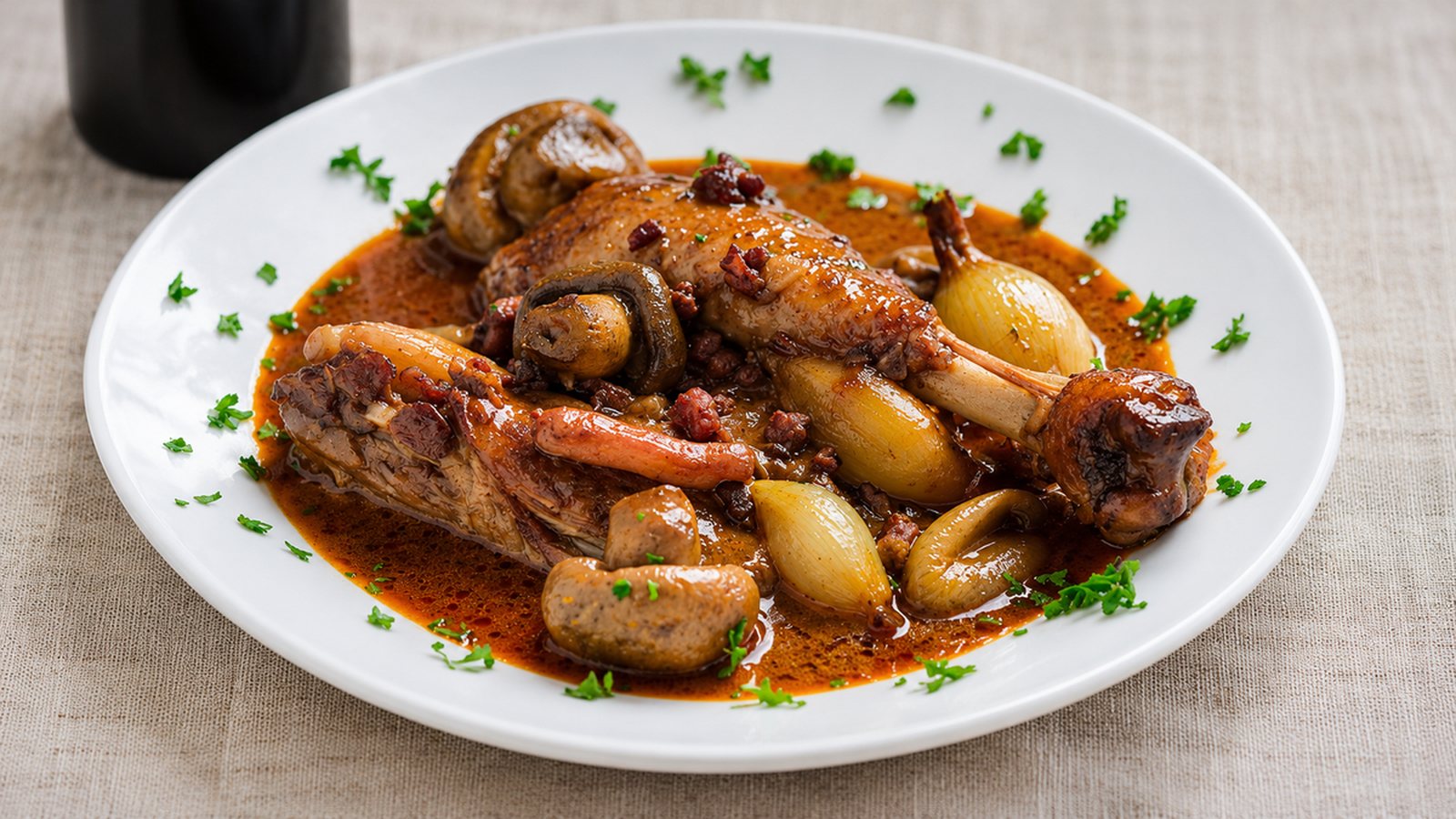
Coq à la bière is a jointed cockerel, browned in a casserole and then braised for two hours in dark beer with lardons, carrots, onions, garlic, thyme and bay leaves. It is a cousin of coq au riesling: same method, but beer replaces the white wine. A winter dish that takes twenty minutes to prepare and then cooks by itself.
Preparation: 20 minutes
Cooking: 2 hours
Ingredients
- 1 whole cockerel, jointed
- 500 ml dark beer
- 4 carrots
- 2 onions
- 200 g lardons
- 3 garlic cloves
- 2 sprigs of thyme
- 2 bay leaves
- Fresh parsley
- Olive oil
- Salt and pepper
Method
- Peel the carrots and cut them into rounds. Slice the onions and crush the garlic.
- Heat a drizzle of olive oil in a large casserole (Dutch oven) and brown the pieces of cockerel for a few minutes on each side, then set them aside.
- In the same pot, cook the onions and lardons until the onions are translucent, then add the carrots and garlic for a few minutes.
- Return the bird to the pot, pour in the dark beer, add the thyme and bay leaves and bring to the boil.
- Cover and simmer over a low heat for about 2 hours.
- Adjust the seasoning, reduce the sauce uncovered if needed and scatter with chopped parsley before serving.
My tip: choose a dark beer that is not too bitter. The sauce reduces for two hours and the bitterness of the hops becomes more concentrated along with it. If in doubt, an amber beer gives a milder sauce.
Why a cockerel and not a chicken?
A cockerel is an older, more muscular bird than a chicken. Its firm flesh stands up to long, covered cooking and gives a richer sauce: hence the two hours of braising. The recipe also works with a free-range chicken, but the meat will be done much sooner, so keep an eye on it so that it does not fall apart.
You can also cook it in the oven, in a covered casserole, at a low temperature. It needs less watching than on the hob.
Origins
Coq à la bière belongs to the family of braised poultry dishes from eastern and northern France. In Alsace it is cited as a variation on coq au riesling, the region’s white-wine poultry dish. It is just as common in northern France and in Belgium, two other beer-loving regions. No source gives it a specific place or date of origin.
Beer is well established on both sides of the Park. On the Alsatian side it goes into other recipes, such as beer soup. On the Lorraine side, the region is France’s third-largest beer producer. In Saverne, on the edge of the Park, beer has been brewed since 1845.
What to serve it with
The sauce calls for something to soak it up: steamed or mashed potatoes, fresh pasta or spätzle, the small egg noodles of Alsatian cooking. The carrots from the pot and a green salad are all you need to round it off.
To drink, serve the beer you cooked with or a dark beer in the same style. If you prefer wine, a light Alsace pinot noir stands up to the sauce without overpowering it.
Where to try it
Coq à la bière is above all a home-cooked dish for autumn and winter Sundays. The easiest option is to make it yourself with a beer brewed in Alsace or Lorraine. At the end of summer, the Saverne beer festival, held in the grounds of the Château des Rohan, is a chance to try the local brewery’s beers; check that year’s dates with the tourist office.
For more of the region’s slow-cooked dishes, browse the Recipes section.
Good to know
Expected crowds this week: usual, busier at the weekend
In the Northern Vosges
- 25 December Christmas Day, public holiday in France (long weekend)
- 26 December St Stephen’s Day (Alsace-Moselle), public holiday in France
- 1 January New Year's Day, public holiday in France (long weekend)
- 20 December – 3 January French school holidays
Back home: the Netherlands
- 25 December Christmas Day
- 26 December St. Stephen's Day
- 19 December – 3 January Christmas Holidays
- 13 February – 21 March Spring Holidays (depending on region)
Getting here
- From Belgium and the Netherlands by car: via Luxembourg and Metz, or via Germany towards Karlsruhe and Wissembourg.
- By train: high-speed trains to Strasbourg (via Paris) or to Karlsruhe (via Germany), then regional trains.
- On site: a car is the easiest way to get around.
Holidays: Nager.Date and OpenHolidays.