Mannele (Manala): Recipe for the Saint Nicholas Brioche Man
A milk brioche shaped into a little man, glazed with egg and decorated with raisins, baked for Saint Nicholas’ Day.

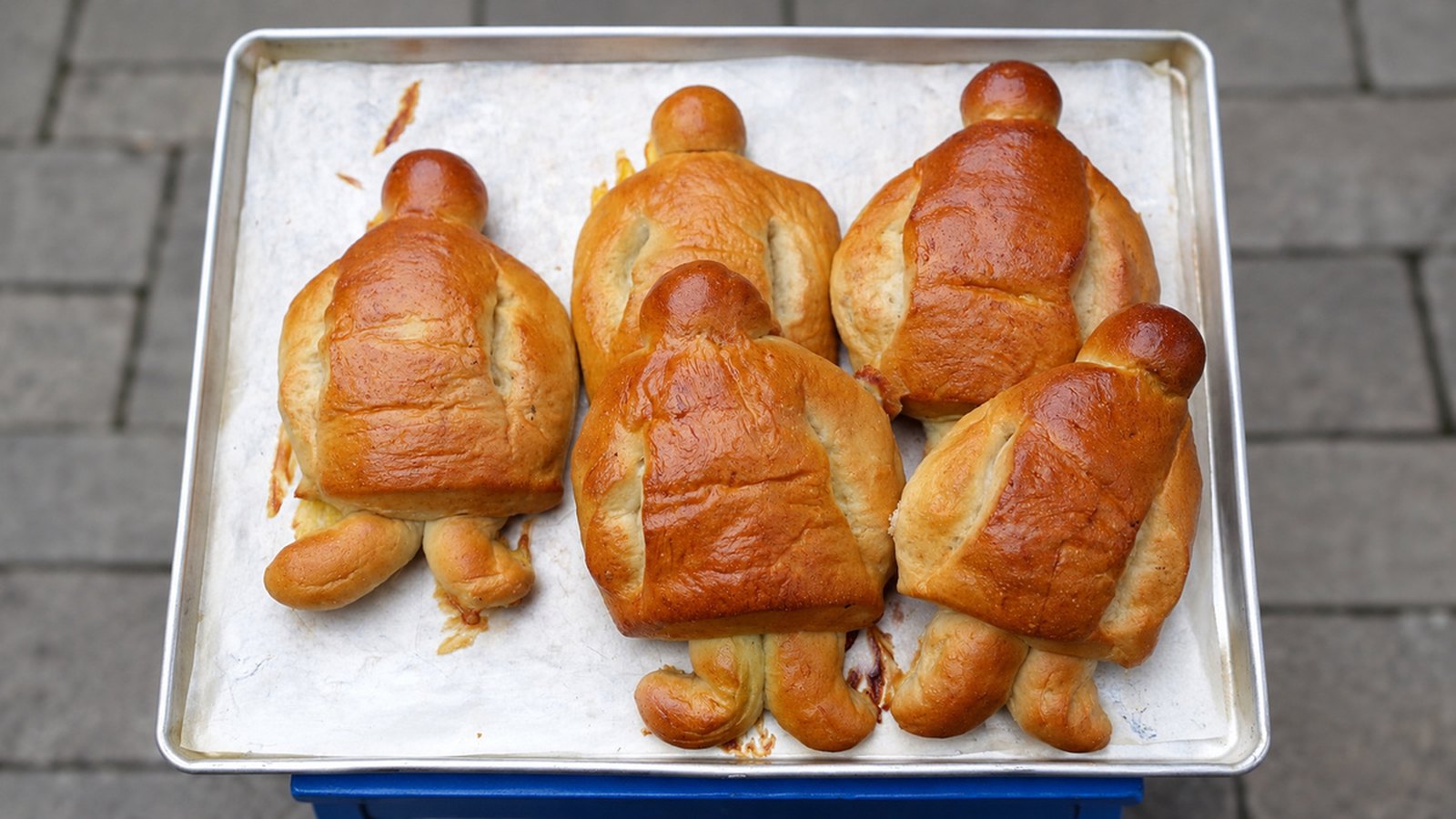
The mannele is a brioche shaped like a little man, baked for Saint Nicholas’ Day on 6 December. The dough is a light milk brioche, rolled into a log and then snipped with scissors to shape the head, arms and legs. In the Northern Vosges, which straddle the Bas-Rhin and Moselle, it is called mannele; further south in Alsace, people tend to say manala.
Preparation: 30 minutes
Resting: 2 hours 15 minutes (two rises)
Baking: 15 to 18 minutes
Makes 8 mannele
Ingredients
For the dough
- 500 g wheat flour (French type T45 or T55)
- 20 g fresh baker’s yeast
- 250 ml lukewarm whole milk
- 70 g caster sugar
- 1 egg
- 80 g softened butter
- 8 g salt
For decorating
- 1 egg yolk and 1 tablespoon milk for the glaze
- A handful of raisins or chocolate chips
- Pearl sugar (optional)
Method
- Dissolve the yeast in 50 ml of the lukewarm milk and leave to stand for 10 minutes.
- In a large bowl, mix the flour, sugar and salt. Add the egg, the dissolved yeast and the rest of the milk, then knead for 8 to 10 minutes.
- Work in the softened butter in pieces and knead for another 5 minutes, until the dough is smooth and comes away from the sides of the bowl.
- Cover with a tea towel and leave to rise for 1 hour 30 minutes in a warm place, until doubled in size.
- Knock back the dough and divide it into 8 pieces of about 110 g. Roll each into a 15 cm log, slightly thicker at the top.
- Pinch the top of the log to mark the neck and form the head. At the lower third, cut the dough in two with scissors for the legs; on each side of the body, a slanting snip frees the arms.
- Place the little men on a baking tray lined with baking paper, spacing them well apart. Leave to rise for 45 minutes.
- Brush with the egg yolk mixed with the milk. Press in two raisins for the eyes and three for the buttons, and sprinkle with pearl sugar if you like.
- Bake for 15 to 18 minutes in an oven preheated to 180 °C, until the mannele are nicely golden. Leave to cool slightly on a wire rack.
My tip: press the raisins in deeply, just before baking. If they sit on the surface, they pop out as the dough puffs up and burn in the oven. And don’t cut the legs too high: a man that is too thin dries out before it has browned.
Shaping the little man
Shaping takes two steps. First the log, which you roll under your palm, leaving the top a little thicker. Then the scissors, which cut the body without separating it. Wet the blades: the dough sticks less and the cut stays clean.
Spread the legs and arms slightly apart on the tray. The dough swells as it rises and bakes, and a man that is too tight closes up again. Some bakers add a scarf made from a strip of dough, or a stick tucked into the hand. These details don’t change the taste, but children notice them.
Variations
The brioche can be studded with raisins mixed into the dough, or with chocolate chips added at the end of kneading. Once baked, the mannele can be half-dipped in melted chocolate or dusted with icing sugar. For a richer dough, replace 50 ml of the milk with a second egg.
You can make the dough the day before. After kneading, leave it to rise overnight in the fridge, well covered. In the morning, shape it straight away, then allow a slightly longer rise, as the dough is cold.
Origins
The name comes from Alsatian and Lorraine Franconian and means “little man”. Depending on the region, the brioche is called mannele or männele in northern Alsace and Moselle, mannala in southern Alsace and Jean Bonhomme in Franche-Comté. In Germany it is known as Weckmann or Stutenkerl; in German-speaking Switzerland, Grittibänz.
In German-speaking lands, these brioches have been linked to Saint Nicholas’ Day since the 15th century. The little man represents the holy bishop of Myra, patron saint of Lorraine since 1477. On his rounds, Saint Nicholas traditionally hands out an orange, gingerbread or a brioche in his likeness. In German-speaking Lorraine he comes on the evening of 5 December; in Alsace, on 6 December. In parts of western Germany, the same little man is eaten instead on St Martin’s Day, 11 November, and often carries a small clay pipe.
The Northern Vosges lie between these traditions. The Regional Nature Park brings together municipalities in the Bas-Rhin and Moselle and borders the German Palatinate: the two names, and the two calendars, meet on either side of the border.
What to serve it with
The mannele is eaten as an afternoon snack, with a bowl of hot chocolate or a milky coffee. It is perfect for dunking. For adults, a mulled wine goes well with an Advent afternoon treat, along with a slice of gingerbread.
The next day, a slightly stale brioche can be toasted and spread with butter and jam. It keeps for two days in an airtight tin, or can be frozen as soon as it has cooled.
Where to taste it
Bakeries in Alsace and Moselle make mannele in late November and December, around Saint Nicholas’ Day. In schools, the saint often hands out brioches during his visit. The Saint Nicholas Market in Haguenau, on the edge of the Park, includes an afternoon visit from Saint Nicholas.
The Christmas markets of the Northern Vosges, such as the one in Wissembourg around the abbey church, open from late November. Dates change every year: check the Christmas markets calendar before you set off. For more seasonal bakes, browse the Recipes section, including the spiced bredele.
Good to know
Expected crowds this week: usual, busier at the weekend
In the Northern Vosges
- 25 December Christmas Day, public holiday in France (long weekend)
- 26 December St Stephen’s Day (Alsace-Moselle), public holiday in France
- 1 January New Year's Day, public holiday in France (long weekend)
- 20 December – 3 January French school holidays
Back home: the Netherlands
- 25 December Christmas Day
- 26 December St. Stephen's Day
- 19 December – 3 January Christmas Holidays
- 13 February – 21 March Spring Holidays (depending on region)
Getting here
- From Belgium and the Netherlands by car: via Luxembourg and Metz, or via Germany towards Karlsruhe and Wissembourg.
- By train: high-speed trains to Strasbourg (via Paris) or to Karlsruhe (via Germany), then regional trains.
- On site: a car is the easiest way to get around.
Holidays: Nager.Date and OpenHolidays.