Savoury kougelhopf with walnuts and bacon: an Alsatian recipe
Kougelhopf with walnuts and bacon: a yeasted dough rolled around its filling, sliced into the fluted mould and baked for 40 to 50 minutes. The savoury brioche of the Alsatian aperitif.

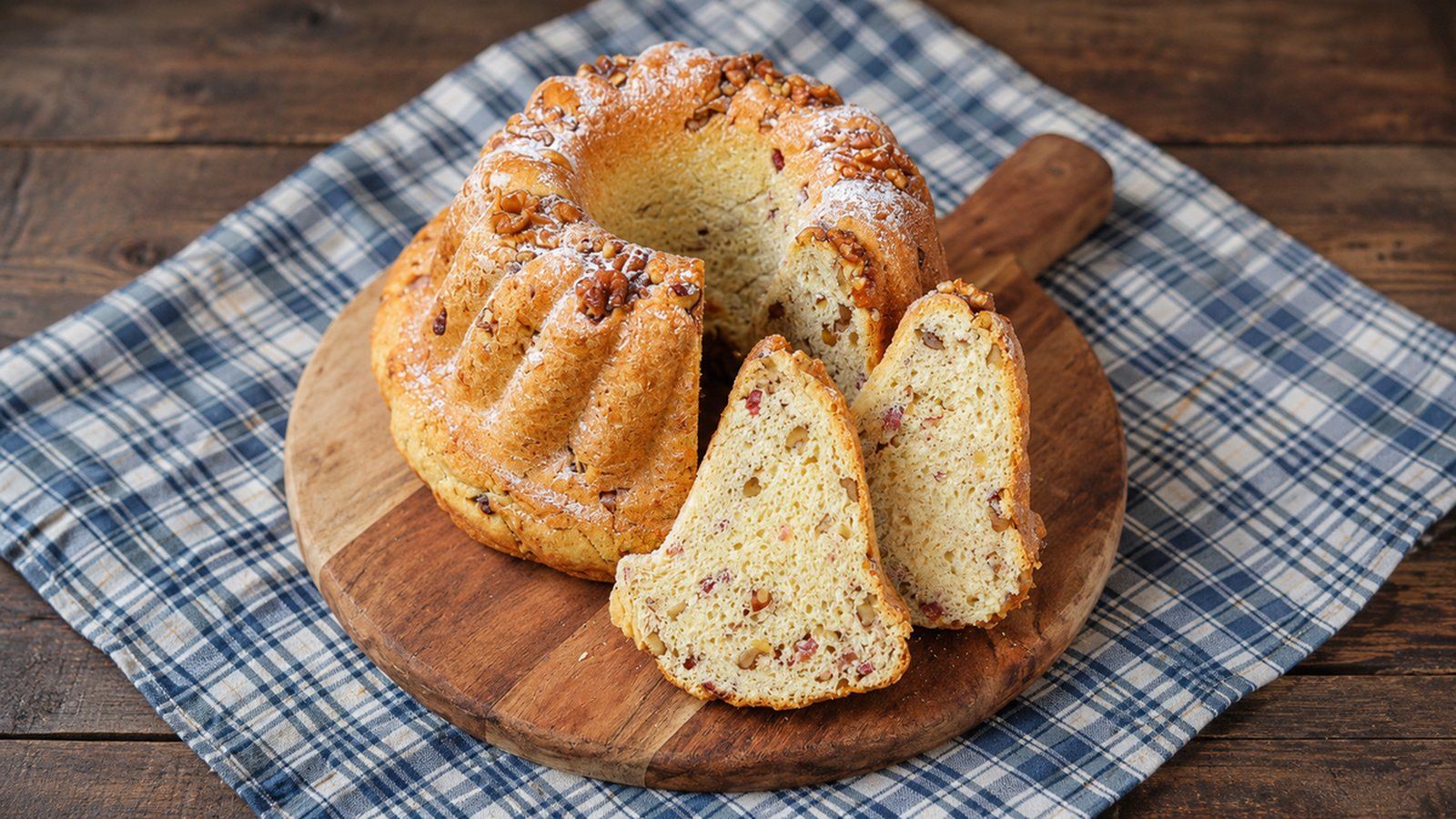
Kougelhopf with walnuts and bacon is the savoury version of Alsace’s ring-shaped brioche: a yeasted dough enriched with milk and butter, rolled around golden lardons (diced bacon) and chopped walnuts, then baked for 40 to 50 minutes in the fluted mould. It is served warm and sliced as an aperitif snack. A classic on Alsatian tables, it is ideal made the day before a party or for a meal with friends.
Preparation: about 30 minutes
Rising: 2 to 3 hours (two rises)
Baking: 40 to 50 minutes
Makes 1 kougelhopf mould
Ingredients
- 500 g flour
- 1 sachet dried baker’s yeast
- 200 ml lukewarm milk
- 100 g butter, melted, plus a little for the mould
- 2 eggs
- 150 g lardons (diced bacon)
- 100 g walnuts, roughly chopped
- 1 tsp salt
- 1 tbsp sugar
Method
- Mix the lukewarm milk with the sugar, add the yeast and leave for about 10 minutes, until the mixture is frothy.
- Sift the flour and salt into a mixing bowl. Make a well, pour in the activated yeast, the beaten eggs and the melted butter, then mix.
- Knead for about 10 minutes on a floured work surface until the dough is soft and elastic. Shape it into a ball, cover and leave to rise in a warm place for 1 to 2 hours: it should double in size.
- While the dough is rising, fry the lardons until golden, drain them on kitchen paper and roughly chop the walnuts.
- Knock back the dough and roll it out into a rectangle about 1 cm thick. Scatter the lardons and walnuts over the whole surface.
- Roll up the dough, cut the roll into thick slices and arrange them in a generously buttered kougelhopf mould. Cover and leave to rise for about 1 hour.
- Bake for 40 to 50 minutes in an oven preheated to 180°C (350°F), until a knife blade comes out clean. Wait a few minutes before turning it out, then leave to cool on a wire rack.
My tip: let the lardons cool completely before spreading them over the dough. If they are still hot, they melt the butter and the dough sticks as you roll it. If your mould is earthenware, brush the butter right into the flutes.
Why roll the dough?
In many recipes, the filling is simply kneaded into the dough. Here the dough is rolled out, topped, rolled up and sliced, so the lardons and walnuts form even spirals and every slice gets its share. The result cuts neatly, which is handy for an aperitif. Another method, with softened onion and a pinch of nutmeg mixed into the dough, is explained in our savoury kougelhopf with bacon and onion.
Origins
Kougelhopf, also spelt kouglof, is a ring-shaped brioche cake baked in a fluted mould and known throughout Central Europe and the German-speaking world: Alsace, Lorraine, Austria and southern Germany. The origin of the word remains unknown, and the Alsatian legends about its birth, involving the Three Wise Men or a baker named Kugel, belong to folklore. One of the oldest written recipes is the one published by Alexandre Dumas in 1873 and attributed to Carême.
The sweet version, with raisins and almonds, is eaten mainly at breakfast; you will find the recipe in our traditional kougelhopf. The savoury version, with bacon and walnuts, has become the aperitif favourite.
In northern Alsace, kougelhopf is also a story of potters: the traditional mould is made of glazed earthenware from Soufflenheim, near Haguenau, where pottery workshops still make them today. Its central chimney spreads the heat through the dough, so it bakes evenly.
What to serve it with
Sliced and warm, savoury kougelhopf goes well with a glass of Crémant d’Alsace or a dry, fruity white such as Auxerrois or Sylvaner. The Cleebourg vineyards, near Wissembourg, produce both grape varieties as well as several crémants. A pale Alsace lager works too.
It rounds out a buffet alongside a tarte flambée (Flammekueche) cut into squares, or can be served at lunchtime with a green salad or a soup. It keeps for two or three days in an airtight tin and can be warmed through in the oven for a few minutes.
Where to try it
Savoury kougelhopf is sold in Alsatian bakeries and patisseries and is a regular on aperitif buffets. For a long time kougelhopf was the cake for special occasions: Christmas, weddings, births and village festivals, whose upcoming dates in the Northern Vosges are listed in the events calendar.
To put together a full Alsatian aperitif, browse our Recipes section.
Good to know
Expected crowds this week: usual, busier at the weekend
In the Northern Vosges
- 25 December Christmas Day, public holiday in France (long weekend)
- 26 December St Stephen’s Day (Alsace-Moselle), public holiday in France
- 1 January New Year's Day, public holiday in France (long weekend)
- 20 December – 3 January French school holidays
Back home: the Netherlands
- 25 December Christmas Day
- 26 December St. Stephen's Day
- 19 December – 3 January Christmas Holidays
- 13 February – 21 March Spring Holidays (depending on region)
Getting here
- From Belgium and the Netherlands by car: via Luxembourg and Metz, or via Germany towards Karlsruhe and Wissembourg.
- By train: high-speed trains to Strasbourg (via Paris) or to Karlsruhe (via Germany), then regional trains.
- On site: a car is the easiest way to get around.
Holidays: Nager.Date and OpenHolidays.