Christstollen (Chrischtstolle), the Christmas stollen: the recipe
Christstollen, or Chrischtstolle: a buttery Christmas bread with rum-soaked raisins and almonds, folded, baked for 45 to 50 minutes, then dusted with icing sugar. The cake of Advent.

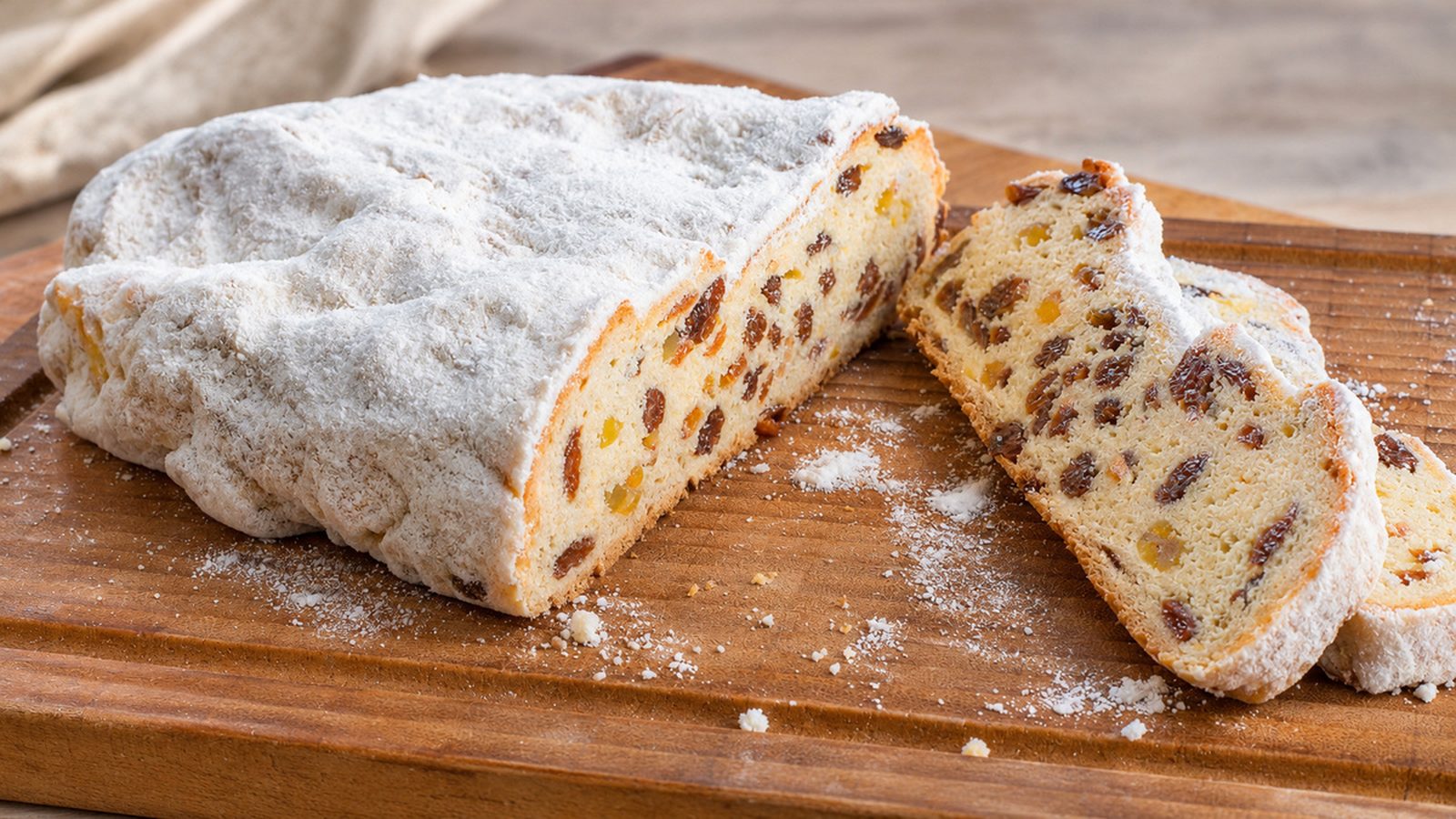
Chrischtstolle, or Christstollen, is a Christmas bread made from a butter-rich yeast dough, filled with rum-soaked raisins, flaked almonds and lemon zest. Folded before baking, brushed with butter and then coated with icing sugar, it is made during Advent and keeps for several days. Originally from Germany, it is known in Alsace as well as in Lorraine.
Preparation: 1 hour
Resting: 3 hr 10 min (soaking and two rises)
Baking: 45 to 50 minutes
Makes 1 stollen
Ingredients
- 500 g flour
- 200 g butter, plus a little melted butter for finishing
- 200 g raisins
- 100 g sugar
- 100 g flaked almonds
- 2 eggs
- 250 ml milk
- 1 sachet baker’s yeast
- 1 teaspoon salt
- 1 tablespoon rum
- The zest of one lemon
- Icing sugar for finishing
Method
- Soak the raisins in the rum for about thirty minutes.
- Mix the yeast with the lukewarm milk and a tablespoon of sugar, and leave to froth for about ten minutes.
- Sift the flour with the salt and the rest of the sugar, then add the flaked almonds and lemon zest.
- Make a well, add the eggs and the melted, slightly cooled butter, and mix until smooth.
- Gradually work in the yeast mixture while kneading, then the drained raisins. The dough should be soft and slightly sticky.
- Leave to rise for 1 hour 30 minutes to 2 hours in a warm place, until the dough has doubled in size.
- Knock back the dough, roll it into a rectangle about 2 cm thick and fold it over to give the stollen its shape.
- Place it on a baking tray lined with baking paper and leave to rise for 30 minutes. Preheat the oven to 180 °C (gas mark 4).
- Bake for 45 to 50 minutes, covering with foil if the top browns too quickly.
- As soon as it comes out of the oven, brush with melted butter, leave to cool on a rack, then dust generously with icing sugar.
My tip: don’t cut the stollen on the day you bake it. Wrapped in foil and kept somewhere cool, it firms up and its flavours blend over a few days. Make it at the start of Advent so you can cut into it as Christmas approaches.
Why this shape and the icing sugar?
Stollen is a long, domed loaf, folded over on itself before baking. According to an often-told tradition, its shape and its coat of icing sugar recall the swaddled Christ Child: hence the name Christstollen, the “stollen of Christ”. The butter brushed on straight from the oven feeds the crust and holds the icing sugar, which keeps the cake from drying out.
Variations
German recipes often add candied fruit (orange and lemon peel), spices or a roll of marzipan in the centre. The version above is simpler: raisins, almonds and lemon. You can add 100 g of candied peel without changing the rest of the recipe.
Origins
Stollen was born in Germany. Its oldest known written mention dates from 1329: a privilege granted to the bakers’ guild of Naumburg, in Saxony-Anhalt, whose Latin original has been lost. Dresden made it its speciality, and Dresdner Stollen has been protected by a European geographical indication since 2010. One tradition links the use of butter to the “Butter Letter” of Pope Innocent VIII in 1491.
From there, stollen spread throughout the German-speaking world, then to Alsace and Lorraine, where it is often called Stolle. In the Northern Vosges, which straddle the Bas-Rhin and Moselle, it is one of the Advent bakes, alongside bredele and gingerbread. No source gives it a history specific to the Pays de Bitche or northern Alsace: it is a heritage shared on both sides of the Rhine.
What to serve it with
Cut into thick slices, stollen goes with afternoon coffee or tea throughout Advent. For a winter treat, serve it with spiced mulled wine.
As for wine, a sweet Alsace white, Gewurztraminer or Pinot Gris, matches the raisins and butter. For a New Year’s Day aperitif, a Crémant d’Alsace goes well with a thin slice. These wines are produced in the far north of Alsace, in the Cleebourg vineyards near Wissembourg.
Where to try it
During Advent, stollen is sold in bakeries and pâtisseries and at Christmas markets. In the Outre-Forêt, the Hunspach Christmas market is held in the village farmyards. La Petite-Pierre and Wissembourg also have their own Christmas markets, and Haguenau, on the edge of the Park, sets up its chalets in the town centre. Dates change every year: check the Christmas markets calendar or the tourist office before you go.
Good to know
Expected crowds this week: usual, busier at the weekend
In the Northern Vosges
- 25 December Christmas Day, public holiday in France (long weekend)
- 26 December St Stephen’s Day (Alsace-Moselle), public holiday in France
- 1 January New Year's Day, public holiday in France (long weekend)
- 20 December – 3 January French school holidays
Back home: the Netherlands
- 25 December Christmas Day
- 26 December St. Stephen's Day
- 19 December – 3 January Christmas Holidays
- 13 February – 21 March Spring Holidays (depending on region)
Getting here
- From Belgium and the Netherlands by car: via Luxembourg and Metz, or via Germany towards Karlsruhe and Wissembourg.
- By train: high-speed trains to Strasbourg (via Paris) or to Karlsruhe (via Germany), then regional trains.
- On site: a car is the easiest way to get around.
Holidays: Nager.Date and OpenHolidays.