Flammekueche (tarte flambée): the Alsatian recipe
Tarte flambée, or Flammekueche: a very thin bread dough, cream, lardons, onions and 10–15 minutes in an oven turned up to 250 °C. The recipe and the story behind the dish.

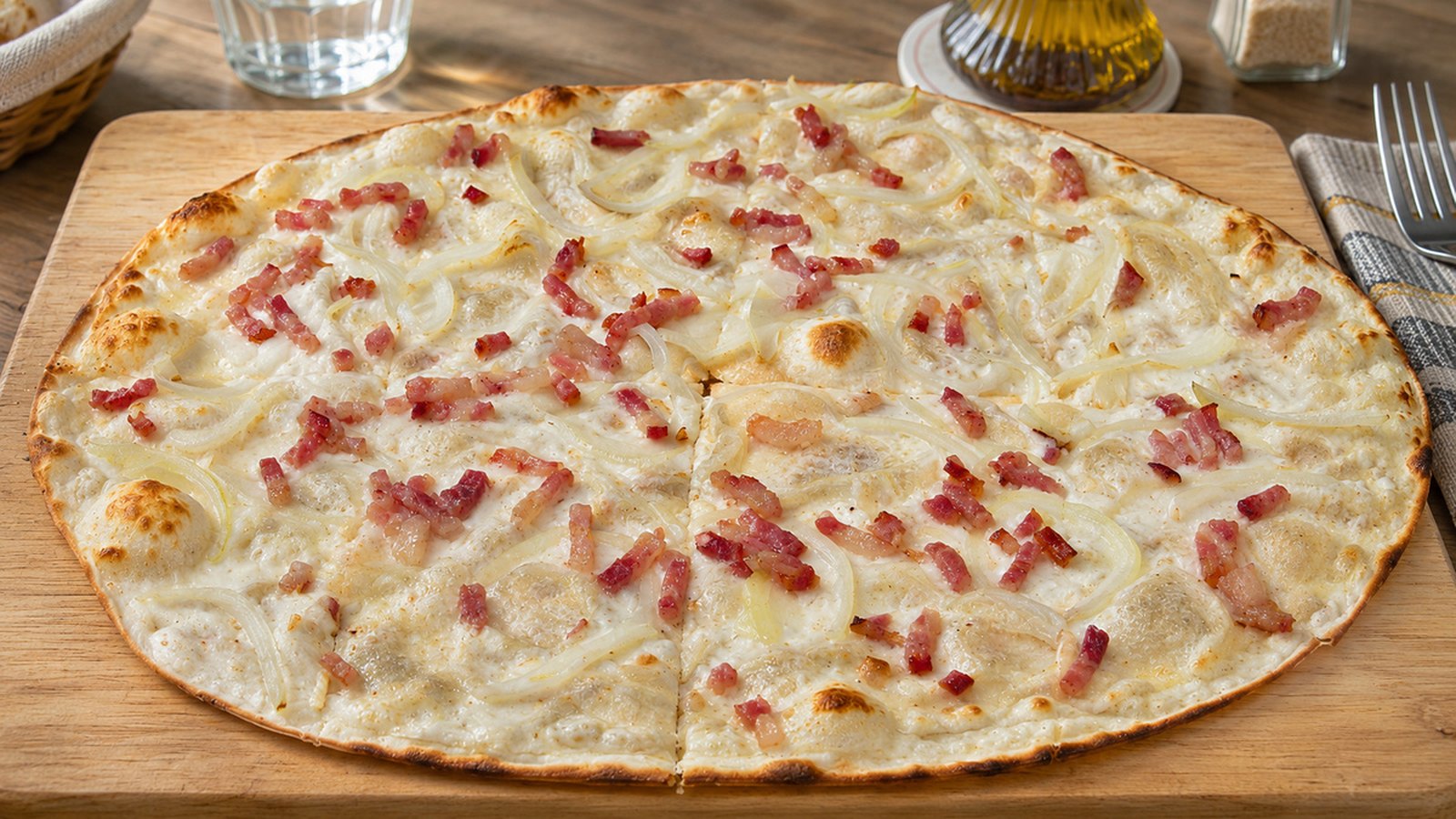
Tarte flambée, Flammekueche in Alsatian, is an unleavened bread dough rolled out very thinly, spread with cream, topped with lardons and onions, then baked for 10–15 minutes in an oven turned up to 250 °C. Born on the farms of Alsace, it is also eaten in German-speaking Moselle, where it is called Flammkuche. In the Northern Vosges it is the dish you share at the table, eaten with your fingers.
Preparation: 30 minutes
Resting: 30 minutes
Cooking: 10–15 minutes
Makes 1 large tarte flambée (one baking tray)
Ingredients
- 250 g wheat flour
- 150 ml lukewarm water
- 1 tablespoon vegetable oil
- 1 pinch of salt
- 200 g thick crème fraîche
- 100 g fromage blanc (optional)
- 200 g lardons
- 2 onions, thinly sliced
- 1 pinch of nutmeg
- Pepper to taste
Method
- Mix the flour and salt, make a well, add the lukewarm water and the oil, then mix until you have an even dough.
- Knead for 5–10 minutes, until the dough is smooth and elastic. Shape it into a ball and leave it to rest for at least 30 minutes under a cloth.
- Mix the crème fraîche with the fromage blanc, nutmeg and pepper.
- Brown the lardons in a frying pan and drain them. In the same pan, cook the onions until translucent.
- Preheat the oven to 250 °C with the baking tray or a pizza stone inside.
- Roll the dough out very thinly on baking paper: it should become almost see-through. Spread it with the cream, leaving a narrow border, then scatter over the lardons and onions.
- Slide the tart, still on its paper, onto the hot tray and bake for 10–15 minutes, until the edges are golden and crisp. Serve at once.
My tip: preheat the tray for at least 15 minutes. It is the tray that sears the base of the dough and gives the crispness that a home oven, cooler than a bread oven, cannot achieve on its own.
Cream or fromage blanc, raw or softened onions?
The topping comes down to three things: a creamy base, onion and bacon. For the base, many Alsatian recipes combine thick cream with fromage blanc, which adds a touch of acidity. In German-speaking Moselle, people tend to use cream alone. Both work, and the fromage blanc is optional here.
The onion can go on raw, sliced very thinly: it cooks in a few minutes in a very hot oven. Softening it first, as in this recipe, mellows its flavour and stops it burning in a domestic oven, which does not get as hot. The dough is made without yeast: it stays flat and crisp, unlike a pizza base.
Origins
Tarte flambée comes from the Alsatian countryside. Tradition places it in the Kochersberg, north-west of Strasbourg. On the days when bread was baked in the wood-fired oven, a piece of dough was rolled out, topped with cream, onions and bacon, and put in the oven to test its heat. Once the embers had been pushed to the side, it cooked in a minute or two in contact with the flames: hence its name, which means “flame cake”, not a tart flambéed with alcohol.
For a long time the dish was made only at home. It did not reach restaurants until the 1960s, and the word Flammekueche spread in the 1990s. It is found throughout the German-speaking Upper Rhine: in German-speaking Moselle, in Saarland, in Baden and in the Palatinate, which is linked to the Park by the cross-border biosphere reserve. The Northern Vosges Regional Nature Park, straddling the Bas-Rhin and the Moselle, therefore knows tarte flambée on both sides, from the Hanau area to the Pays de Bitche.
Variations
The gratinée adds grated cheese on top of the cream. The forestière adds mushrooms: the mushroom tarte flambée gives the recipe. Some restaurants serve a Munster cheese version and, for dessert, a sweet version with apples and cinnamon. The same combination of cream, onion and bacon appears, thicker and baked in a tin, in the onion tart.
What to serve it with
Tarte flambée is cut into squares on the tray, rolled up between the fingers and shared in the middle of the table. A green salad is enough to make it a meal.
For wine, a crisp dry white balances the cream and bacon: Pinot Blanc, Auxerrois, Sylvaner or Riesling. A Pinot Noir rosé also works. These grapes are grown in the far north of Alsace, in the Cleebourg vineyards, near Wissembourg. If you prefer beer, a light Alsace lager is a good choice.
Where to try it
In summer, village festivals in the Northern Vosges, on both the Bas-Rhin and the Moselle sides, often serve tartes flambées baked by local associations at long communal tables; you will also find them at some Christmas markets. The dates change every year: check the village festivals calendar. Elsewhere in Alsace, Ittenheim, in the Kochersberg, holds a tarte flambée festival at the end of August: check the date with the town hall.
For other classics of Alsatian and Lorraine cooking, browse the Recipes section.
Good to know
Expected crowds this week: usual, busier at the weekend
In the Northern Vosges
- 25 December Christmas Day, public holiday in France (long weekend)
- 26 December St Stephen’s Day (Alsace-Moselle), public holiday in France
- 1 January New Year's Day, public holiday in France (long weekend)
- 20 December – 3 January French school holidays
Back home: the Netherlands
- 25 December Christmas Day
- 26 December St. Stephen's Day
- 19 December – 3 January Christmas Holidays
- 13 February – 21 March Spring Holidays (depending on region)
Getting here
- From Belgium and the Netherlands by car: via Luxembourg and Metz, or via Germany towards Karlsruhe and Wissembourg.
- By train: high-speed trains to Strasbourg (via Paris) or to Karlsruhe (via Germany), then regional trains.
- On site: a car is the easiest way to get around.
Holidays: Nager.Date and OpenHolidays.