Potée colmarienne: Alsatian pork and cabbage hotpot recipe
Potée colmarienne: green cabbage, pork shoulder, smoked bacon and sausages simmered for at least two hours with potatoes, carrots and leeks. The winter dish of Alsace and Lorraine.

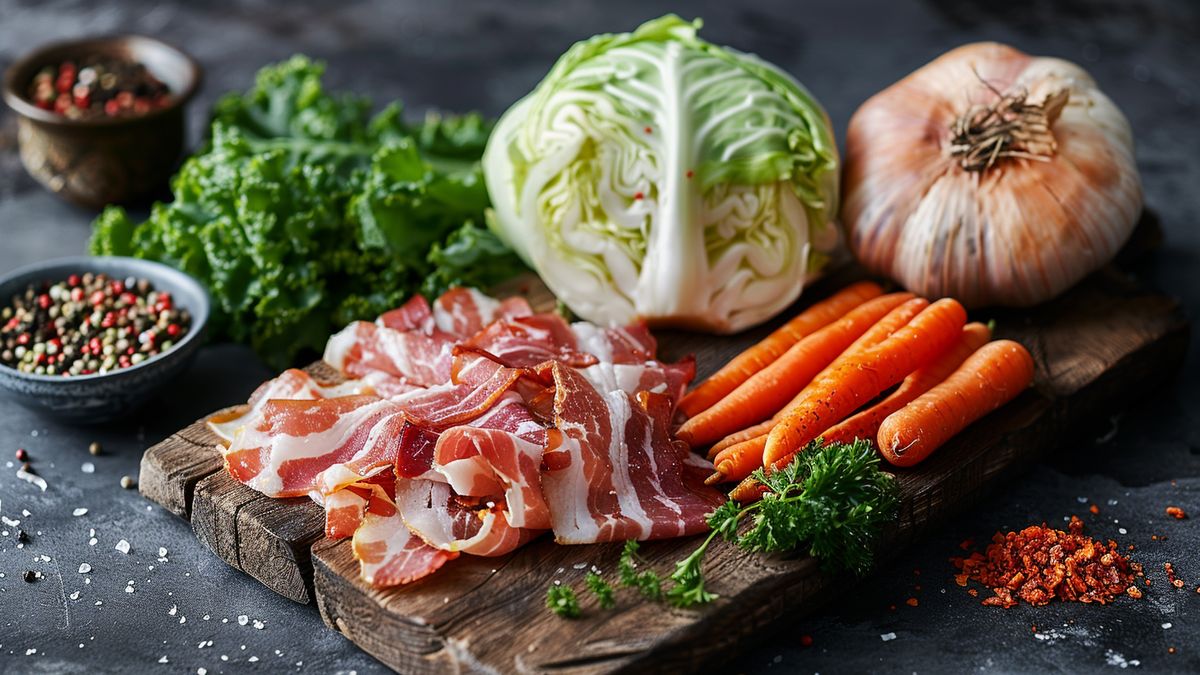
Potée colmarienne is a green cabbage hotpot: cured pork shoulder, smoked bacon and smoked sausages simmered for at least two hours in stock with potatoes, carrots and leeks. It is a hearty one-pot winter meal, served with wholegrain mustard. Under other names, you’ll find it on both sides of the Northern Vosges, in Alsace as well as in Lorraine.
Prep time: 30 minutes
Cooking time: at least 2 hours 10 minutes
Serves 4
Ingredients
- 1 green cabbage
- 6 potatoes
- 4 carrots
- 2 leeks
- 1 onion
- 2 garlic cloves
- 1 batch of meat stock (preferably beef stock)
- 500 g pork shoulder (palette)
- 250 g smoked bacon
- 4 smoked sausages
- Salt and pepper
- 1 bouquet garni
- Wholegrain mustard, to serve
Method
- Remove the outer leaves of the cabbage, cut it into pieces and blanch them for 10 minutes in boiling salted water; drain.
- Peel the potatoes and cut them into chunks, slice the carrots into rounds, cut the leeks into lengths, slice the onion and chop the garlic.
- In a large casserole dish, brown the pork shoulder and smoked bacon, then set them aside; next, lightly brown the smoked sausages.
- In the same pot, soften the onion and garlic, then add the cabbage, carrots, leeks and potatoes.
- Return the meat to the pot, add the bouquet garni and cover with stock; season with salt and pepper.
- Cover and simmer over a low heat for at least 2 hours, adding more stock if needed.
- Remove the bouquet garni and serve piping hot with wholegrain mustard.
My tip: if you’re worried that the sausages might burst or the potatoes fall apart, set them aside and add them only for the last half hour of cooking. That is often how potée lorraine is made. Go easy on the salt: the bacon and pork shoulder already bring plenty.
Which cabbage to choose?
Choose a good heavy head of green cabbage with crinkly leaves, such as a Savoy. It holds up to long cooking without turning to mush. Blanching it for 10 minutes takes away some of its bitterness and makes it easier to digest.
Palette is the pork shoulder. You’ll find it smoked or lightly salted (demi-sel) at the butcher’s. If it is salted, soak it in cold water for a few hours before you start, so it doesn’t make the stock too salty. The smoked bacon, in a single piece, is cut into thick slices just before serving.
Origins
The word potée comes from the earthenware pot (pot) in which the dish used to be cooked: the potée is what the pot contains. Almost every region of France has its own. This one brings together what an eastern French farm had to hand in winter: cabbage from the garden, root vegetables and cured pork.
The name potée colmarienne refers to Colmar, in the Haut-Rhin, but we found no old source attributing it to that town. The recipe is in fact the cabbage potée shared by Alsace and Lorraine. In Alsace it is called potée alsacienne, a name sometimes also given to baeckeoffe, another dish of meat and vegetables cooked for a long time. In Lorraine, potée lorraine likewise combines salted pork, cabbage, garden vegetables and smoked sausages, and is served with mustard.
The Northern Vosges Regional Nature Park straddles these two regions. In the Pays de Bitche, in Moselle, you are in Lorraine and people tend to speak of potée lorraine; in the villages of the Bas-Rhin, of potée alsacienne. The dish itself changes little from one side to the other. The same cabbage, fermented, gives Alsatian choucroute garnie, which shares most of its meats with the potée.
Variations
Depending on the family, a turnip, a stick of celery or white beans are added. Some replace the smoked sausages with one larger cooking sausage, sliced at the table. The broth is sometimes served first as a soup, poured over a slice of toasted bread, before the meat and vegetables.
What to serve with it
Wholegrain mustard is the classic accompaniment. A green salad as a starter lightens the meal. The next day, leftover meat and vegetables are eaten cold, with a vinaigrette.
For wine, choose a dry Alsace white whose acidity balances the richness of the meat and the taste of the cabbage: a Riesling, a Sylvaner or a Pinot Blanc, as with choucroute. These grapes are grown in the far north of Alsace, in the Cleebourg vineyards near Wissembourg, where Pinot Blanc also comes as Auxerrois. If you prefer beer, a light blonde with little bitterness goes well with smoked, cured meats.
Where to try it
Potée is a winter dish, from November to March, when the cabbages have been harvested and people cook slow, long-simmered food. It is mostly eaten at home, and returns to the menus of winstubs (traditional Alsatian taverns) and country inns during the cold season; it is rarer at village fêtes, where choucroute and tarte flambée reign. We found no potée festival in the Park.
To recreate it at home after your stay, buy the pork shoulder, bacon and smoked sausages from a butcher in the Bas-Rhin or Moselle. For more winter dishes, browse the Northern Vosges Recipes section.
Good to know
Expected crowds this week: usual, busier at the weekend
In the Northern Vosges
- 25 December Christmas Day, public holiday in France (long weekend)
- 26 December St Stephen’s Day (Alsace-Moselle), public holiday in France
- 1 January New Year's Day, public holiday in France (long weekend)
- 20 December – 3 January French school holidays
Back home: the Netherlands
- 25 December Christmas Day
- 26 December St. Stephen's Day
- 19 December – 3 January Christmas Holidays
- 13 February – 21 March Spring Holidays (depending on region)
Getting here
- From Belgium and the Netherlands by car: via Luxembourg and Metz, or via Germany towards Karlsruhe and Wissembourg.
- By train: high-speed trains to Strasbourg (via Paris) or to Karlsruhe (via Germany), then regional trains.
- On site: a car is the easiest way to get around.
Holidays: Nager.Date and OpenHolidays.